The deals are flowing, bankers are busy, sponsors are spending. The clients aren’t hesitating.
“It’s gung-ho, folks,” Jamie Dimon told the Bernstein Strategic Decisions Conference on May 27. Then came the footnote that should make every CFO, fund manager, and investor think twice.
“There’s a lot of exuberance out there,” Dimon continued. “But it was in 1972, 1986, 2000, 2007. That doesn’t give me comfort.”
Four years, and four peaks. Four disasters waiting just around the corner from the party.
Nobody has a better real-time read on the global economy than the chairman and CEO of JPMorganChase, the largest bank in the United States with nearly $5 trillion in assets. When Dimon says M&A is tracking toward the best year in recent memory, that equity capital markets activity (i.e., initial public offerings) is set to be “huge,” and that corporate clients are broadly eager to transact, he’s watching the flow of money, deals and risk appetite from his perch as the mayor of Wall Street.
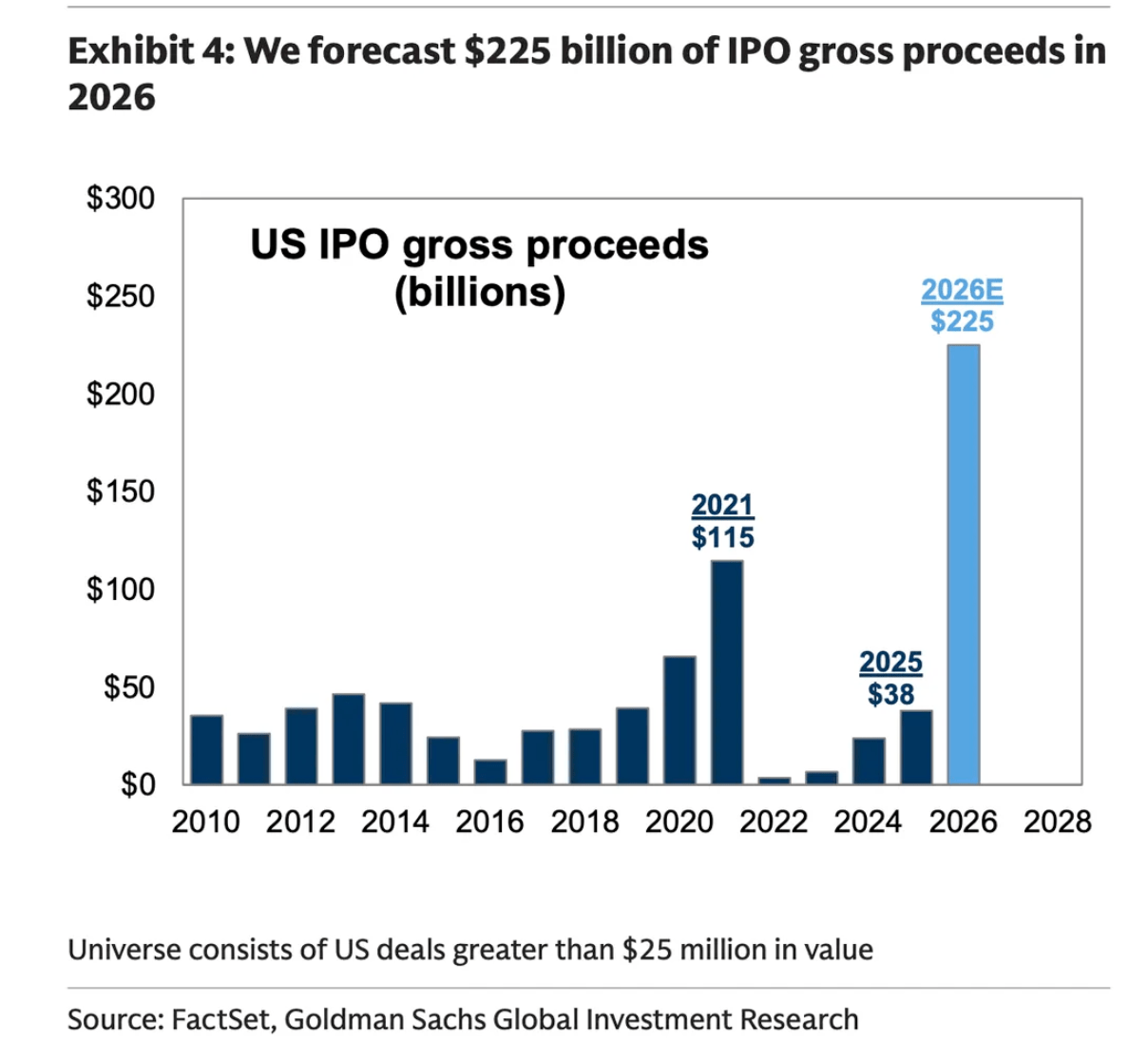
In the week since Dimon uttered his remarks, the $956 billion-valued Anthropic confidentially filed for an IPO, and Goldman Sachs equity analysts projected a record $225 billion in IPOs this year. (SpaceX has officially filed to go public, leaving OpenAI as the other major listing yet to drop).
Fortune has heard this word before
It’s unclear if Dimon’s historical callback was intentional. He reached for one very particular word: exuberance, the same word Alan Greenspan used in December 1996 when he remarked on “irrational exuberance” in equity markets.
Here’s something worth noting before we go further: Fortune has a direct, if largely forgotten, connection to the vocabulary Dimon just deployed. In March 1959, a young economist named Alan Greenspan (the very same) was quoted in a Fortune article using the phrase “over-exuberance” to describe financial market sentiment. Nearly four decades later, as Federal Reserve Chairman, Greenspan reached back for that same word—sharpened into “irrational exuberance”—to some, an infamous example of a central banker who refused to call a bubble before it burst. But that market partied for three more years before the dot-com collapse.
The word has been in circulation ever since, a kind of financial Cassandra’s curse: always right, always early, always ignored. And now Jamie Dimon, not a regulator but the man running the largest bank in America, has picked it up again.
Dimon said he knows that this feels good, even if it may not be healthy under the surface. “Of course, it feels good,” he said. “It feels good for all of us.”
Why those four years?
Dimon’s choice of historical benchmarks wasn’t random. Each year on his list represents a moment when confidence was high, activity was robust, and the music was playing, right before it stopped.
- 1972 preceded the 1973 oil shock and one of the worst bear markets of the 20th century, which wiped out the Nifty Fifty darlings of that era.
- 1986 came just before Black Monday in October 1987, when the Dow fell 22% in a single day, with the savings & loan crisis metastasizing.
- 2000 was the peak of dot-com euphoria. The Nasdaq lost over 75% of its value over the next two-and-a-half years.
- 2007 needs the least explanation: the last year before the global financial crisis, when leveraged buyouts were booming, credit spreads were at historic lows, and Bear Stearns was still standing.
The common thread isn’t just that bad things followed. It’s that in each of those years, the prevailing sentiment was that this time the fundamentals supported the optimism. As former Citigroup CEO Chuck Prince said in 2007, “When the music stops, in terms of liquidity, things will be complicated. But as long as the music is playing, you’ve got to get up and dance. We’re still dancing.”
The stimulus hangover nobody is pricing in
What worries Dimon most isn’t irrational behavior on its own terms—it’s that much of what looks like organic economic health is actually the tail end of an extraordinary fiscal sugar rush. He estimates that $10 trillion to $12 trillion in deficit spending over the last six to seven years has mechanically inflated corporate profits. “The government borrows money and gives it to people and that money gets spent,” he said. “It also fuels corporate profits. Corporations, it’s just not all automatically, they’re all geniuses all of a sudden.”
Add to that the current round of stimulus—the One Big Beautiful Bill ($300 billion), deregulation, and AI capital expenditure running at $300 billion year-over-year—and the picture is one of an economy that looks healthy in no small part because it has been, and continues to be, flooded with money. That’s fine until it isn’t.
Dimon also flagged the specific vulnerabilities he sees building in the credit cycle: weakening covenants, stretched EBITDAs, growing refinancing risk, and private credit marks that haven’t yet reflected the volatility of early 2026. “When it happens,” he said of the inevitable credit cycle, “it will be worse than people expect.”
A lonely club with a terrible track record of being ignored
Dimon is not alone in sounding the alarm. He is, however, in distinguished and historically frustrated company.
Warren Buffett laid out his own warning framework in a landmark 2001 Fortune article—published, notably, only after the dot-com bubble had already begun deflating — explaining what became known as the Buffett Indicator: the ratio of total U.S. stock market capitalization to GDP. “If the relationship approaches 200% as it did in 1999 and 2000, you are playing with fire,” Buffett wrote. That indicator recently hit 230%, well past Buffett’s own fire threshold.
Michael Burry, the investor immortalized in The Big Short for calling the 2008 housing collapse, has been warning since early 2026 that current market conditions feel like “the last months of the 1999–2000 bubble.” He points to the same AI-concentration dynamic that defined the dot-com era’s final act — 87% of venture capital now flowing into AI firms, AI-related borrowers making up nearly half of investment-grade bond issuance—and draws an explicit parallel to the over-issuance of tech debt in 1999 and 2000 that was subsequently downgraded to junk.
So what does Dimon actually think will happen?
That’s the honest answer he gave: he doesn’t know, and he’s suspicious of anyone who claims to. His explicit view is that treating any scenario as a “base case” is a “false sense of security” in an environment this complex—with unresolved war in Ukraine, instability in the Middle East, massive global deficits, and trade relationships in flux.
What he is certain of is that JPMorgan is positioned for the range, not the point estimate. The firm expects $40 to $50 billion of excess capital to accumulate. Dimon is in no hurry to deploy it. “It’s not burning a hole in our pocket at all,” he said. “If it sits there for a while. No problem.”
Disclaimer : This story is auto aggregated by a computer programme and has not been created or edited by DOWNTHENEWS. Publisher: fortune.com