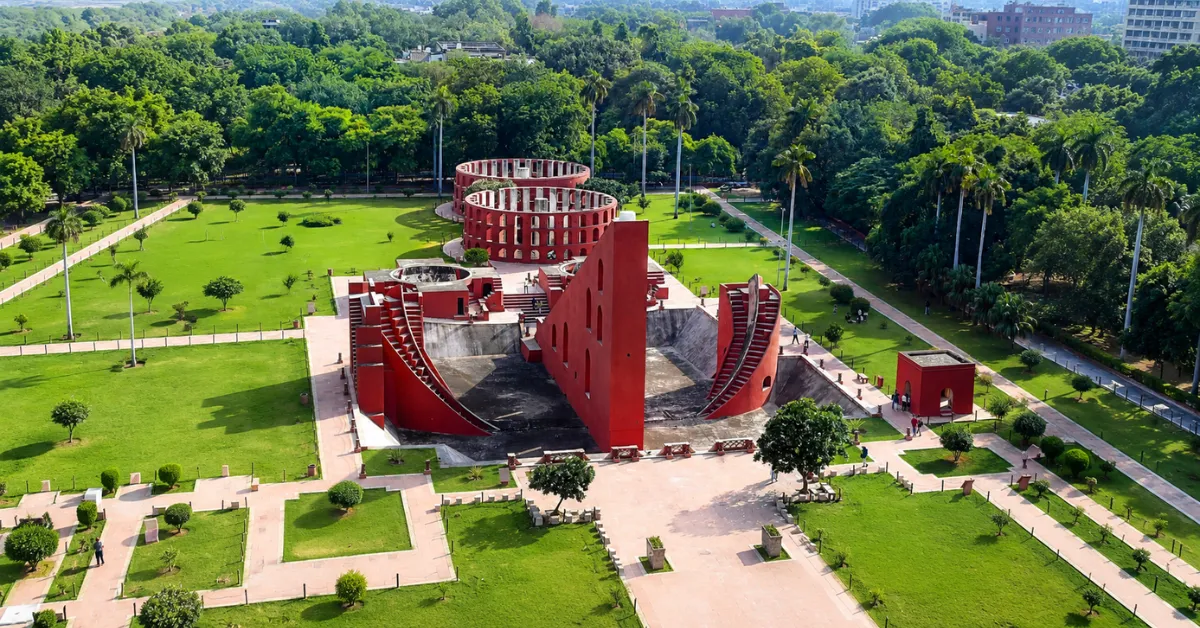
Imagine a place where giant stone instruments once tracked the movement of planets and measured time with the sun. Now imagine that same place becoming one of the most recognisable public spaces for people to gather, speak and be heard.
That unlikely transformation is the story of Delhi’s Jantar Mantar — a site where science, history and civic life have intersected for more than 300 years.
Built to read the skies
Long before it became associated with public demonstrations, Jantar Mantar was an astronomical observatory. Commissioned by Maharaja Sawai Jai Singh II and completed in 1724, it was the first of five observatories he built across northern India, followed by those in Jaipur, Ujjain, Varanasi and Mathura.
Photograph: (Hindustan Times)
Jai Singh was fascinated by astronomy and sought greater accuracy in celestial observations. Rather than relying solely on smaller instruments, he commissioned massive masonry structures designed to measure the position of celestial bodies, calculate time and improve astronomical tables used in calendars and navigation.
The Delhi observatory became the starting point of this ambitious scientific network.
Even today, the geometric forms of Jantar Mantar stand apart from most of Delhi’s historic monuments. It is neither a fort nor a palace. Instead, it is a scientific monument — a rare reminder of India’s rich tradition of astronomical inquiry.
A monument unlike any other
The name ‘Jantar Mantar’ itself is believed to be derived from the Sanskrit word yantra, meaning instrument. The site houses several large-scale astronomical instruments, each designed for a specific purpose, from tracking the sun’s movement to determining time and observing celestial coordinates.
What makes these observatories particularly remarkable is their scale. Built entirely of stone and masonry, they represent an era before modern telescopes became widespread in India.
/filters:format(webp)/english-betterindia/media/media_files/2026/07/21/jantar-mantar-2026-07-21-12-54-42.png)
Their striking shapes — ramps, arcs and circular structures — often leave visitors wondering whether they are looking at a monument, a sculpture park or a scientific laboratory.
Delhi’s Jantar Mantar may not be as large as its famous counterpart in Jaipur, but it remains one of the capital’s most distinctive heritage sites and an enduring symbol of scientific curiosity.
From observatory to public square
The transformation of Jantar Mantar into a space for public assembly happened much later. Until the late 20th century, large demonstrations in Delhi were commonly held at the Boat Club lawns near India Gate.
However, after massive protests there in the 1980s, authorities began directing demonstrations to Jantar Mantar Road. By the early 1990s, the area had effectively become the capital’s designated protest venue.
/filters:format(webp)/english-betterindia/media/media_files/2026/07/21/jantar-mantar-2026-07-21-12-56-30.png)
Photograph: (Incredible India)
Its location played a major role. Situated close to Parliament and key government offices, it offered visibility without completely disrupting the functioning of the city. Over time, the site evolved into a recognised platform where citizens, groups and movements could bring their concerns into the public eye.
Why Jantar Mantar still matters
Few places in India embody such a unique blend of science and public life. In one chapter of its history, Jantar Mantar helped astronomers understand the heavens. In another, it became a place where people sought to make their voices heard.
/filters:format(webp)/english-betterindia/media/media_files/2026/07/21/jantar-mantar-2026-07-21-12-59-55.png)
That dual identity is what makes the site so fascinating. It is both an architectural achievement of the 18th century and a living part of contemporary India’s urban story. Visitors may arrive to admire its unusual instruments, but they often leave with a deeper appreciation of how spaces evolve with time.
Three centuries after it was built to observe the skies, Jantar Mantar continues to be a place where people look beyond the present — whether toward the stars above or the future they hope to shape.
Sources:
‘How An 18th-Century Monument Became India’s Protest Epicentre’ by Rooplekha Das for Outlook Traveller, Published on 6 january 2026.
‘From astronomy to activism: How Jantar Mantar became Delhi’s iconic protest site’ by Anuj Trehan for Firstpost, Published on 20 July 2026.
‘A place called Jantar Mantar’ by Ifrah Mufti for The New Indian Express, Published on 20 July 2026.
Disclaimer : This story is auto aggregated by a computer programme and has not been created or edited by DOWNTHENEWS. Publisher: thebetterindia.com