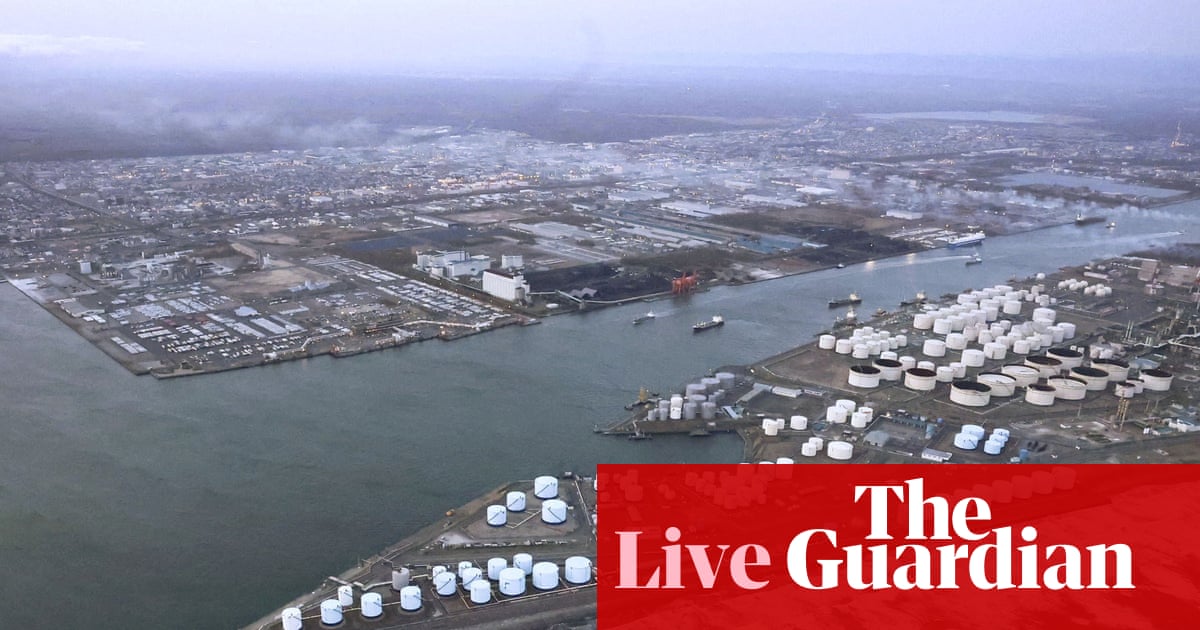
An earthquake registering a preliminary magnitude of 7.7 off northern Japan on Monday prompted a short-lived tsunami alert and the advisory of a higher risk of a possible mega-quake for coastal areas there.
The Cabinet Office and the Japan Meteorological Agency said there was a 1% chance for a mega-quake, compared to a 0.1% chance during normal times, in the next week or so following the powerful quake near the Chishima and Japan trenches, Associated Press reports.
The Fire and Disaster Management Agency said only one person in Aomori, north of Iwate, was injured after falling due to Monday’s quake.
Still, Monday’s events were a reminder to the quake-prone area of the March 2011 disaster that ravaged large swaths of the northern coast, triggering a nuclear crisis in Fukushima.
The quake occurred off the coast of Sanriku at around 4:53pm local time (0753 GMT) Monday, at a depth of about 19km (11 miles), the meteorological agency said.
Footage on NHK television showed hanging objects swaying and people squatting at a shopping centre in Aomori, as authorities told people to seek higher ground and stay away from coastal areas.
Shinkansen bullet trains connecting Tokyo and northern Japan were suspended.
A tsunami of about 80cm (2.6ft) was detected at the Kuji port in Iwate prefecture within an hour of the quake.
The US-based Pacific Tsunami Warning Center later said the tsunami threat “has now passed.”
The Nuclear Regulation Authority said nuclear power plants and related facilities in the region were intact and no abnormalities were detected.
The disaster management agency said at one point more than 170,000 people in five northern prefectures from Hokkaido to Fukushima were advised to take shelter.
It is now 11pm in Japan and given the downgrading of the tsunami alerts we will be closing this blog shortly.
Given the slightly increased risks of a megaquake, officials have urged residents in 182 towns along the northeastern coasts to raise their preparedness while continuing their daily lives.
Prime Minister Sanae Takaichi, speaking to reporters, urged residents in the affected area to confirm their designated shelters and evacuation routes and to check emergency food and grab bags so they can run immediately when the next big one hits. “The government will do our utmost in case of an emergency,” she said.
It was the second such advisory for the region in recent months. One was issued following a 7.5-magnitude quake in December but no mega-quake occurred.
The International Atomic Energy Agency (IAEA) said that there have been no abnormalities observed at Japan’s nuclear facilities as of 8.16am GMT following a 7.7 magnitude earthquake earlier in the day.
The warnings for those in the affected areas of northern Japan have been downgraded to advisory.
The information for people on the NKH website states:
If you are in the affected areas, keep away from coasts and river mouths which could overflow. Continue to evacuate until all advisories are lifted.
There may be some changes to the sea level, but there is no threat of tsunami damage.
Waves can get much higher than expected.
The meteorological agency said that “the likelihood of a new, huge earthquake occurring is relatively higher than during normal times”.
Municipalities in the affected region issued non-compulsory evacuation directives to more than 182,000 residents, according to the Fire and Disaster Management Agency.
The agency said the later advisory about another possible earthquake only reflected an elevated risk, rather than providing any specific predictions.
The coastline of Tomakomai, Hokkaido Prefecture, Japan, after a tsunami advisory was issued following an earthquake earlier today:
Soldiers stationed at the Iwate Garrison, part of the Japanese Army, are making preparations following a tsunami alert in Iwate, Japan.
Here is an image of them:
The tsunami alert is “serious enough to respond immediately” but not close to the same scale as the 2011 disaster, an expert had said.
Dr Ioannis Karmpadakis, associate professor in coastal engineering at Imperial College London, said:
What matters here is not whether the wave looks dramatic on camera, but what the water does when it reaches the coast.
The shape of this coastline can turn a regional tsunami into a very local problem, with harbours, bays and river mouths all behaving differently.
This situation is serious enough to respond immediately, but not on the scale of the 2011 Tōhoku disaster.
Japan issued a special advisory on Monday warning of an increased risk of earthquakes at magnitude 8.0 or stronger, after a powerful jolt rattled the country’s north and prompted a tsunami warning.
The Japan Meteorological Agency said in a statement that “the likelihood of a new, huge earthquake occurring is relatively higher than during normal times.”
The quake measured an ‘upper 5’ on Japan’s seismic intensity scale – strong enough to make it difficult for people to move around and cause un-reinforced concrete-block walls to collapse. The tremor had an epicentre in the Pacific Ocean and was 10km deep, JMA said.
A three-metre tsunami could cause damage to low-lying areas by flooding buildings and carrying off anybody exposed in its currents, according to JMA.
Located in the ‘Ring of Fire’ of volcanoes and oceanic trenches partly encircling the Pacific Basin, Japan is one of the world’s most earthquake-prone countries, with a tremor occurring at least every five minutes.
It accounts for about 20% of the world’s earthquakes of magnitude 6.0 or more, such as the 2011 disaster that caused nuclear meltdowns at a Fukushima power plant.
Disclaimer : This story is auto aggregated by a computer programme and has not been created or edited by DOWNTHENEWS. Publisher: theguardian.com