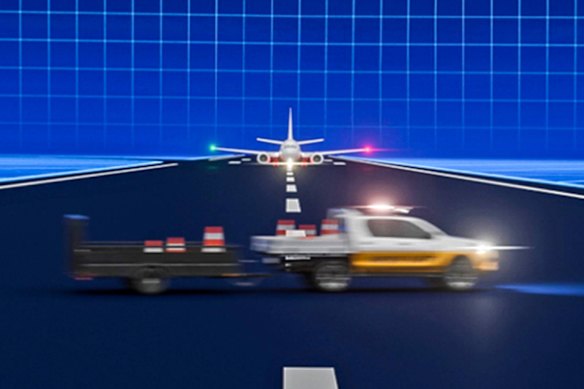

A 737 plane nearly collided with an airport safety vehicle in Melbourne causing the jet to abort its take off seconds before reaching “decision speed” in an incident considered “serious” by the aviation safety regulator.
The freighter operating for Team Global Express was taking off from runway 34 at Melbourne Tullamarine Airport in the early hours of February 17 when the event occurred.
At the same moment, safety officers were removing lights and cones from a closed runway, 9/27, which crossed over runway 34, as part of works being done on the runways.
As the Boeing 737 began its take-off run, the vehicle inadvertently entered the active runway without air traffic control clearance. The incident, which the Australian Transport Safety Bureau has classed as a “serious incident”, occurred about 4.45am.
As the plane approached, a runway occupied alert was generated by the electronic surveillance system, which warned Melbourne’s air traffic control tower that a vehicle was on the runway.
“Looking out from the tower, the controller detected [the car] on the runway and immediately instructed the vehicle to vacate the runway and, at 4.45am, instructed the flight crew of the 737 to ‘stop immediately’,” said the report from the ATSB.
The vehicle, a car with a trailer attached, responded by accelerating and exiting the runway, with the driver reporting seeing the aircraft’s lights as they crossed the intersection, with the on-coming plane about 412 metres away at that moment.
The pilot of the 737 reported seeing the vehicle at the same time as receiving the instruction from traffic control and the crew conducted a high-speed rejected take-off at 257km/h, just below the calculated “decision speed” for the flight of 261km/h.
“Decision speed” is the critical point during a take-off when pilots must commit either to stopping the aircraft on the runway or continuing the take-off. During a “rejected take-off”, pilots reduce thrust to idle, apply maximum brakes on wheels, deploy spoilers and speed brakes on the plane and wings, and use reverse thrusters on engines.
The pilot later estimated that the plane had passed the runway intersection at between 129km/h and 148km/h.
In the investigation, the ATSB found the safety officer driving the airport safety vehicle “misidentified their position while collecting works lights and markers on the closed runway”.
The driver had said the darkness, numerous lines of red lights, the absence of centre line lighting on the closed runway and a lack of knowledge about the partial closure of the taxiway conspired to create confusion, according to the report.
“The airside safety officer was experienced in night-time maintenance works, but was operating in a complex airside environment in the dark,” said ATSB Chief Commissioner Angus Mitchell.
“The positioning of unserviceability lights had changed when the works plan progressed the night prior to the occurrence, and the pre-shift briefing did not include the required review of the local works plan.
“Consequently, the airside safety officer had an incomplete understanding of the revised works.”
The report said visual cues had not sufficiently distinguished the active runway intersection from other crossings within the works, resulting in the vehicle entering the active runway without clearance.
The safety officer driving the vehicle later reported they had not slept well the night before the incident thanks, in part, to fireworks going off near their home.
“Research has shown that alertness and vigilance appear to be the cognitive capacities most consistently impacted by insufficient sleep,” the ATSB reports.
After the aborted take-off, the two-person flight crew brought the plane to the parking bay and requested the airport fire and rescue crew inspect the landing gear to ensure tyres remained intact, and the brakes didn’t show signs of fire or excessive heat.
Because of the high-speed rejected take-off, the brakes required “about 48 minutes to naturally cool, before a visual inspection could be performed and the aircraft was cleared back into service”.
Given that there had been some confusion with the use of orange cones used to delineate runway closures, the airport said it would buy and use yellow cones to more clearly identify entry points to an active runway from a closed runway.
“Safety is the No.1 priority at Melbourne Airport,” an airport spokesperson said.
Immediately after the February event, the airport conducted an internal investigation that confirmed the runway closure was compliant with CASA standards.
“Melbourne Airport has since taken proactive steps to further improve airfield procedures and protocols,” the spokesperson said. “The airport also identified opportunities to strengthen safety controls with improved aides at runway intersections, providing better visual distinction and physical barriers at active runway entry points during works.”
The near miss in Melbourne comes after four ground incidents at Sydney Airport raised concerns about safety for air traffic control.
The Market Recap newsletter is a wrap of the day’s trading. Get it each weekday afternoon.
 Chris Zappone is a senior reporter covering aviation and business. He is former digital foreign editor.Connect via X, Facebook or email.
From our partners
Disclaimer : This story is auto aggregated by a computer programme and has not been created or edited by DOWNTHENEWS. Publisher: www.smh.com.au