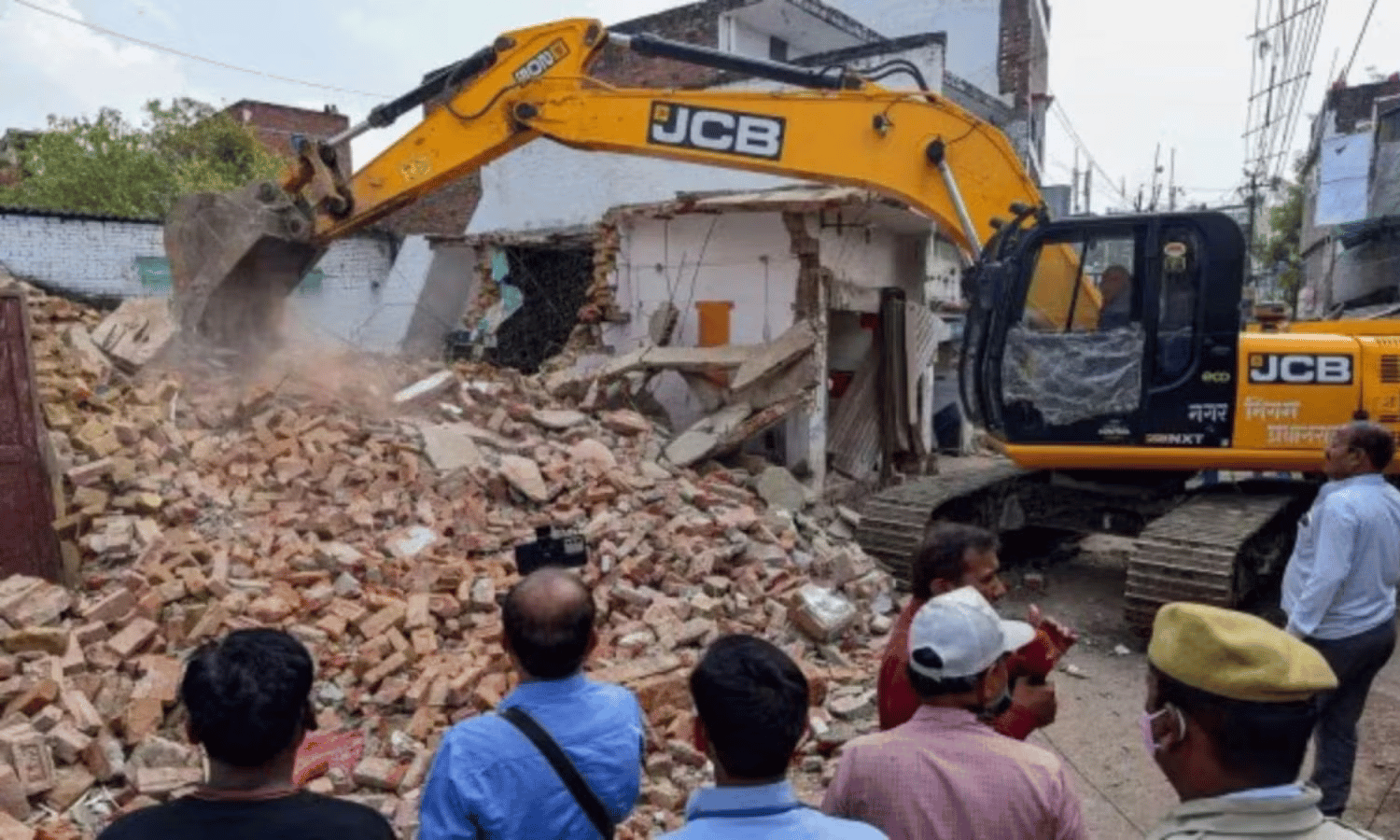
Srinagar: The Jammu and Kashmir Government on Wednesday ordered a formal inquiry into the recent demolition of houses belonging to tribal families in the Railak Bandi area of Sidhra, Jammu, amid growing controversy and public outcry.
Acting through Government Order No. 18-JK(TAD) of 2026, issued by the Department of Tribal Affairs, the administration constituted a fact-finding committee to examine alleged violations of the Forest Rights Act (FRA), 2006. The panel has been tasked with conducting a detailed investigation into the circumstances surrounding the demolition and submitting its findings within a period of seven days.
The two-member committee comprises Mohammad Mumtaz Ali, Director of Tribal Affairs, and Muzamil Hassan Choudhary, Assistant Director in the same department. The order constituting the panel was issued by Prasanna Ramaswamy G, Commissioner/Secretary to the Government, Department of Tribal Affairs. The move signals an official acknowledgment of the seriousness of the allegations raised by affected communities and political stakeholders.
The inquiry follows a major anti-encroachment operation carried out on Tuesday on the outskirts of Jammu city, where authorities demolished more than two dozen hutments and temporary structures. Officials stated that the drive was aimed at reclaiming nearly 60 kanals (approximately 7.5 acres) of forest land in the Mahamaya–Raika Bandi belt of the lower Shivalik range. The operation, conducted jointly by the Forest Department, Forest Protection Force, Revenue Department, and the police, lasted for nearly four hours and was described by officials as part of a broader campaign to curb illegal encroachments and safeguard ecologically sensitive forest areas.
Authorities maintained that the area had witnessed a steady rise in unauthorised constructions over the past five to six years, gradually transforming a sparsely populated forest stretch into a cluster of makeshift settlements. They argued that such encroachments posed a threat to the fragile ecosystem and necessitated decisive administrative action. However, the demolition has sparked sharp criticism, particularly from members of the nomadic Gujjar-Bakarwal community, whose dwellings were predominantly affected.
Displaced families have alleged that the action was carried out without prior notice, terming it an unjust and abrupt eviction. Many residents claimed long-standing habitation in the area, with some asserting that their presence dates back generations and is reflected in official records such as voter lists from as early as the 1950s. Community members further accused the authorities of selectively targeting them and alleged bias against Muslims. They also contended that references to curbing drug-related activity, often described locally as the “Chitta menace,” were used as a pretext to justify what they described as a blanket demolition of an entire settlement.
The issue quickly escalated into a political flashpoint, drawing strong reactions from within the government itself. Minister for Forest, Ecology and Environment Javed Ahmed Rana visited the site in the aftermath of the demolition and interacted with the affected families. Describing the action as “absolutely illegal and unjust,” he announced that an official inquiry would be conducted into what he termed an “illegal eviction drive.” He also warned of strict action against officials found responsible and criticised the operation as an instance of administrative overreach and high-handedness.
Rana further stated that the demolition had allegedly been carried out without consultation with the elected government or even his own ministry, raising concerns about institutional coordination and accountability. He indicated that he would take up the matter with Chief Minister Omar Abdullah and press for an immediate halt to similar drives until a proper framework ensuring legal compliance and protection of vulnerable communities is established.
The controversy unfolds against the backdrop of a wider issue of land encroachments in J&K. Official data indicates that Jammu district accounts for the largest share of encroached land in the Union Territory, with figures reaching 1,45,487 kanals and six marlas (approximately 7,350 hectares). This is significantly higher than the corresponding figures for Srinagar. Across the Union Territory, more than 17 lakh kanals (around 85,996 hectares) of state land have reportedly been encroached upon, with the Jammu division accounting for over 14 lakh kanals—more than three times the extent recorded in the Kashmir Valley. Authorities have also undertaken efforts to clean up revenue records, reportedly expunging over 17 lakh kanals of encroached land as part of ongoing administrative measures.
In response to the controversy, forest authorities have outlined plans to systematically map tribal habitations located within forest areas across Jammu. This exercise is expected to involve photographic and video documentation, verification of claims and documents, and the digitisation of records through official portals. Officials have reiterated their stance that illegal occupation of forest land will not be tolerated and that future anti-encroachment drives will continue as part of environmental protection efforts.
However, beyond community representatives, leaders from various political parties have also voiced strong concern, reiterating that such demolition drives appear discriminatory and carry troubling undertones of religious and ethnic bias. They have questioned both the intent and the manner in which the operation was conducted, calling for greater sensitivity and adherence to legal safeguards when dealing with vulnerable populations.
CPI(M) leader and MLA Mohammad Yousuf Tarigami strongly condemned the action, criticising the authorities for demolishing hutments and temporary shelters belonging to members of the nomadic community. He described the move as inhumane and deeply distressing, emphasising that rendering already vulnerable families homeless reflects a grave disregard for their dignity and basic rights. Tarigami asserted that targeting a marginalised community in such a manner is unacceptable and urged the administration to ensure justice, proper rehabilitation, and the restoration of dignity for all those affected.
Adding to the chorus of criticism, Kashmir’s chief Muslim cleric Mirwaiz Umar Farooq also expressed serious concern over the developments. In a social media post, he described the demolition and displacement of the tribal Gujjar-Bakerwal community in Sidhra area as “very disturbing,” noting that it had left many families homeless. He alleged that such actions point towards a pattern of selective targeting under the guise of law enforcement, referring to other recent incidents to underline his concern. According to him, measures that appear to single out communities—whether through evictions or legal action—risk being perceived as a “weaponisation of law,” which, he warned, could vitiate the overall atmosphere and deepen mistrust among the public.
The Mirwaiz further called on those in power to reflect on the broader implications of such policies, questioning the direction in which J&K is being steered if development and governance are pursued without humanitarian consideration.
Disclaimer : This story is auto aggregated by a computer programme and has not been created or edited by DOWNTHENEWS. Publisher: deccanchronicle.com