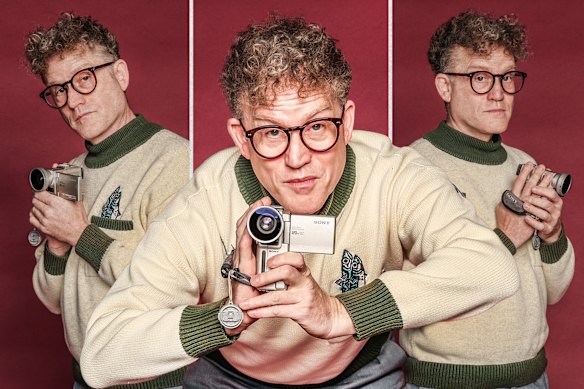
In June 1997, a 24-year-old John Safran packed his bag, grabbed a handheld digital camera and stepped on a plane bound for Japan. Little did he know, a “token skinny, pale, whiny” star would soon be born.
Over the next 100 days, Safran would create and star in 10 short films for the debut season of the ABC’s hit travel documentary competition Race Around the World. He would get nude in Jerusalem, place a curse on his ex-girlfriend while on the Ivory Coast and break into Disneyland.
He would become an audience favourite – a cult hero – for his daring and eccentric videos. He was loathed by one judge, director David Caesar, and ended up disqualified after he secretly taped a confessional with a priest in Brazil. However, he was named the winner of the people’s choice award and a career as Australia’s No.1 TV enfant terrible was guaranteed.
Now, 29 years later, Safran – filmmaker, author, radio star – is back on Race Around the World, but this time he’s the one judging the six newbies who have been sent overseas as part of the ABC’s reboot of the popular series.

“I definitely have opinions,” he says. “I’m pretty invested because I think it’s important because they’re fighting the robots now, like AI and stuff, and storytelling is important.”
It’s a Friday morning and Safran is soon off to film episode three of the show, now hosted by Zan Rowe. It’s also about four weeks since the contestants left in early April, heading for countries as diverse as Egypt, Moldova and the US.
“I have already Simon Cowell-ed one of them,” he says. “Because I want their stories to be good … there’s a couple of them who have this great, like, hectic energy, where they’re just putting themselves on the line … and I’m just going, ‘Oh my god, so that’s all great, but if you just do this and this, your stories will be like 10 times as good.’”
And the big tip? “Don’t film Wikipedia Blurb The Movie,” he says. “That is really difficult to make interesting.”
The new series follows roughly the same format as the original – 10 countries, 10 films, in 100 days – but some of the rules have been changed to allow for the change in technology.
When Safran and his fellow contestants set out, they knew where they were going and had time to roughly plan out stories and make contacts before they left. This time, the six filmmakers have no idea where they are being sent, so they cannot plan ahead. They must also edit their films while on the run, whereas in Safran’s day, their tapes were posted back to the ABC with editing instructions.
Contact with the contestants was also more haphazard in 1997, as they were only required to call the ABC once every 10 days (remember this was the time before mobile phones and social media) to reassure everyone they were still alive. And the budget? About $100 a day. Difficult? You bet.
“I found it really so stressful, especially after I thought I’d screwed up the first story [where he was locked in a subway in Osaka],” says Safran. “I became sharpened and became this edited version of myself. And even the thing where I’m like squeaking at camera, that just wasn’t me, I wasn’t a squeaker at camera. I just did it because I thought it was funny.”
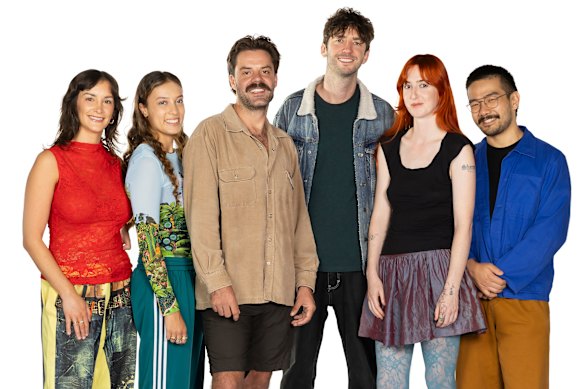
Most of the new contestants – Elliot, Jayden, Kate, Lucinda, Mikaela and William – were born before the first series even aired, and they have all come of age in a world where being online, digital storytelling and selfie culture is the norm. But if you think this puts them at an advantage, Safran has other ideas.
“There is a counter-current, though, where it’s like young people are very nervous about putting stuff out there because they know the consequences of fumbling, in a way that I never did,” he says. “There might be the opposite issue in some ways, of like, ‘Guys, you’ve got to free yourself up and not worry.’ But selfie culture is kind of good, as long as the material is strong.”
Safran was never afraid to put himself in front of the camera. And in fact, one of the key new features of the digital camcorders that the original racers had in 1997 was the ability to flip the screen so they could record themselves, selfie-style. And unlike some of the other contestants – many of whom have gone onto serious careers in film and television – Safran loved being in front of the camera.
“Nearly all of them just wanted to be regular doco makers, and they had to be dragged kicking and screaming in front of the cameras,” says Safran.
He still calls his first story, where he was locked in the subway in Osaka, a disaster (“I was really humiliated”), but it fortified him and by the time he came to put the voodoo curse on his ex-girlfriend, “that’s where it kind of just seemed to just make sense”.
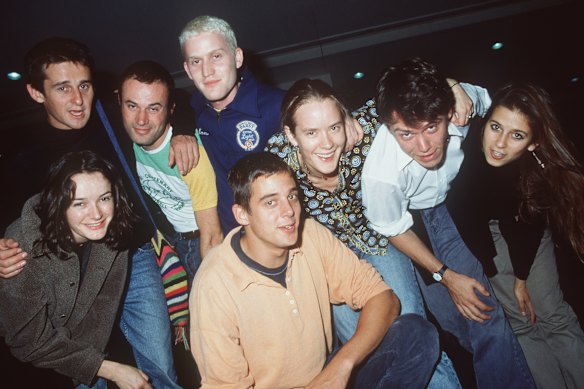
“I did work out this sort of, like, premise where an audience has a preconception of what a documentary should be, and then me being a bit of a smartass about it,” he says. “Like, rather than being this fly on the wall and being all kind of, ‘Oh my god, these magical people’ or whatever. I’m just being the fool in it. I didn’t think about it that hard, but I think subconsciously I was subverting what I felt was a documentary, and my issues with them.”
Safran was also inspired by, of all things, Nick Giannopoulos and his comedy Wogs Out of Work.
“It was the kind of comedy, where if you are from a background, you lean into that or whatever,” he says. “And people [were] just going, ‘Oh, is that a bit hack or something?’ I didn’t think it was hack at all, by the way. Anyway, and the one thing I thought [to myself] was, ‘Listen, I’m not going to do the Jewish Wogs Out of Work. I’m not going to do that.’
“And then I was getting baptised in the Ivory Coast, I think it was at this church, and I just thought, ‘Oh, this has got stakes’ and it’s funnier if ‘Mum, I’m not Jewish Any More’ is the title of this film. So I’ll just this once, I’ll just bring up the Jewish stuff this once, and that’s it. But then it just became like the gift that kept on giving, and I’m streaking through Jerusalem for the St Kilda Football Club.”
Safran’s notoriety during the show grew so much that he was even recognised while filming at Disneyland (where he broke in through a hole in the fence), but he had also determined that filmmaking was something he wanted to do for a career.
“I really wanted just to keep doing work,” he says. “I didn’t want to have this personality career … when I came back, I was determined to take advantage of it, and do other projects that I wanted.”
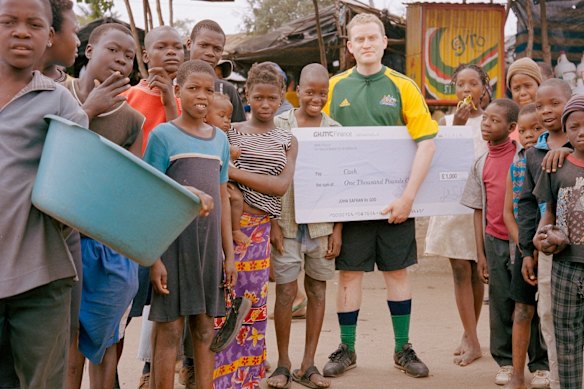
For Safran, that Race Around the World success soon translated into a couple of pilots with the ABC, including one that featured his infamous run-in with Ray Martin, and then a small stint on Channel Seven. However, he truly found his feet at SBS, with the award-winning Music Jamboree in 2002, then John Safran vs God in 2004 (in which he had a curse lifted on the Socceroos) and then Speaking in Tongues, in 2005, which he co-hosted with Catholic priest Father Bob Maguire (they would also later do a radio show on Triple J together).
In 2007, he ended up back on the ABC, with three seasons of Race Relations, in which he was infamously nailed to a cross in the Philippines. Does he still have the scars?
“Nah,” he says. “I don’t know, some people really make a big deal out of that, they’ve been crucified – I’m not gonna say who, I’m not gonna say which religious figure – so what happens is, when the nail goes in, it does go all the way in, but the only thing that it breaks is this very, it’s like a pin breaking [the skin], whilst the rest of the nail it stretches out the skin. But then as soon as you pull it out, the skin springs back into being this little pinhole, So no scars, alas.”
He’s since added writing non-fiction and true-crime books to that list, and has returned to TV sporadically, including his new SBS documentary on free speech, Shut Your Big Fat Mouth John Safran!, and an upcoming appearance on the new season of the ABC’s Portrait Artist of the Year.
Does this mean we are in the middle of a John Safran TV renaissance?
“Hopefully, yeah,” he says. “I’d like it to be, as long as it leads to another documentary series, 100 per cent. Books are just so – I mean, they’re so rewarding – but goddamn, they’re hard.
“I’m not complaining, but it’s all on you. Even doing this SBS doco, it’s just being out there with a camera guy and a soundie and the producer, and everything’s not on you, and you don’t worry about every last thing, someone else is organising the flights. It’s fun, in a different way. So watch out, Screen Australia. I’m pitching. I have a pitch deck.”
Race Around the World premieres at 7.30pm, Sunday, June 7, on the ABC and ABC iview.
Want more TV? We’ve got you.
Disclaimer : This story is auto aggregated by a computer programme and has not been created or edited by DOWNTHENEWS. Publisher: www.smh.com.au