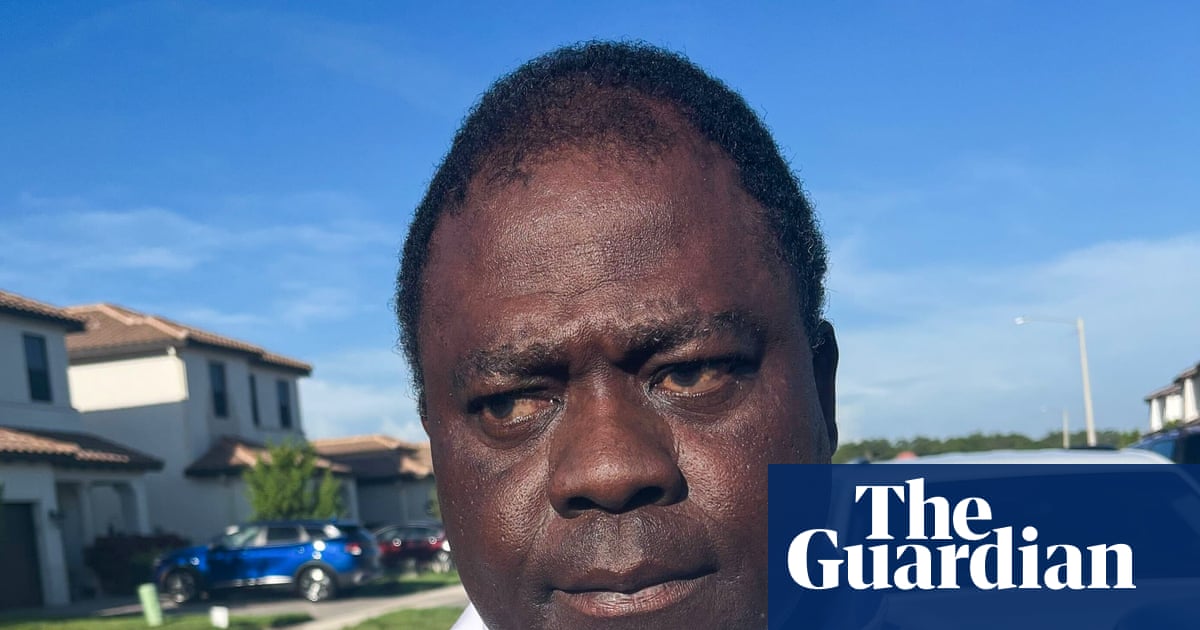
A jury of eight women and four men was seated on Tuesday in the criminal trial of a Roman Catholic priest who ministered in Texas and south-east Louisiana and was charged with illicitly abusing his status as a clergyman to pursue sex with spiritually vulnerable female congregants.
Anthony Odiong, 57, faces five charges of first-degree sexual assault and two such counts in the second degree in Waco, Texas, involving three women whom he met while working there.
He could receive life imprisonment if convicted on any of the first-degree charges at the end of a trial that is likely to stretch into the following week. Second-degree sexual assault can carry between two and 20 years in prison as well as a maximum $10,000 fine.
Opening arguments were scheduled for Tuesday morning, with the start of witness testimony following thereafter.
The charges against Odiong were effectively prompted by a February 2024 report from the Guardian about women who accused him of sexual coercion, unwanted touching and abusive financial control after meeting him in his capacity as a priest.
A woman whom the Guardian did not interview subsequently brought a copy of the outlet’s story on Odiong to Waco police and reported that he had sexually assaulted her in 2012. Investigators subsequently identified as many as 10 women whom Odiong was suspected of sexually preying on after meeting them over the years while ministering in Texas as well as the New Orleans archdiocese.
Prosecutors eventually managed to charge Odiong with alleged conduct that Texas law classifies as a felony: exploiting three women’s “emotional dependency upon him as a spiritual adviser” to engage in sexual conduct with them.
Those women include the one who reported Odiong to Waco police; another whom the Guardian interviewed in its piece on the clergyman, where she described how he convinced her to submit to a form of sexual intercourse with her husband with which she was not comfortable; and a third whom officers identified through messages recovered during the ensuing investigation.
He is charged with sexually assaulting two of those women in the first degree because they were married at the time of those alleged crimes. A Texas anti-bigamy law prohibited Odiong “from living under the appearance of being married” with those particular victims, according to prosecutors.
Many of those women’s cases, including ones from Louisiana, did not yield criminal counts. But Waco prosecutors contend that his having more than four accusers allows them to legally charge Odiong with some of his alleged crimes no matter how much time had passed from when they purportedly occurred. He nevertheless argued on Tuesday that the state waited too long to file charges against him, opening the door for prosecutors to introduce hearsay testimony – inadmissible in most trial settings – about the number of accusers he has.
Court records filed in advance of the trial show prosecutors Ryan Calvert and Liz Buice are ready to call a number of those accusers. They also are expected to present evidence establishing that Odiong violated Catholic priests’ promise to practice sexual celibacy by fathering at least one child with a woman who had been a congregant of his.
That woman is not one of the three whom Odiong was charged with clerically abusing. Still, authorities argued that that particular child was living proof that Odiong had a pattern of pursuing female congregants.
Authorities initially arrested Odiong in July 2024 over allegations of possessing illicit digital images of a disrobed child that they found when investigating the complaint against him prompted by the Guardian’s reporting. But prosecutors never filed formal charges against him over those images.
Odiong’s attorneys, Gerald Villarial and Carolina Truesdale, recently argued in court that a congregant concerned about her sick daughter had sent the images to the clergyman, the local news outlet KWTX reported. Villarial maintained that the photos were meant to display the girl’s skin irritations and a possible rash, and the parishioner asked Odiong to pray for the child’s healing, according to the outlet.
Villarial moved for all evidence derived from Odiong’s arrest on those images to be prohibited from being introduced at his trial. Yet the Texas state judge presiding over that case, Thomas West, denied that motion.
West also denied a separate motion to postpone Odiong’s trial, whose first day ended on Tuesday evening with the 12 jurors and two female alternates being chosen.
Those were chosen from a pool of 100 prospective jurors. Questions posed to the prospective jurors included whether those prospective jurors could be impartial despite media coverage of the case, if they believed pastors could sexually exploit adults’ emotional dependency on them, if they thought such religious personnel could ever go off duty for periods of time, and if they could convict someone in the event they are proved to have done that.
Odiong has denied wrongdoing. He has been held in custody in lieu of $5.5m bail since his arrest.
After gaining ordination into the Catholic priesthood in his native Nigeria in 1993, Odiong made a name for himself through holding prayer services after which some attenders reported recovering from significant ailments. The naturalized US citizen transferred to a region including Waco in 2006 under the auspices of the then Austin, Texas, bishop Gregory Aymond.
Odiong, among other things, worked in campus ministry at Baylor University in Waco and was an assistant priest at a church in West, Texas. He later evidently spent some time studying in Rome; and in 2015, he began working within the archdiocese of New Orleans, six years after Aymond had become archbishop there.
His main role in the New Orleans area was as the pastor of St Anthony of Padua church in Luling, Louisiana. He also built a healing chapel next to St Anthony – named Our Lady of Guadalupe – after reportedly raising $600,000.
No later than 2019, church officials in Austin said they suspended Odiong from being able to minister in their area over allegations of misconduct with multiple women. Austin church officials did not publicly announce that but said they notified their counterparts in New Orleans.
Meanwhile, Aymond waited until December 2023 to similarly suspend Odiong from the ministry within the New Orleans archdiocese.
The archdiocese at the time cited misconduct with multiple women without revealing that they had been notified of the alleged behavior by diocesan officials in Austin at least four years earlier. Furthermore, Odiong’s New Orleans suspension came around the same time he had publicly made a string of anti-LGBTQ+ community remarks to his congregation as international church leaders were seeking to make the faith more inclusive.
Waco authorities criminally charged Odiong amid a debate within the Catholic church over whether to widen the definition of a vulnerable adult in the context of clergy abuse to encompass those who are under the spiritual authority of priests and then targeted for sexual contact by the clerics.
The church presently only considers a vulnerable adult to be anyone who is older than 18 while having “severe, intellectual, developmental or psychological disabilities”. Sexual misconduct with vulnerable adults or children is clearly defined as clergy abuse under modern Catholic church policies.
Aymond retired in February, a couple of months after the New Orleans archdiocese and its insurers agreed to pay $305m to abuse survivors to settle a bankruptcy protection case that the organization filed amid the financial fallout of the global church’s enduring clerical molestation scandal.
James Checchio, the former bishop of Metuchen, New Jersey, is Aymond’s successor as New Orleans’ archbishop.
Disclaimer : This story is auto aggregated by a computer programme and has not been created or edited by DOWNTHENEWS. Publisher: theguardian.com