
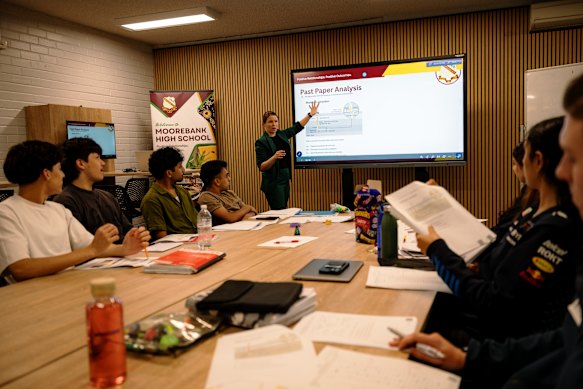

Eight teenagers huddle around a table inside an echoing library at Moorebank High in Sydney’s south-west. It’s a warm spring day, the kind that taunts fluorescent lights and stuffy classrooms. Class ended weeks ago, but these high school graduates have returned to school for a final study sprint.
It’s crunch time for this year’s recently graduated year 12 students. On Tuesday, the biggest exam of a student’s school experience, the HSC, will begin. More than 60,000 students will sit their first exam, English paper one and exams will continue until November.
As the clock runs down, graduates have flocked to libraries and classrooms. Like many schools, Moorebank High runs holiday study camps – practice tests, exam revision and study sessions to help students stay on track. Others find haven in public libraries.
Patronage at Marrickville library has swelled. Teens flood the study rooms, sipping from free sparkling water supplied by the library cafe.
Councillor Jo Carlisle moved to extend the library hours in time for the crucial exam block. Teens arrive from morning and stay until closing, as late as 10pm on Thursday. “It has become this fantastic meeting place,” she said.
“If one of … them is starting to struggle or have problems they’re among friends so that they can get that support,” she said.
Sessions and spaces like this have become a lifeline for teenagers caught in a strange limbo. Free from bells, timetables and teachers, but tethered to looming exams, Moorebank High student Tejal Ingale found structure inside her former school’s gates.
“It’s a bittersweet feeling,” Ingale said. “The end is near.” She flicks through her notes – handwritten, of course, so they stick in her brain. She’s raring to go, but beneath it all Ingale admits she is scared. “I have to keep going forward. There is no point in losing myself because then I know I am not going to get anything done. Even if I am tired, I just have to push through.”
Unlike many, Ingale has not obtained early entry to her dream course. In her case, it is medicine at the University of NSW. The highly competitive course is ineligible for early access, so Ingale must do it the old fashioned way; through voracious study.
Early entry – the practice of a university offering students a place at their institution before they sit their exams – is an increasingly common trend that sees three in 10 school leavers using a non-ATAR pathway to go to university.
This year, the University Admissions’ Centre (UAC) received its largest ever number of applications for its Schools Recommendation Scheme. More than 28,000 students applied for the early offer initiative, which guarantees some students’ entry into university based on their year 11 results. Offers will be made in November. This number has steadily risen over the past decade: there were just 9804 applicants in 2015.
Ingale believes the system is a game changer for HSC for students from low-SES or underrepresented backgrounds, such as Indigenous students. At her school near Liverpool, the majority of her grade applied for such programs.
“Because of early entry, we can have the same access as students at schools like North Sydney Girls,” she said. “It makes it much easier.”
Her classmate, Jessica Alkuhaili, will walk into her exams knowing that whatever happens, her future is certain. She will study commerce at UNSW under its early entry scheme. Her shoulders are light, though she notes early acceptance affected her motivation.
“I still want to do good to compound the effort I’ve already been made,” Jessica said. “I don’t want it to all go to waste.”
UNSW said round one applications for its gateway program, which supports entry for students from underrepresented backgrounds, were 23 per cent higher than at the same stage last year, while conditional offers were 21 per cent higher.
Macquarie University was unable to provide figures on the number of early offers it had made, but said it had increased by 25 per cent. Charles Sturt University has made almost 4000 offers.
At Western Sydney University, more than 10,000 offers have been made for 2027. Approximately two in three early offers were made to students from greater western Sydney.
“The ATAR is very often a bit of a proxy for privilege,” vice-chancellor George Williams said. Often it relates more to what fortune you have had with the school you’ve gone to.
“We are trying to level the playing field.”
The Australian National University received 8141 applications for its early access program, and made 7504 early offers for 2027.
Not all universities offer early entry. The University of Technology Sydney suspended its early entry program, and the University of Sydney says the 2 per cent of its offers that are made early are the exception based on equity considerations or a creative portfolio.
Education Minister Prue Car previously raised concerns about the scheme’s equity and recipients taking it easy for the remainder of year 12 after their place was secure.
“There are just some students, in some communities, that do not have the opportunity to go out and do extracurricular activities to build up their CV, to build themselves an unconditional early offer,” Car told the Herald’s education summit in March.
Moorebank High principal Randa Charara said despite the early offers, her students were still determined to achieve their best. “We have given them the motivation and strategy to get them through,” she said. “It does not impact them adversely; it’s just a positive additional opportunity they have access to. It’s there for their peace of mind.”
Start the day with a summary of the day’s most important and interesting stories, analysis and insights. Sign up for our Morning Edition newsletter.
 Emily Kowal is a Walkley award-winning education reporter for The Sydney Morning Herald.Connect via email.
From our partners
Disclaimer : This story is auto aggregated by a computer programme and has not been created or edited by DOWNTHENEWS. Publisher: www.smh.com.au



