Brought to you by BULLS N’ BEARS
Murray Ward
Multi-mine gold producer Kaiser Reef is gearing up for a major regional exploration offensive across its district-scale Tasmanian landholding after locking in a highly experienced geology executive to spearhead the growth strategy.
The company has appointed veteran exploration geologist Colin Skidmore as its dedicated exploration manager at the Henty gold mine, tasked specifically with driving resource growth outside the immediate underground mine footprint.
Skidmore brings more than 25 years of senior management experience spanning a broad spectrum of commodities across Australia, the Americas, Canada and Europe.
His immediate focus centres on a regional strategy which plans to systematically test a multi-kilometre mineralised trend that has received very little attention in recent decades.
′ Any exploration success will be able to leverage off our significant infrastructure and existing operating capacity at Henty.′
Kaiser Reef managing director Brad Valiukas
The Henty project sits within the richly endowed Mount Read volcanics domain, a world-class geological belt famed for hosting prolific operations.
This legendary region has delivered enormous wealth to the Tasmanian mining sector, yielding significant volumes of copper and gold from the massive Mount Lyell system, alongside exceptional high-grade zinc, lead, and precious metal credits from the volcanic-hosted massive sulphide (VMS) deposits at Rosebery, Hellyer, and Que River.
Kaiser’s extensive regional holdings remain heavily under-explored despite hosting numerous known gold and base metal occurrences both north and south of the Henty mine.
Key regional exploration hotspots identified so far across the Henty fault zone include the prospective Moxan Saddle, Tyndall Creek and Red Hills prospects, alongside a cluster of historical workings and gold anomalies.
The targets give Kaiser direct exposure to the same multi-commodity potential that defines the broader district. Specifically, Red Hills is prospective for high-grade polymetallic zinc, lead and silver zones that run parallel to narrow, gold-rich horizons. The Moxan saddle also holds promise for high-grade gold, mirroring the main Henty deposit, along with volcanogenic massive sulphide (VMS) style mineralisation.
Additionally, the Tyndall Creek target captures a potential six-kilometre-long mineralised corridor that tracks old copper workings and intense alteration zones. Last but not least, Lakeside shows all the signs of an intrusion-related gold system. Put together, Kaiser believes it’s well-positioned to hunt for both high-grade precious metals and extensive base metal deposits.
Kaiser Reef managing director Brad Valiukas said: “Colin’s appointment is another step towards kicking off regional exploration at Henty. Regionally, Henty has some fantastic exploration potential, with numerous historical occurrences and small workings both north and south of the mine.”
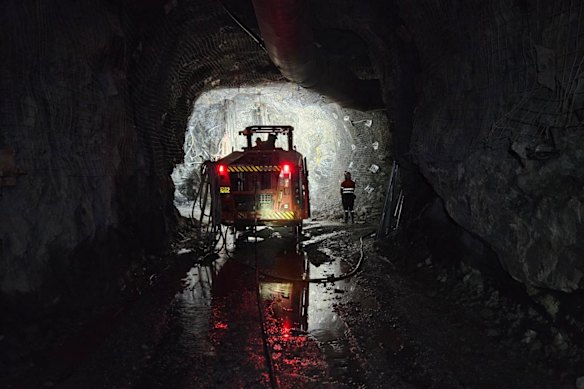
While the new regional push gathers momentum, the company continues to extract consistent value from its core Henty underground mining operation.
The established Tassie mine is underpinned by a substantial mineral resource of 438,000 ounces of gold grading 3.3 grams per tonne (g/t) gold, alongside a high-grade ore reserve of 199,000 ounces of gold at 3.28g/t gold. The operation utilises a conventional 300,000 tonnes-per-annum processing facility to maintain a production profile of 30,000 ounces of gold per annum.
Beyond Tasmania, Kaiser also has another string to its bow in Victoria’s historic Golden Triangle through the company’s high-grade Maldon gold project.
Maldon features a fully permitted, operational 200,000 tonnes per annum carbon-in-leach processing facility, existing underground mine access and an inferred mineral resource at Union Hill, which stands at 187,000 ounces grading 4.4g/t gold.
Kaiser additionally holds a helpful near-term feed source at Union Hill, where historical waste dumps host a surface stockpile of 570,000 tonnes grading 0.48g/t gold for 8600 ounces.
The company’s next steps under its new exploration hire will involve a workmanlike period of regional data consolidation and early-stage surface works.
The initial phase will be to define and refine high-priority targets along the Henty fault trend, paving the way for a dedicated regional drilling campaign expected to kick off this coming summer.
Importantly, any exploration success could potentially be leveraged against Kaiser’s existing processing infrastructure and operating capacity.
With steady cash flows from Henty funding the hunt and $47 million in its back pocket as at the end of March, Kaiser looks well-placed to unlock the true scale of its Tasmanian neighbourhood. Punters will likely be keeping an eye out for the drill rods to start turning this summer.
Is your ASX-listed company doing something interesting? Contact: mattbirney@bullsnbears.com.au
From our partners
Disclaimer : This story is auto aggregated by a computer programme and has not been created or edited by DOWNTHENEWS. Publisher: www.smh.com.au