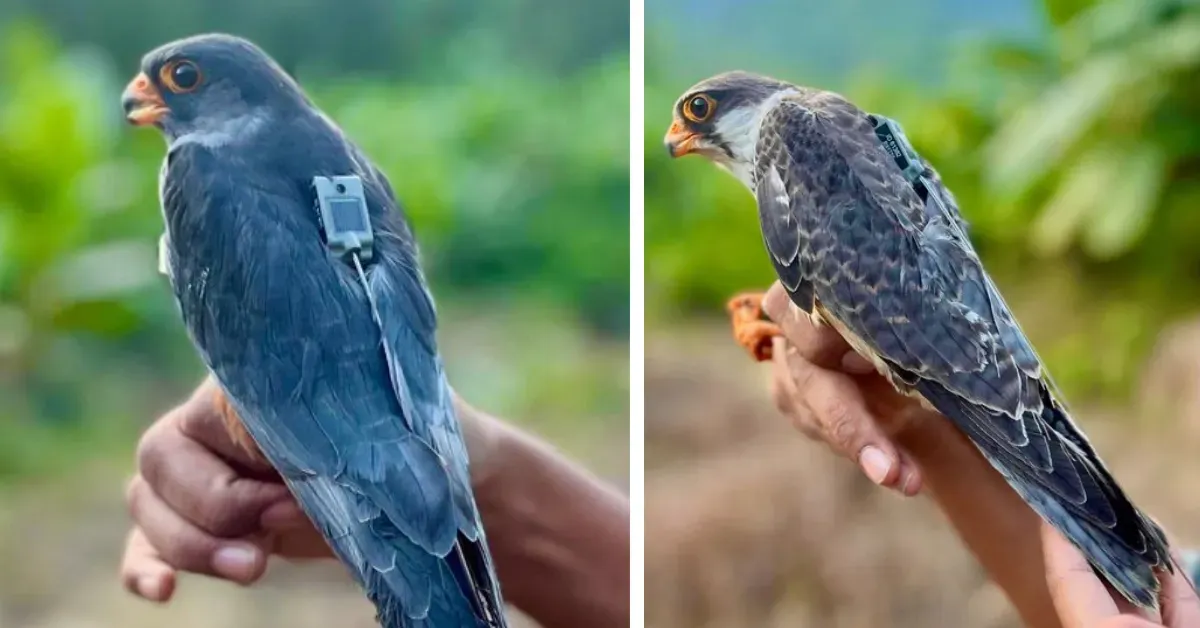
Every winter, the forests of Northeast India become temporary resting grounds for one of the world’s most remarkable migratory birds.
Amur falcons, travelling from their breeding grounds in Siberia and northern China, arrive in Assam in October and November to feed and replenish their energy reserves before continuing their journey to southern Africa.
This year, as more than one lakh of these birds gather at seasonal roosting sites across Assam, the state has introduced restrictions on drone activity around their habitats.
On Friday, 6 November 2026, the Assam Forest Department prohibited unauthorised recreational, commercial and non-essential drone operations around identified Amur falcon congregation and roosting sites.
These include Umrangso in Dima Hasao district and Dharamtul in Morigaon district.
An order stated that the restrictions were necessary to ensure the birds’ “undisturbed resting, feeding and migratory movement”.
A stopover that needs protection
The importance of these sites is documented in a 2024 study published in the journal Indian BIRDS, titled Amur Falcons Falco amurensis at Umrongso, Assam: Estimating roost size and monitoring migratory dates.
Researchers Anwaruddin Choudhury and Fizala Tayebulla monitored an Amur falcon roost at Umrongso in Dima Hasao district during the autumn of 2022.
The study involved four enumerators, including two trained local assistants, who independently estimated the number of birds gathering at the site each evening.
The researchers recorded the first arrivals on 4 October, with all birds having departed by 13 December. During the second and third weeks of November, the roost held more than one lakh falcons. On 7 November, the estimated congregation crossed two lakh.
It noted that the birds depend on select sites with suitable vegetation and abundant food, particularly winged termites, to replenish their energy during migration. The researchers also pointed out that a previously known roost at Habang had been abandoned because of human disturbance.
What science says about drones and birds
The concerns surrounding drone activity are also supported by scientific research.
A 2024 meta-analysis titled A Meta-analysis of the Impact of Drones on Birds, published in Frontiers in Ecology and the Environment on 10 October, examined 149 peer-reviewed studies on bird responses to drones.
The researchers found that the likelihood of birds taking flight in response to drones was influenced by factors such as the distance between the aircraft and the birds, drone speed, the species’ body size, and breeding status.
The analysis found that smaller bird species were generally more likely to display escape responses than larger ones. Faster drone approaches also increased the likelihood of disturbance.
Importantly, the researchers cautioned that drones should not automatically be considered harmless monitoring tools. Although they can help collect wildlife data with less disturbance than some conventional methods, their use requires species-specific precautions and careful flight protocols.
For Amur falcons gathering in large numbers, avoiding unnecessary drone activity can help minimize sudden disturbances during their feeding and resting periods.
Making conservation a shared responsibility
The new restrictions also place emphasis on monitoring and public awareness. Divisional Forest Officers have been directed to identify and demarcate sensitive roosting areas and coordinate with district administrations and police authorities to enforce the rules.
Temporary No-Drone Zones can be declared wherever required under applicable regulations.
Tourists, photographers, content creators and local communities are also to be sensitised about the importance of keeping these habitats undisturbed. The restrictions will remain in effect during the birds’ seasonal presence at the identified sites or until further orders.
Here is an update – All three satellite-tagged Amur Falcons Apapang (male), Alang (young female) and Ahu (female) are now undertaking their daring Arabian Sea crossing. Apapang has already flown nonstop for 76 hours, covering 3100 km at an average of 1000 km per day, aided by strong easterly tailwinds. From here, the journey becomes even more extraordinary as they head towards Somalia on their epic 3000 km oceanic flight @sureshwii @wii_india #Amurfalcons
— Supriya Sahu IAS (@supriyasahuias) November 16, 2025
The move followed concerns raised by biodiversity conservation organisation Aaranyak, which had urged authorities to restrict drone operations around major congregation sites. The organisation welcomed the subsequent order.
There are other signs of progress in understanding and protecting the species. On 23 October, two geo-tagged Amur falcons, Apapang and Alang, returned to Tamenglong in Manipur after completing an annual migratory cycle across 23 countries in Asia and Africa. Tracking such birds helps researchers document migration routes and identify habitats that need protection.
As the falcons continue their seasonal passage through Northeast India, Assam’s restrictions bring attention to an important aspect of migratory bird conservation: protecting not just the birds themselves, but also the conditions that allow them to complete their journeys.
Keeping drones away from sensitive roosting areas, involving local communities in monitoring and ensuring that visitors follow wildlife-friendly practices can help make these seasonal habitats safer for the birds returning year after year.
Sources:
‘Assam prohibits unauthorised drone operations near Amur Falcon roosting sites’: By Express News Service, Published on 6 November 026
‘Amur Falcons Falco amurensis at Umrongso, Assam: Estimating roost size and monitoring migratory dates’: by Anwaruddin Choudhury & Fizala Tayebulla, Published on 21 December 2024
‘A meta-analysis of the impact of drones on birds’: By Émile Brisson-Curadeau, Rose Lacombe, Marianne Gousy-Leblanc, Vanessa Poirier, Lauren Jackson, Christina Petalas, Eliane Miranda, Alyssa Eby, Julia Baak, Don-Jean Léandri-Breton, Emily Choy, Jade Legros, Elena Tranze-Drabinia, Kyle H Elliott, Published on 10 October 2024
Disclaimer : This story is auto aggregated by a computer programme and has not been created or edited by DOWNTHENEWS. Publisher: thebetterindia.com