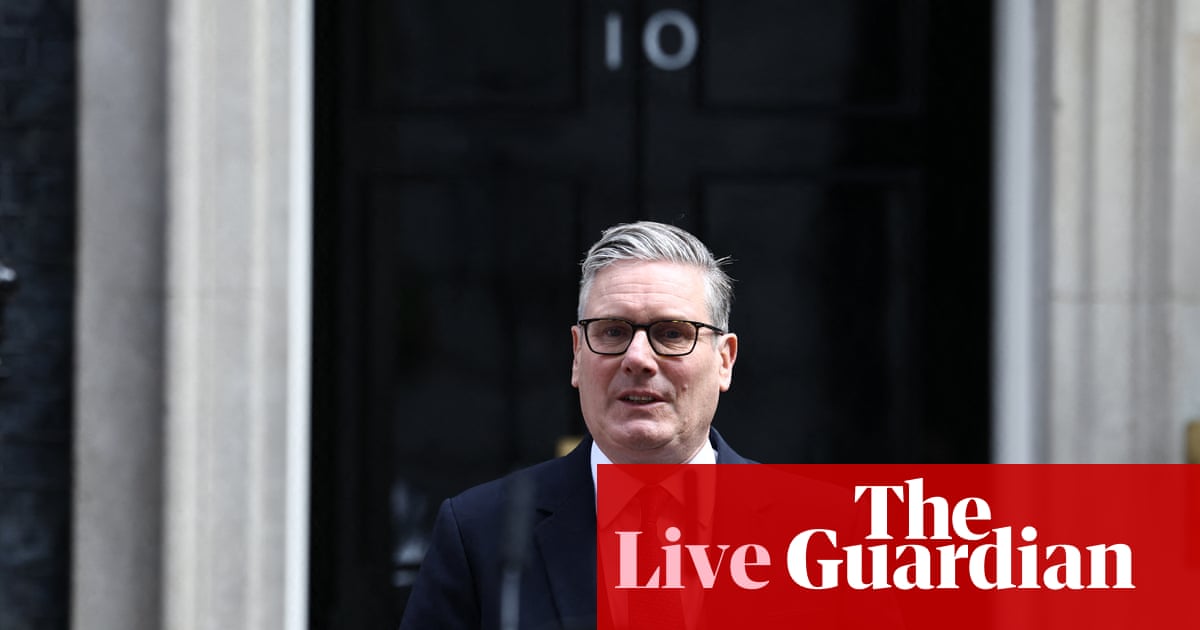
Andy Burnham has had a secret meeting with Keir Starmer to discuss the transition (see 12.43pm, 1.01pm and 1.18pm, Oliver Wright from the Times reports. He says:
Andy Burnham is understood to have held secret talks with Sir Keir Starmer, as the prime minister pledged to smooth his transition to power.
Starmer was said to have left Downing Street for an hour-long “off-site” meeting with Burnham – the first time the two men had spoken since he returned to Westminster.
UPDATE: Pippa Crerar has had this confirmed.
Nigel Farage, the Reform UK leader, has published his latest long essay on his new Substack blog. It is his third in less than a fortnight. This one is about why he believes “the political class betrayed Brexit”.
Here is an extract.
If you listen to one fierce critic of the last Conservative government, this is precisely the failure mode for how it failed to seize the benefits of Brexit. They didn’t “use our regulatory system to exploit [our] competitive advantage”, or seize the “opportunities in areas like tech, and AI, even in farming”. It’s a shame that Kemi didn’t live by these words when she had the chance to do so. Instead, she chose a different maxim: “it is not the bonfire of regulations – we are not arsonists”. Indeed not. And it’s not surprising: the Conservative chose to conserve EU laws.
The More in Common polling out today shows that a lot of people are open to the idea that Brexit might have worked. It suggests that, while 35% of people think it was never going to work, 46% of people believe it might have worked well but was badly handled by politicians.
Anna Turley, the Labour chair, has claimed that Nigel Farage’s answers in interviews today about his undisclosed £5m donation show that he holds the public in “utter contempt”. (See 10.27am.)
In a statement she said:
This morning Nigel Farage seemed to change his story over his secret £5m “gift” every other minute. First it was described as a “reward for Brexit”, then it was apparently for security, and now Farage says it is a “wholly private matter”.
If Farage has nothing to hide, he should stop dodging questions and come clean. Despite what Farage may think, the British public have a right to know who is bankrolling a man seeking high office and what influence, if any, that money buys. The fact he thinks it’s not the public’s business to know shows what utter contempt he truly holds for the British people.
Here is our story on the Farage interviews by Jessica Elgot and Rowena Mason.
Jonathan Haskel, a politics professor at Imperial College London and a former member of the Bank of England’s monetary policy committee, has been named as the government’s preferred candidate for chair of the Office for Budget Responsibility.
Announcing the proposed appointment, Rachel Reeves, the chancellor, said:
Jonathan Haskel is an outstanding nominee for chair. His depth of expertise in economics and his track record of independent, rigorous analysis make him exactly the right person to lead the OBR – supporting the credibility of our fiscal framework and ensuring our economy is underpinned by sound public finances.
Commentators have welcomed the appointment.
This is from Faisal Islam, the BBC’s economics editor.
Professor Jonathan Haskel appointed as Chairman of OBR by Chancellor (needs to be approved by treasury Select committee) – well respected replacement for Richard Hughes, thoughtful ex Bank of England MPC member, expert on productivity and AI…
OBR likely to remain tough independent feature of governance whoever is in Downing Street.
There may have been a slight angle here a few months back, because some of the people in Burnham’s economic orbit (and even on the party’s right too) had also begun to make an argument that more pro investment reform of the OBR was required… all that seems parked now, and Haskel will prove credible and independent, while also an expert on the determinants of productivity and low investment.
This is from Gus O’Donnell, the former cabinet secretary, and former head of the Treasury.
Congratulations to Jonathan Haskel, new chair of OBR . Great to see excellent, independently minded economist in this vital role who also knows a lot about productivity.
And this is from Ben Zaranko, economics editor of the Observer.
Jonathan Haskel has been nominated to be the next Chair of the Office for Budget Responsibility. Currently a Professor at Imperial, he’s done lots of research into productivity (including the role of AI), economic inactivity, and various other issues highly relevant to the OBR.
Peter Walker is a senior Guardian political correspondent.
Emma Reynolds, the environment secretary, has praised Andy Burnham as a “fantastic communicator” providing a “different and compelling story”, as she urged potential rivals to the former Greater Manchester mayor to avoid triggering a formal leadership contest.
“I don’t want a contest,” said Reynolds, who was a close ally of Keir Starmer, who put her in the cabinet just 14 months after she returned to the Commons following five years out.
Speaking in an interview with the Times, she said:
I’ve lived through many different contests as an MP and as a party member. I don’t want to do that in government. I don’t think we should spend the summer turning in on ourselves.
She added: “Frankly nobody else has got the numbers.”
Andy Burnham has had a secret meeting with Keir Starmer to discuss the transition (see 12.43pm, 1.01pm and 1.18pm, Oliver Wright from the Times reports. He says:
Andy Burnham is understood to have held secret talks with Sir Keir Starmer, as the prime minister pledged to smooth his transition to power.
Starmer was said to have left Downing Street for an hour-long “off-site” meeting with Burnham – the first time the two men had spoken since he returned to Westminster.
UPDATE: Pippa Crerar has had this confirmed.
Lisa O’Carroll is a senior Guardian correspondent covering post-Brexit affairs.
The UK could rejoin the EU on a “short” timeline because of the remaining alignment on regulation, Michel Barnier, the EU’s former Brexit negotiator has said.
He also said the UK could also join a new European security and defence council, which he is promoting to allow more formal cooperation with non-EU European countries such as the UK and Norway.
Speaking at the UK in a Changing Europe conference, Barnier declined to put a timeline on potential timetable for a potential re-entry into the EU but said: “It could be short.”
However, he predicted that “it would take much longer” for the UK government “to decide to rejoin” than it would to become a member again.
Barnier restated his familar warning from the Brexit talks that there would be “no cherrypicking” for the UK. It could get back into the EU quickly but there would be “no indivisibility of the four freedoms” of the single market which covers free movement of labour, capital, services and goods, he said.
Jakub Krupa has more coverage of the conference on his Europe live blog.
More in Common has released some detailed polling today on Brexit. In line with most polling on this topic, it shows that by a margin of about three to one people are more likely to say Brexit has been a failure (59%) than to say it has been a success (17%).
The polling also shows that 42% of all Britons say Brexit had made them worse off. And the poorest voters are most likely to say this, and most likely to say Brexit has made them “much worse off”.
The report says:
Over 4 in 10 Britons (42 per cent) say they are financially worse off because of Brexit. Just as many say it has made no difference and less than 1 in 10 say it has made them better off.
The most financially insecure Britons perceive the greatest impact from Brexit with around 6 in 10 saying that leaving the EU made them worse off and 4 in 10 of those saying much worse off.
Only the most financially comfortable are more likely to say that leaving the EU made them better off (36 per cent) than worse off (24 per cent).
Much analysis after Brexit showed that poorer people were more likely to support Brexit than wealthier people. But there is also research making a counter argument, that wealth made people more willing to tolerate what they saw as the risk associated with voting leave.
The More in Common polling also suggests that 49% of people say they would back a referendum to rejoin the EU, against 34% who would be opposed.
Sienna Rodgers from the House magazine has the full details of the timetable for the election of the new Labour leader. She says these are the date that have been agreed by the officers group on the party’s national executive committee. They have to be signed off by the full NEC, but that is normally a formality.
She says:
EXCL: Full details of Labour’s leadership timetable revealed
– MPs nominate: Thursday 9 July to Wednesday 15 July
– MP hustings: Monday 13 July
– Affiliated organisations nominate: Wednesday 15 July at 6pm to Thursday 16 July at 6pm
– Special conference to confirm result on Friday 17 July
I’m told:
– Burnham expected to become PM on the same day
– Even if he is the only candidate, he needs both MP and affiliate nominations
– Even if all MPs nominate before 15 July or more than 80% back Burnham, the window won’t be shortened
Ten years on from Brexit – and our European friends are still wondering what’s gone wrong with Britain. Michael Savage has been looking at how the continental papers are covering the news that we’ve just had our sixth prime ministerial resignation in a decade.
Rafael Behr, the Guardian political columnist, is holding a Q&A with readers later today. There are details here, where you can also submit questions BTL.
Disclaimer : This story is auto aggregated by a computer programme and has not been created or edited by DOWNTHENEWS. Publisher: theguardian.com