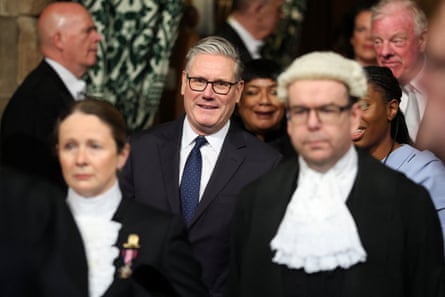
Keir Starmer attempted to reassert his authority over his restive party on Wednesday, announcing his plans for the next parliamentary session even as speculation grew that he would be challenged for his job as soon as Thursday.
Starmer announced his second king’s speech as prime minister, promising a package of measures with bills to abolish NHS England, overhaul the provision of special educational needs teaching, limit trials by jury, introduce digital ID and end the leasehold system in England and Wales.
The prime minister is promising to begin work on his legislative agenda immediately, bringing forward a bill to curb the ability of people in England to buy their own social homes in a effort to boost the country’s stock of affordable housing.
The changes will exempt social homes from the right-to-buy scheme for 35 years, while only tenants who have been living and paying rent there for 10 years will be eligible.
However, his plans risk being derailed almost immediately, with the health secretary, Wes Streeting, expected to resign on Thursday in an attempt to trigger a leadership contest.
Starmer appealed to his MPs to stay the course, promising changes that would make Britain “stronger and fairer”. He told the Commons: “It is an agenda of radical reform across our major public services, an urgent activist Labour government that tilts power back to workers.”
He faced criticism from his own MPs however for elements of the package, including changes to the migration system to make it harder to appeal against asylum rejections. The bill forms part of a wider plan by Shabana Mahmood, the home secretary, to curb legal and illegal migration, including doubling the length of time it will take for some people to be granted indefinite leave to remain in the country.
Rachael Maskell, the Labour MP for York Central, said: “I implore the government maintain the rights of those with indefinite leave to remain, as new communities work alongside established communities.”
Bell Ribeiro-Addy, the MP for Clapham and Brixton Hill, said: “Today’s offering pales in comparison [with what is needed], both because we have heard so much of it before but definitely because it lacks the urgency and the radical transformation we need.”
There were few surprises in the king’s the 11 and a half-minute speech, which marked the formal opening of the government’s second parliamentary session.
The king said in the speech: “My government believes that the United Kingdom’s economic security depends on raising living standards in every part of the United Kingdom. My ministers will support measures that maintain stability and control the cost of living.”
The speech included several measures that ministers hope will boost economic growth, including a bill to lay the ground to adopt European regulations, which is part of the prime minister’s plan to move closer to the EU. Another will force regulators to consider growth when making and enforcing rules for business.
Starmer is promising two major changes to housing in England and Wales: a bill to make it harder for people to buy their own council houses, and another to all but end the leasehold system. The leasehold bill will introduce a ban on new flats being sold as leasehold properties, though the housing minister, Matthew Pennycook, recently said the ban would not be enacted until after the next election.
On public services, the package will bring in several bills aimed at repairing major problems, including long NHS waiting lists, major courts backlogs and the escalating costs of providing special educational needs support.
Streeting is due to follow through with his pledge to legislate to abolish NHS England, something the health secretary promised last year and the process for which has already begun.
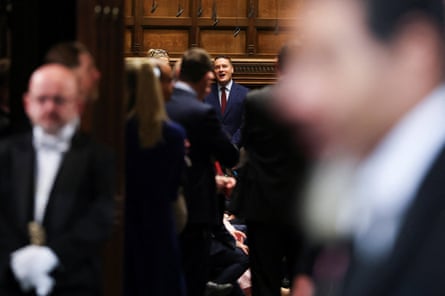
Bridget Phillipson, the education secretary, will enact the changes to special educational needs provision that she outlined in a speech earlier this year. Under the changes, fewer people will be eligible for education, health and care plans than would otherwise be the case, but schools will have more responsibility for deciding how pupils with special educational needs should be taught.
Ministers will also legislate to bring in a digital ID for the first time as a way to check people’s immigration status when they get a new job, although the ID will not be mandatory after the prime minister backed down on a key element of his plans.
Disclaimer : This story is auto aggregated by a computer programme and has not been created or edited by DOWNTHENEWS. Publisher: theguardian.com