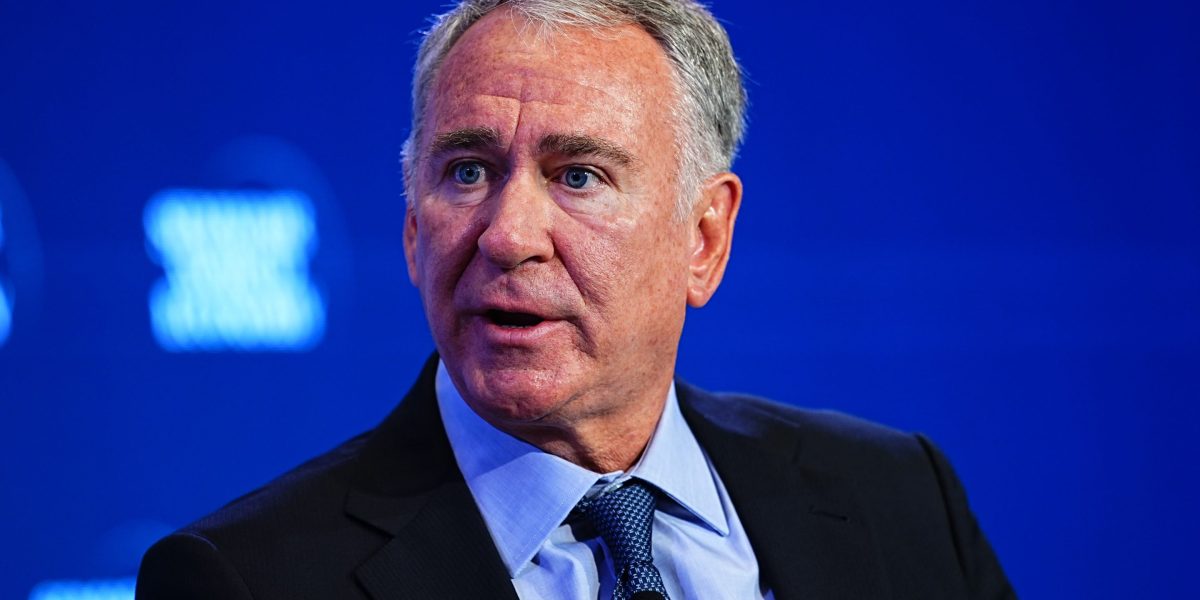
Ken Griffin says he had to watch it twice before it fully sank in.
When New York City Mayor Zohran Mamdani posted a social media video on Tax Day filmed from outside Griffin’s $238 million penthouse at 220 Central Park South — using the Citadel CEO as a prop to promote his new pied-à-terre tax — Griffin said his initial reaction was pure disbelief. “The first time, I couldn’t believe what I was watching,” he told CNBC’s Sara Eisen on Tuesday at the Milken Global Conference. “It took a moment to digest what I was watching.”
What followed, Griffin said, was not just irritation — but genuine alarm.
“What really upset me about the video was the fact that it put me in harm’s way,” Griffin told Eisen. “He seems to have forgotten that the CEO of another American company was assassinated just blocks from where I live in New York.” The reference was unmistakable: the December 2024 killing of UnitedHealthcare CEO Brian Thompson outside a Midtown hotel. “To put any citizen in harm’s way is just inappropriate for one of our political leaders,” Griffin said.
“To turn me into a political puppet was just in poor taste, really poor taste.”
Mamdani’s play
Mamdani filmed the video on April 15, standing in front of Griffin’s building and announcing what he called a first-of-its-kind pied-à-terre tax — an annual surcharge on residential properties valued over $5 million owned by non-full-time city residents. The proposal is projected to generate at least $500 million. Griffin’s penthouse, which he purchased in 2019 for a record-setting price, became the centerpiece of Mamdani’s pitch. The mayor declared, “When I ran for mayor, I committed to taxing the wealthy. Today, we’re taxing the rich.”
Griffin pushed back on the policy itself, too. “The tax, as a tax that discriminates against a narrow group of people, is also disconcerting,” he said. “Are they going to now have a special tax rate for those that own office buildings who live out of state? Like, where’s this stop in New York?”
Miami wins
The episode has had concrete business consequences. In response to Mamdani’s move, Griffin said Citadel has already filed permits with the city of Miami to expand the square footage of its new headquarters by “several hundred thousand square feet” — a decision he said was made “with no regrets.” Citadel will add far more jobs in Miami over the next decade as an immediate and direct consequence of the mayor’s poor decision, Griffin told Eisen, saying it was in direct response to Mamdani’s video. “We probably will go through with the building when it’s all said and done, but I got to tell you, it’s a real topic of debate.”
Griffin declined to comment three times on his meeting with New York Gov. Kathy Hochul, which took place soon after the social media video. He said he was struck by a spokesperson for Hochul’s office, who said that Mamdani had “scored political points” with the video. “Wow, like, that’s real leadership, Governor Hochul,” Griffin said sarcastically.
Griffin’s Miami counterpunch didn’t come from nowhere. Earlier this month, even before Tuesday’s interview, Citadel had quietly scrapped hotel plans for its new Brickell headquarters and converted the project into a standalone 54-story, 1.7 million-square-foot all-office tower at 1201 Brickell Bay Drive — a bayfront site Griffin purchased for $363 million in 2022.
The expansion is also the most visible real-world consequence yet of a deliberate, billionaire-backed campaign that Fortune has been tracking all year. In February, Fortune talked to Mike Simas, president of the Florida Council of 100, who — alongside Griffin and Stephen Ross, the Related Companies chairman — seeded a $10 million national recruitment effort called “Ambition Accelerated,” targeting CEOs, founders, and investors weighing New York and California against Florida’s Gold Coast. Last week, former Miami Mayor Francis Suarez revealed in Fortune‘s pages that he had joined the campaign as a senior advisor. Mamdani’s penthouse video may have become the campaign’s best recruiting advertisement.
Griffin closed with a broader warning for New York, invoking a familiar cautionary tale. “Detroit was the most wealthy city in America per capita in the 1950s,” he said. “Detroit was the powerhouse of our country.” The implication was sharp: no city, no matter how dominant, is immune to the consequences of driving away the people who fuel its economy. “With 1% of New York taxpayers paying 45% of all the taxes, the city is in a precarious position, if they make those who create value feel like they’re best off moving their businesses and their lives to other jurisdictions.”
Griffin’s frustration with Albany fits a broader worldview that Fortune‘s Shawn Tully explored in March: Griffin sees himself not just as a business builder but as a political force capable of reshaping the Republican Party and, by extension, American governance. Griffin will no doubt continue his long-running argument that no city, however dominant, is immune to the consequences of driving away its productive class.
For this story, Fortune journalists used generative AI as a research tool. An editor verified the accuracy of the information before publishing.
Disclaimer : This story is auto aggregated by a computer programme and has not been created or edited by DOWNTHENEWS. Publisher: fortune.com