
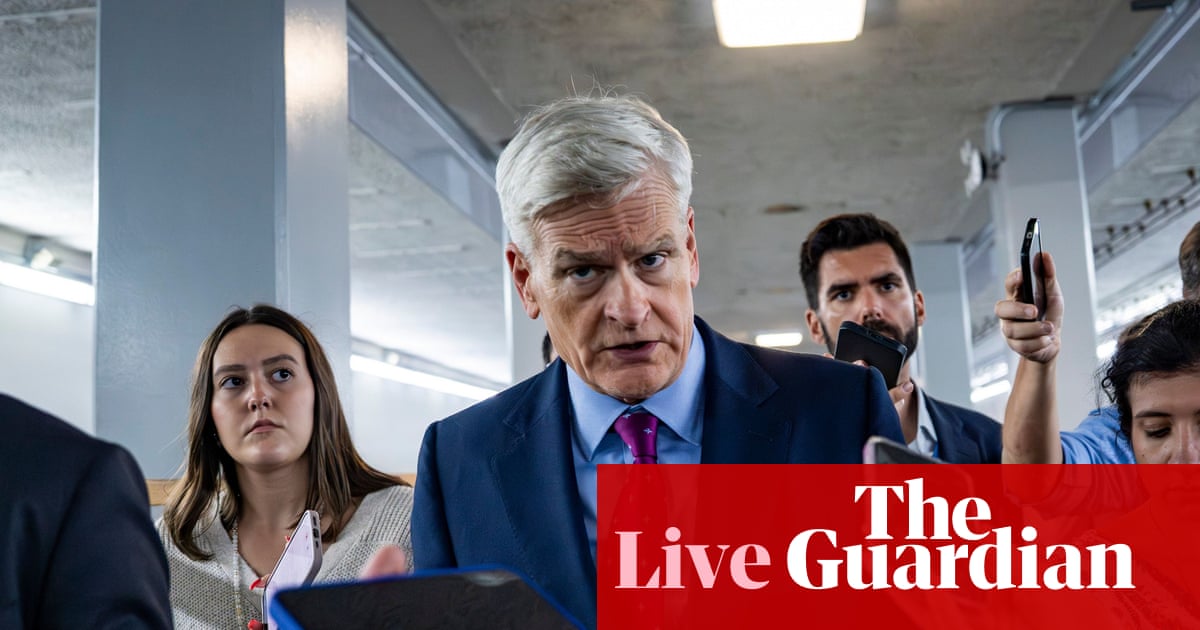
Senator Bill Cassidy, the last Republican who was undecided about Todd Blanche’s nomination as attorney general, said he would vote to confirm Blanche.
He noted that while Blanche, who previously served as Donald Trump’s personal lawyer, is “not perfect”, it is ultimately a decision between him or “another acting attorney general who may not run the department effectively”.
“This is not a referendum on President Trump. It is a decision regarding Mr Blanche in very specific circumstances,” Cassidy said on the Senate floor, explaining his decision process. His “yes” vote, will now likely clear the way for Blanche to receive the 50 votes needed. Vice-president JD Vance will then cast a tie-breaking vote that will ensure Blanche’s confirmation.
Cassidy also noted that pushing back against Donald Trump’s “unrelenting” pursuit of perceived political enemies is a constant “no matter who the attorney general is”.
“This is the rationale for having a Senate confirmed attorney general with more leverage to push back,” Cassidy added, while explaining his vote for Blanche.
The Louisiana senator also said that Blanche is criticized “for things over which he has no control” – namely the presidential pardons of January 6 rioters.
“But this is a presidential prerogative, and he is not the president,” Cassidy said. “He can advise the president, but the president is not obligated to take his advice.”
Cassidy noted in a recent conversation with Bill Barr, an attorney general for part of Trump’s first term in office, that the president would “at times” not take Barr’s advice.
While Cassidy did criticize Blanche’s recent actions, noting that Trump’s nominee showed “poor judgment” in approving the $1.8bn so- called “anti-weaponization fund”, and exempting the president from IRS audits, these did not impact his vote to confirm Blanche as attorney general.
Senator Bill Cassidy, the last Republican who was undecided about Todd Blanche’s nomination as attorney general, said he would vote to confirm Blanche.
He noted that while Blanche, who previously served as Donald Trump’s personal lawyer, is “not perfect”, it is ultimately a decision between him or “another acting attorney general who may not run the department effectively”.
“This is not a referendum on President Trump. It is a decision regarding Mr Blanche in very specific circumstances,” Cassidy said on the Senate floor, explaining his decision process. His “yes” vote, will now likely clear the way for Blanche to receive the 50 votes needed. Vice-president JD Vance will then cast a tie-breaking vote that will ensure Blanche’s confirmation.
One of the first legislative items on the Senate’s agenda today is a sanctions bill, named after the late senator, Lindsey Graham.
Late last month, the Senate voted to advance the bill with widespread support from both sides of the aisle, but did receive criticism because it would allow Donald Trump to slap hefty tariffs on major importers of Russian oil – namely India, China and the European Union.
We can expect a vote shortly in the upper chamber, where it will need 60 votes to pass.
In a new straight-to-camera video on social media, Mike Rogers – the Republican nominee in the US Senate race in Michigan – made a plea to Democratic voters who did not pick Abdul El-Sayed in Tuesday’s primary to join his campaign in the general election.
Rogers – who ran unsuccessfully for Senate in 2024 but lost out narrowly to Elissa Slotkin – addressed Democratic voters who “woke up on Wednesday feeling well hopeless because the person who won does not represent your values”. Rogers added that they “have a home” in his campaign.
“To the vast majority of people across Michigan who do not want to throw their support behind a campaign filled with anger, divisiveness, calls for violence, and the views that are out of touch with your values, well, you have a home with us,” Rogers said.
Haley Stevens lost by a single percentage point, just over 15,000 votes, in the Democratic primary, and now El-Sayed is working to heal the fracture within his party to shore up Stevens’ base to ensure that Democrats can retain Michigan’s open Senate seat in November.
Max Miller, the controversy-plagued congressman running for re-election in his Ohio district, is lending his campaign $1m, according to the Wall Street Journal.
This comes as Miller faces pressure to drop out of the race and resign, amid several allegations of domestic abuse against his ex-wife and infant daughter.
The outlet is the first to report that the congressman is investing the large sum of cash, which appears to be the latest example of him choosing to stay in the race.
Miller said he plans to transfer $1m to his campaign in two installments of $500,000, according to the Journal. The loan would give Miller at a significant financial bump over his Democratic challenger, Brian Poindexter.
Following Lisa Murkowski’s announcement that she plans to vote “no” on Todd Blanche’s nomination to lead the Department of Justice, the acting attorney general can’t afford another defection in order to secure the permanent position.
So far the only other holdout is Senator Bill Cassidy – a GOP lawmaker from Louisiana. Cassidy, a former physician, said this week he’s concerned about Blanche’s ability to lead the justice department independently, considering he once served as Donald Trump’s personal lawyer.
Cassidy said in a radio interview Wednesday that he’s still undecided. “I’ve got to be convinced that he is an attorney general who just happens to have once been President Trump’s personal attorney, as opposed to President Trump’s personal attorney who is now the attorney general,” he said. “I think there’s a big difference between the two.”
Cassidy’s “yes” would get Blanche to 50 votes – with both Murkowski and Susan Collins voting “no” and Mitch McConnell still absent from Congress as he recovers from a fall. In this case, vice-president JD Vance would offer a tie-breaking vote to get Blanche across the finish line. Without Cassidy, however, it would result in failed confirmation that would be a major setback for Trump’s agenda.
Cassidy is one of two Republican senators up for re-election this year who voted to convict the president during his 2021 impeachment trial after the Capitol riots.
However, Cassidy lost his primary race earlier this year to a Trump-backed challenger – hardline representative Julia Letlow – and will be leaving Congress at the end of his term.
Since Trump returned to the White House last year, Cassidy has notably clashed health secretary Robert F Kennedy Jr. Although the Louisiana senator voted to confirm Kennedy, he has since expressed frustration and disappointment in much of the health secretary’s anti-vaccine agenda.
US employers unexpectedly lost 23,000 jobs in July and job gains for the previous two months were revised down sharply, as the summer slump in job growth continued amid ongoing conflict in the Middle East.
The unemployment rate, however, held steady at 4.1%. Economists had projected an unchanged unemployment rate and 83,000 new jobs for the month.
In June, the US added 57,000 jobs, about half of what economists had predicted, with most of the growth concentrated in healthcare and social assistance. The Bureau of Labor Statistics (BLS) also revised its job figures for the previous two months down by a total of 74,000 jobs.
The unemployment rate had also dropped to 4.2% in June, down from 4.3% in May, driven by 720,000 people leaving the workforce.
Donald Trump will begin his day in Washington. We can expect to hear from the president at 3pm ET when he holds a roundtable event at the state department on American mining. We’ll bring you the latest as that gets under way.
Trump will then travel to Bedminster, New Jersey where he’ll be through the weekend.
Donald Trump has ordered a new 15% tariff on imported products made of polysilicon, an important ingredient in microchip manufacturing that is primarily produced by China.
The new tariff, which will take effect on 4 December, is aimed at supporting US chip and solar panel supply chains to compete with Beijing on artificial intelligence and energy.
The executive order signed by the president on Thursday evening said: “The plan of action in this proclamation will, among other things, help ensure the commercial viability of United States production of polysilicon and its derivatives that is necessary to meet United States economic and national security requirements.”
Polysilicon, an ultra-pure form of silicon, is an important ingredient in making the semiconductors vital for AI processing power, datacentres and solar power generation.
US solar factories have long accused Chinese rivals of dumping cheaper panels on the market, which they say have been enabled by excessive government subsidies and by moving manufacturing to other countries to dodge US tariffs.
Tennessee primary voters picked a pair of Memphis-area lawmakers to square off in a dramatically reconfigured US House seat central to Donald Trump’s plan to try to hold on to a slim Republican majority in the midterm congressional elections.
Republicans chose state senator Brent Taylor, who was endorsed by Trump, to be their nominee in the revamped 9th congressional district. Democrats picked state representative Justin Pearson, who gained national prominence three years ago when he was expelled from the Tennessee House for protesting in support of gun control measures.
The previously compact Memphis-based district had a majority Black population, but it was cracked apart by Republican officials this year following a US supreme court ruling that weakened federal Voting Rights Act protection for minorities. Republicans hope the redistricting, which is part of a broader national plan pushed by Trump, could give them a clean sweep of all nine of Tennessee’s seats.
The new ninth district stretches about 200 miles (320km) east from Memphis across rural areas before reaching north toward Nashville. It previously favored Democrats but now tilts Republican, with 71% of voters new to the district, according to an Associated Press estimate. Some Memphis voters have raised concerns that their representation has been diminished.
The redistricting also significantly reshaped the fifth congressional district held by Republican representative Andy Ogles, who was defeated by the former Tennessee agriculture commissioner Charlie Hatcher.
Progressive Democratic proposals including ‘Medicare for all’ and new taxes on billionaires have powered insurgent candidates to primary victories this year, shaking the party establishment and leading it to worry about how Democrats will perform in November’s midterm elections.
But a Reuters/Ipsos poll concluded early this week found those ideas – though by no means all of the progressive agenda – are supported by independent voters who could be decisive in determining whether president Donald Trump’s Republican Party maintains its congressional majorities for the next two years.
Some 64% of independent registered voters in the six-day nationwide poll said they support increasing taxes on corporations and billionaires, compared to 15% who oppose the idea.
And 60% of independents said they support government-provided healthcare coverage for all Americans, which progressives including Michigan US Senate nominee El-Sayed have pitched as “Medicare for all” – expanding the government-run health insurance program to cover all Americans.
President Donald Trump will convene executives from some of the world’s largest mining companies at the State Department on Friday as his administration intensifies efforts to secure domestic and allied supplies of critical minerals.
The White House needs critical minerals to replenish weapons stockpiles depleted during the Iran conflict and reduce US dependence on Chinese supply chains, Reuters reports.
US forces have burned through large numbers of precision-guided missiles and air-defense interceptors during the five-month-long Iran war.
Defense officials and lawmakers have warned that replenishing some inventories could take years given existing production constraints, even as the Trump administration has disputed reports of significant shortages.
Republican senator Lisa Murkowski of Alaska said on Friday that she will oppose US president Donald Trump’s nominee for attorney general, Todd Blanche.
“I have had numerous constructive meetings with Mr. Blanche and he comes across as decent and capable,” Murkowski said in a post on X.
“Ultimately, however, I will oppose his nomination,” she said.
It comes after Republican senator Susan Collins said on Tuesday she would vote against him, leaving Trump’s former personal lawyer with little margin for error.
With Republican senator Mitch McConnell out indefinitely, Blanche is only able to afford one more Republican defection, in the shape of Murkowski.
Blanche, now serving as acting attorney general, persuaded Republican holdouts John Cornyn and Thom Tillis to support him by pledging in writing that Trump’s $1.8bn “anti-weaponization” fund was dead and that a related tax-immunity deal applied only to past tax returns. Both arose from a settlement of Trump’s $10 billion lawsuit against the IRS.
Questions remain about whether the fund could later be revived and why the president would receive a deal from his own administration that could personally save him millions of dollars
Donald Trump has made a second attempt to restrict the constitutional guarantee of birthright citizenship, just weeks after the US supreme court rejected his initial, more sweeping bid to deny automatic citizenship to the children born to undocumented immigrants and temporary foreign residents.
Trump on Thursday signed two executive orders that seek to broaden the categories of children ineligible for automatic US citizenship and ban so-called “birth tourism”. The directives are expected to face legal challenges.
Trump has long sought to dismantle birthright citizenship and has made the effort a centerpiece of his second-term immigration crackdown. He has thus far been unsuccessful.
On Thursday, the president lashed out at the supreme court over what he called “a very unfortunate decision in the supreme court concerning birthright”.
“It was close, but a very, very unfortunate decision,” Trump told reporters. “So we’re making adjustments because it’s very unfair.”
A first new order seeks to expand the definitions of children who would not be able to receive birthright citizenship.
Hello and welcome to the US politics live blog.
Donald Trump is declining to say whether representative Max Miller, of Ohio, should withdraw his reelection bid following domestic abuse allegations levelled against him by his ex-wife.
Trump was asked about the embattled Republican congressman while taking questions from reporters in the Oval Office at a Thursday signing event.
“Well, I’m not going to get involved in that,” Trump said. He echoed his earlier comments, calling it a “very sad situation.” Miller was a senior adviser to Trump during the president’s first term.
Miller’s ex-wife is the daughter of Republican senator Bernie Moreno of Ohio, who has said Miller should not be serving in the House.
“If there are any basic standards of character required to hold elected office, Max Miller fails them,” Moreno, an ally of Trump, posted on Sunday. “He should not serve in the House of Representatives.”
Moreno’s comments came after Miller posted a livestream video defending himself against the abuse accusations and saying his former wife had “significant mental-health challenges”.
Ohio’s other Republican senator, Jon Husted, on Thursday called for Miller to resign and not seek reelection.
Under Ohio law, Miller would need to withdraw by Saturday to allow enough time for the replacement process to play out before the 4pm Monday deadline.
In other developments:
-
One month after the United States supreme court struck down his first attempt to restrict the guarantee of birthright citizenship enshrined in the US constitution, Donald Trump signed executive orders on Thursday that aim to deny US citizenship to children born in the United States to so-called “birth tourists”.
-
The two new orders came just five weeks ago after the US supreme court struck down Trump’s previous order denying citizenship to the children of non-citizens, a right that has been guaranteed since the 14th amendment was ratified in 1868.
-
The orders were part of a quixotic campaign Trump has waged for more than a decade, since he promised to eliminate the right at a 2015 campaign event.
-
Despite an endorsement from Trump, congressman Andy Ogles, a virulently anti-Muslim Tennessee Republican, was in danger of losing his re-election bid to a primary challenger backed by the state’s governor, Bill Lee.
-
Trump refused to confirm a Washington Post report that he told donors at a recent meeting that they need to help JD Vance win the 2028 presidential election.
Disclaimer : This story is auto aggregated by a computer programme and has not been created or edited by DOWNTHENEWS. Publisher: theguardian.com





