South Korea’s National Intelligence Service briefed the National Assembly’s intelligence committee on Sept. 1. Kim Ju Ae, it said, is effectively at the stage of being informally designated as her father’s successor. Ju Ae is the daughter of North Korean leader Kim Jong Un. North Korean state media has recently been showcasing her more often, and in a more prominent manner. Given that, this writer also believes she has likely already been chosen. Still, many rungs remain on the ladder Ju Ae must climb before reaching North Korea’s highest seat of power.
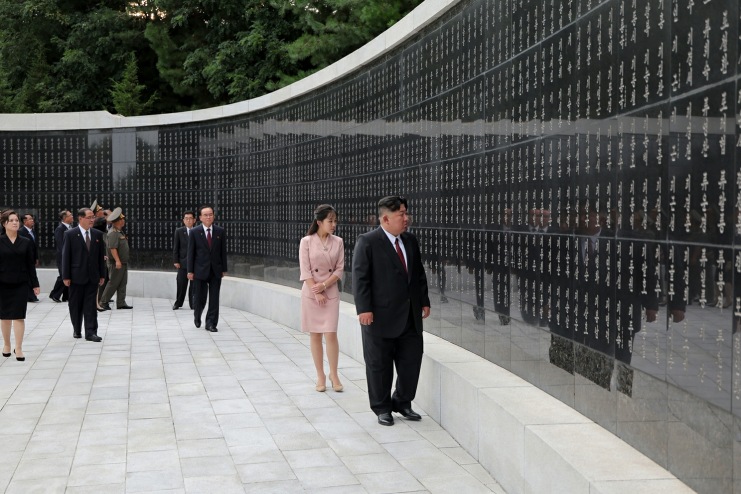
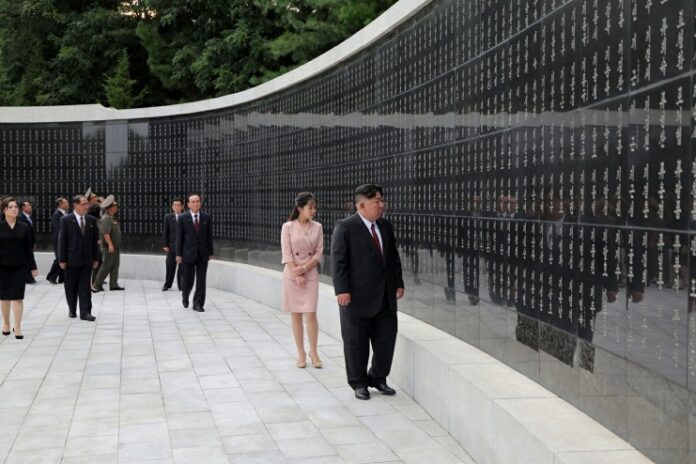
Kim Jong Un visited the Taesong Mountain Revolutionary Martyrs’ Cemetery in Pyongyang on Aug. 14 to mark the 81st anniversary of Korea’s liberation from Japanese colonial rule. The cemetery holds the remains of figures who took part in the anti-Japanese guerrilla struggle and helped found the North Korean state. Most senior officials in attendance wore dark suits, but two people stood out sharply from the rest. Ju Ae wore a light pink suit, while Kim Yo Jong, director of the Workers’ Party of Korea Central Committee’s general affairs department, wore white.
A Korean resident of Japan known to this writer described reactions within the Zainichi Korean community. Some questioned whether the scene made any sense at all, and what Ju Ae’s parents could possibly have been thinking. Andrei Lankov, a professor at Kookmin University, offered a different reading. He said the royal family can do whatever it wants. Ju Ae need not wear a party badge or follow ordinary dress codes, he added. At this stage, he said, it would be fair to call her Kim Jong Un’s successor.
Recently, this writer noticed an even more striking detail across two videos featuring Ju Ae: her strikingly different facial expressions from one event to the next. The first was a performance held on July 27, marking the 73rd anniversary of what North Korea calls its “victory in the Fatherland Liberation War.” That anniversary marks the armistice that ended the Korean War. The performance leaned heavily on political messaging and reenacted North Korean army combat scenes. Audience members who had lived through the war, along with younger generations in the crowd, wept openly and waved flags. Kim Jong Un himself wiped away tears several times, and this writer watched the full broadcast on Korean Central Television. Throughout it, Ju Ae sat right beside her father and remained almost entirely expressionless.
Her expression looked markedly different at a National Circus Troupe performance on Aug. 16, held for the same liberation anniversary. She smiled repeatedly and spoke to Kim Jong Un at several points. She made no attempt to hide her astonishment while watching tightrope walking and acrobatics. A similar pattern emerged on Sept. 6 at the commissioning ceremony for the new destroyer Kang Gon at Wonsan port. There, Ju Ae appeared relatively bright and cheerful as she looked out over the ship and the sea.
Learning the face of a leader
This writer believes both reactions reflect natural responses from someone who is still a child. South Korea’s National Intelligence Service estimates Ju Ae was born in 2013. Expecting a child that age to feel genuine emotional investment in a war that ended more than 70 years ago may simply be unrealistic. Many of the younger attendees at the armistice anniversary event likely felt much the same detachment.
But in North Korea, political events like these are never just performances. They function as propaganda meant to stoke hostility toward the United States and South Korea. They also work to rally the unity and loyalty of the North Korean people. Applause, cheers and even tears can all serve as displays of political loyalty. For an ordinary North Korean person, or even an official, showing a different expression from those around them would not come easily. Doing so in such a setting risks casting doubt on their political reliability. Seen in that light, Ju Ae stood out as nearly the only person in the crowd without an emotional reaction. That, in turn, may actually underscore her unique position within the Kim family.
If Ju Ae does eventually become North Korea’s next leader, though, the calculus changes. Lankov told this writer that an honest person cannot govern a country. Ju Ae, he meant, will eventually have to learn what expression a leader is expected to show. With practice, he added, she will eventually learn to cry too.
In a system like North Korea’s, the facial expressions of the supreme leader are never purely personal. The tears Kim Jong Un has shed in public may well reflect genuine emotion. At the same time, they carry a political function, reinforcing his image as a leader who shares in the joys and sorrows of the North Korean people. This writer previously reported that footage shown to Workers’ Party of Korea officials for internal education in May 2018 depicted Kim Jong Un in tears. He reportedly wept out of frustration that his economic reforms had not gone as planned. This came despite his own efforts to build what North Korea calls a powerful and prosperous nation. The following month, North Korea’s state-run Korean Central News Agency named and criticized this writer directly. Notably, Kim Jong Un has since appeared in tears in public more often.
Ju Ae, too, will eventually learn the meaning behind such political expressions. She will need to smile when she is expected to smile, cry when she is expected to cry and show anger when anger is called for. That process, gradually constructing the face of a leader, may be one more rung on the ladder toward supreme power.
Recent revisions to the Workers’ Party of Korea’s rules are also worth noting here. According to South Korea’s National Security Strategy Institute, the minimum age for party membership has been raised from 18 to 20. That means the point at which Ju Ae herself could formally join the party has likewise been pushed back. Adjusting the party membership age alone is not enough to draw firm conclusions about Kim Jong Un’s succession plans. Still, the change is plausibly read as reflecting an intention to build Ju Ae’s image as successor gradually, over a long period. That would mean not rushing to grant her party membership or an official title. It is also possible that Kim Jong Un himself believes he still has ample time.
A more fundamental question remains, however: can a system built on such tight control and hereditary succession endure, largely unchanged, into Ju Ae’s own era?
Former U.S. Secretary of State Condoleezza Rice once recounted an episode from the collapse of Nicolae Ceausescu’s regime in Romania, where Ceausescu had wielded absolute power for decades. While he was delivering a speech, someone in the crowd shouted “liar” at him. In that moment, people in the crowd stopped fearing the dictator.
Authoritarian systems can look remarkably stable on the surface, but the moment people lose their fear, the situation can change with startling speed. Kim Jong Un, Kim Yo Jong and Ju Ae are all bound up in that risk. Ju Ae, after all, is now being groomed for power herself. The moment they may fear most could be exactly that one, when the North Korean people stop fearing them at all.
Views expressed in Daily NK’s guest columns do not necessarily reflect those of the editorial staff.
Disclaimer : This story is auto aggregated by a computer programme and has not been created or edited by DOWNTHENEWS. Publisher: dailynk.com