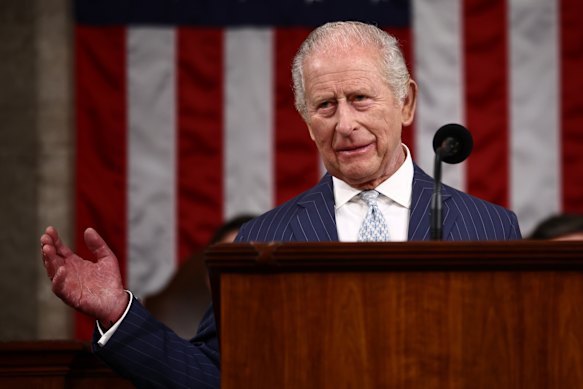

London: King Charles used the power of the podium at the US Congress to deliver a gentle but compelling message to Donald Trump and the American people about the value of remembering their friends.
The King’s address was serious, persuasive and incredibly sly in the way it told the US president what his many critics think he needs to hear.
But even a superb speech, surrounded by the high ceremony of a state visit, will not be enough to restore the “special relationship” between Britain and America when Trump is unlikely to listen.
This was a very clever speech. At a time of war with Iran, the King spoke of fostering compassion and promoting peace. At a time of concern about presidential power, he spoke of the Magna Carta and its core principle that executive power is subject to checks and balances. He emphasised respect for people of different faiths.
At a time when Trump dismisses climate change, the King spoke of the “disastrously melting ice-caps of the Arctic” and the need to safeguard nature.
With a nod to Australia, he urged support for the AUKUS pact. He also addressed the doubts about Trump’s allegiances in Europe by calling for more support for Ukraine – and received sustained applause from Congress.
Every message was crafted so carefully, and spoken so mildly, that it would have been churlish for anyone to point out that the King was being political.
His most important task, however, was to bond the American and British people together in a way that might survive Trump’s complaints about the alliance. He probably achieved this to some extent, given the audience inside and outside the Congress, and this alone gives his address a significant value.
“The challenges we face are too great for any one nation to bear alone,” he said. Throughout the speech, the King argued against the isolationist streak in American politics and against the “might is right” approach that defines the Trump administration.
Will this save the special relationship? No. It does not hurt for the King and the president to project friendship and common purpose with all the glamour of the ceremonial visit.
It is wise, however, not to put too much weight on what we see. The US visit simply repeats the cycle we saw last year when Trump enjoyed a very successful state visit to the UK.
Back then, the magic of the monarchy certainly had its effect on the president when he and his wife, Melania, arrived at Windsor Castle. He appeared to soften in the presence of the unfailingly polite royal family, as he enjoyed a banquet in St George’s Hall with the Princess of Wales on his right and the King to his left.
But the warmth did not last. The September visit was followed by a deep freeze in relations at the start of this year when Trump sought control of Greenland and claimed that American allies had “stayed a little back” from the front lines in Afghanistan and Iraq.
This began the great rift with UK Prime Minister Keir Starmer and most other European leaders. Trump has complained about Starmer ever since. The King pushed back at this by quoting Starmer in his address to Congress, but that seems unlikely to change the president’s mind.
The president’s move on Greenland confirmed the fears in the UK and Europe that the old alliance was over. Trump did the previously unthinkable: he actually threatened allies who opposed him taking control of an Arctic island that was part of the kingdom of a NATO friend, Denmark.
The lesson for Britain? Under Trump, there is no such thing as a special relationship.
The remarks about allied forces were deeply offensive in Britain, as they were in Australia. The King, as ceremonial head of the armed forces, would be justified in rebuking Trump and reminding him of the soldiers of the Commonwealth who died in those conflicts.
But the biggest argument is the most recent one: Trump’s expectation that the UK, and other NATO allies, should have joined him in his decision to launch airstrikes on Iran in tandem with Israeli Prime Minister Benjamin Netanyahu.
Starmer dithered over his response: he refused US access to British bases, then allowed it for defensive operations. His most important decision, however, was in line with every other European leader: none of them joined the war. NATO, the North Atlantic Treaty Organisation, was not going to be turned into an offensive pact to start fights in the Middle East.
While almost every NATO leader learned from the mistakes in Afghanistan and Iraq over the past two decades, one of them did not. Trump is now caught in an Iranian quagmire – and his only committed ally is Netanyahu.
In an unguarded moment, a British diplomat confirmed this reality to a private group of students in February.
“I think there is probably one country that has a special relationship with the United States, and that is probably Israel,” said Christian Turner, who is now the UK ambassador to the US. This was reported by The Financial Times on Tuesday. The remark made news because it captures the overwhelming sense of a lasting divide between Trump’s America and the old allies, especially Britain.
Smiles and ceremonies can hide some of the divisions for a few days, but they cannot make the underlying problem go away. Nor can a king’s speech, not matter how cleverly it is crafted.
On the surface, the British relationship with America looked solid and, frankly, a little glamorous with the arrival of royalty in the US capital. Below the surface, there is a structural gulf in the way the two countries see the world.
King Charles cannot change this. That task is too great for anyone, even a monarch, when Trump is in the White House.
Get a note directly from our foreign correspondents on what’s making headlines around the world. Sign up for our weekly What in the World newsletter.
 David Crowe is Europe correspondent for The Sydney Morning Herald and The Age.Connect via X or email.
From our partners
Disclaimer : This story is auto aggregated by a computer programme and has not been created or edited by DOWNTHENEWS. Publisher: www.smh.com.au