
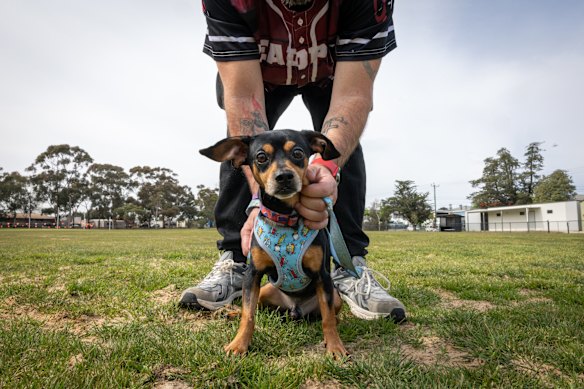

“King” Dobby, as the Chihuahua Dachshund cross is called, wasn’t behaving like his normal, energy-filled and demanding self.
He wasn’t playing, he was lethargic, and sat shaking on the corner of the bed – usually he’s plonked right in the middle of his owners. His family knew something was wrong and rushed him to the Lort Smith Animal Hospital.
Turns out he had eaten an olive oil bottle top and chewed up a Croc sandal. The emergency surgery, necessary for the life-threatening blockage, was set to cost them almost $6000.
The Aarons family – Caitlin, Jai and their two sons – were distraught. They couldn’t afford the massive vet bill and had to stop and contemplate letting Dobby go.
“[I was] feeling lower than crap because, like, I can’t afford to get my fur baby fixed,” said Caitlin. How on earth, she thought, would she tell her kids their dog wouldn’t be coming home?
The Aarons are not alone.
Across Victoria, families are skipping vet visits, missing out on preventative care and, increasingly, facing the difficult decision of either incurring debt or euthanising their pet.
A 2025 survey by Animal Medicines Australia, the peak body representing the animal health industry, found that about 16 per cent of pet owners had accessed financial assistance to cover the cost of veterinary care, and that one in six people skipped taking their dog or cat to the vet to save money.
Last year, 54 per cent of all people who visited pet hospital Lort Smith were struggling financially and received discounted care from the not-for-profit.
“Financially, it was incredibly stressful,” Caitlin said. “It was the day before payday, we don’t have pet insurance, and we couldn’t use Afterpay. I had to borrow money from family just to get started. I was panicking, wondering what we were going to do and calling everyone for help.”
After much stress, Dobby got the surgery he needed. Lort Smith has a fund for people experiencing financial hardship. That fund, said Caitlin, covered almost $4000 for the surgery, with the family borrowing the remaining $2000 with a no-interest loan from Good Shepherd.
“I was so worried about paying for treatment that I couldn’t even food shop,” Caitlin said. “We were just eating whatever was left in the fridge, hoping for the best but preparing for the worst.”
Lort Smith chief executive Frances Mirabelli said the hospital is eating into its cash reserves to keep pace with rising costs and surging demand for its care.
To manage the volume, Mirabelli has rostered extra vets, staff and volunteers. But the model relies heavily on full-paying clients to subsidise care for those who cannot afford it – a balance that is becoming harder to maintain as household budgets tighten across the state.
With a state election approaching, the hospital is calling on both the government and the opposition to commit $1 million in targeted funding. “That’d help us help thousands of animals, and have a massive impact on so many people,” Mirabelli said.
“It’s the emergencies that are the problem,” Mirabelli said, “that’s when it starts get really expensive. That’s not because we’re making huge profits – it’s just because that’s the cost of care at the moment.”
Beyond that emergency relief, Lort Smith is also seeking an additional $4 million commitment to expand its crisis relief animal boarding network for the pets of people experiencing family violence.
The push addresses a documented gap in Victoria’s domestic violence support system. A 2024 study by the Australian Institute of Family Studies recognised harming or threatening to harm pets as a method of family violence, while recent reporting by The Age highlighted how many family violence victims decide to stay in, or were torn about leaving, dangerous homes because they were unable to take their pets to crisis accommodation.
Mirabelli said many victim-survivors (statistically mostly women) “won’t leave the house if they have to leave their pet.”
“What we’d ideally like to do is have a purpose-built boarding facility, which would then be open to those fleeing domestic violence, housing instability, illness,” Mirabelli said. “We’re asking for $4 million to build a facility, and we’re also seeking recurrent funding for that so we’re not relying on philanthropy to fund that service.”
Start the day with a summary of the day’s most important and interesting stories, analysis and insights. Sign up for our Morning Edition newsletter.
From our partners
Disclaimer : This story is auto aggregated by a computer programme and has not been created or edited by DOWNTHENEWS. Publisher: www.smh.com.au



