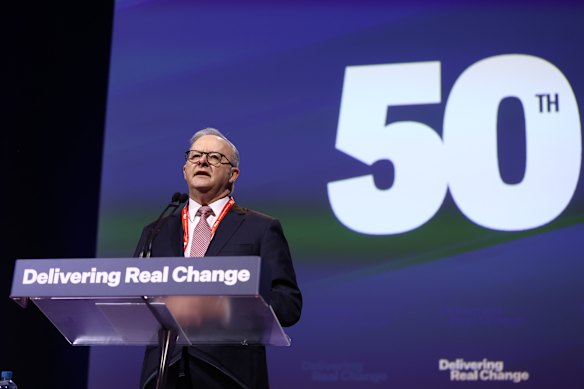

Anthony Albanese’s allies will temper the excitement of Labor’s grassroots by talking down the importance of new commitments to turbocharge the government’s green agenda, as the party gave itself licence to wind back contentious tax credits to miners.
The sparring came on the first day of Labor’s national conference as the prime minister tried to position it as the natural party of government, rejecting hardline approaches and warning that, “in every way that matters, the Liberals, Nationals and One Nation are already a coalition”.
Despite the excitement among Left faction MPs and unionists, senior Labor MPs from resource states such as Queensland and Western Australia are privately staring down environmental advocates and insist that Labor is not about to embark on a radical green agenda outside its existing plans.
Delegates backed an Electrical Trades Union push to create more publicly owned renewables that could power heavy industrial energy users, which employ blue-collar workers. Approvals for solar and wind projects have been too slow to hit the government’s ambitious renewables targets.
The union’s secretary, Michael Wright, said that “a big part of the backlash towards renewables was due to private ownership”, arguing that regional voters would feel less suspicious about the energy transition if it were in public hands.
“People don’t believe it’s in their interests when it’s privately owned,” he said.
The bumpy transition away from fossil fuels, an issue particularly salient in regional areas where One Nation is thriving, was a key focus of the first day of the three-day meeting on Thursday.
Labor backbencher Ed Husic spent the day generating momentum for a tax on gas exports that is also fiercely resisted by industry.
Husic held a press conference on the sidelines of the conference to ask Albanese to act on a new section of the party’s platform that demands a “fair share” from resources companies.
Albanese replied “No” in an interview on ABC radio when asked if he interpreted that part of the platform as a reference to a tax on liquefied natural gas. The prime minister said he was focused on securing fuel from Asian neighbours as the war in the Middle East dragged on, not taxing companies that provided LNG to those nations.
Husic said it was incumbent on Labor to be bold in taking on One Nation, a call echoed by South Australian Premier Peter Malinauskas.
“We must recognise the current upheaval of anti-Labor forces does bring with it two clear, omnipresent and undeniable risks for our party,” Malinauskas said in his speech to the Labor membership.
“The first is complacency. Complacency in the idea that a split conservative movement automatically renders Labor as electoral favourites.”
The tussle over ambition permeated a range of policy debates on Thursday as Albanese and his ministry tried to temper demands of rank-and-file members.
The change to Labor’s platform on renewables could push the government to change the mandate of Snowy Hydro and the Clean Energy Finance Corporation to facilitate more public ownership.
An initial push from the ETU that would have given the government an even more expansive role was watered down, suggesting friction between the demands of environmentalists and ministers who must manage financial trade-offs involved in the green energy agenda.
Such a move would be expensive at a time when Labor wound back spending on green energy in its last budget, but Wright said that government-backed wind and solar could power smelters and large manufacturers to stop them competing with households for electricity.
In a separate policy debate, Bennelong MP Jerome Laxale claimed a win on the contentious issue of fuel tax credits for mining firms.
Environmentalists have long wanted to pare back a scheme that refunds miners the 52.6¢-a-litre excise applied to petrol and diesel. Doing so would save about $2.5 billion a year. Mining companies and resource states have been against the proposal.
“Our new platform should scream that Labor are serious about climate action and no one who reads it should be surprised when we use our time in government to deliver,” Laxale said.
Backed by Labor’s environmental group, delegates voted to commit the party to removing any tax measures that discouraged decarbonisation.
While the government is not immediately looking at curbing the tax credits, it may re-examine the policy after the fuel crisis subsides later in the term.
However, the mining lobby said the wording in the amendment was vague and did not specifically refer to the tax credits.
Senior Labor MPs on the opposite side of the argument to Laxale suggested the government was not locked into a position.
“We greatly appreciate the support of the prime minister, Resources Minister Madeleine King … and other ministers and regional Labor MPs who have stood up for fuel tax credits within the Labor Party,” said Minerals Council of Australia chief executive Tania Constable.
“This is a sensible outcome, because the last thing our industries need is higher costs which would threaten their survival.”
Energy and Climate Change Minister Chris Bowen said he was proud that Labor had adopted language on the “important role the public sector will play” in building up renewable energy.
“These words strike an appropriate balance between recognising what more role the public sector can do,” Bowen said.
Go deeper on Labor’s national conference:
 Paul Sakkal is Chief Political Correspondent. He previously covered Victorian politics and won a Walkley award and the 2025 Press Gallery Journalist of the Year. Contact him securely on Signal @paulsakkal.14.Connect via X or email.
From our partners
Disclaimer : This story is auto aggregated by a computer programme and has not been created or edited by DOWNTHENEWS. Publisher: www.smh.com.au