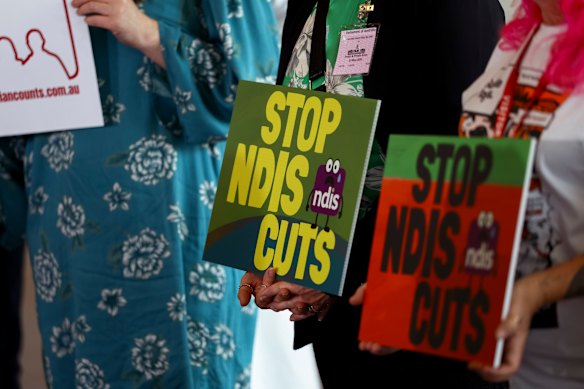

Labor’s contentious overhaul of the $56 billion NDIS is hitting early roadblocks as the Coalition threatens to withhold its support while states push for more detail and those with disabilities warn that major changes are being rushed through without safeguards.
The government’s own advisory committee on disability reform briefed state and federal ministers in a closed-door meeting on Friday afternoon to caution that federal laws to curb National Disability Insurance Scheme spending would harm thousands of disabled Australians if the process didn’t slow down.
State and territory disability ministers, who have been frustrated by the consultation process, also want more information from the Albanese government about the impact on state services under plans to start removing up to 300,000 people from the scheme in 19 months’ time.
Labor wants to pass a wide-ranging NDIS bill by the end of June so that it can start delivering the bulk of its budget savings for the next four years. Recent data show the government’s efforts to control the NDIS have gone backwards this year, and growth is picking up speed, adding urgency to that task.
But it needs Coalition support to pass the laws, and the opposition is threatening to withhold its backing in the Senate unless a parliamentary inquiry scrutinises the budget’s controversial tax reform package.
Labor’s efforts to sell its budget’s key theme of intergenerational equality have been overshadowed by debate over how changes to taxing capital gains will affect small businesses and start-ups, and an inquiry promises to give more air time to those concerns.
The government wants to push the tax changes through with the Greens, but the manager of opposition business in the Senate, Jonno Duniam, said the Coalition would not help Labor to meet its deadline on NDIS reforms if that happened.
“Any attempt to rush the proposed tax reforms through parliament in a dirty deal with the Greens without proper scrutiny will jeopardise our willingness to support the NDIS reforms on the government’s timeframe,” he said.
More than $38 billion in NDIS savings have been baked into the federal budget’s bottom line, but they require new laws to take effect. These laws are before a Senate inquiry, but stakeholders have been given just two weeks to make submissions on the 100-page bill before two days of hearings next month.
Disability advocacy groups will push the case that the laws risk breaching recommendations of the disability royal commission because they give the minister sweeping powers to cut funding or therapy hours across entire sections of the scheme – regardless of individuals’ assessed needs.
Health Minister Mark Butler said he will first use this power to reduce people’s social and community participation budgets to 2023 levels, and reduce therapy from 72 to 68 hours a year. The bill also enables automated decision-making, and will require people to exhaust all other treatment options before they are considered permanently impaired to enter the scheme.
Inclusion Australia, which represents people with intellectual disability, is arguing that the new assessment approaches may exclude people who need the scheme due to its narrow definitions.
It also fears that the minister has too many discretionary powers with limited safeguards and review rights, and is calling for an extension of the inquiry so that the disability community can be meaningfully consulted, given many people haven’t had time to understand the changes.
That view was backed by Down Syndrome Australia, which fears the cuts to social and community participation budgets will also slash funding for supports that help people in employment.
“I fear that’s an unintended consequence. If you cut [these budgets] by 50 per cent, it cuts work hours, and people are at huge risk of harm and exploitation,” chief executive Darryl Steff said.
“Our biggest concern is there’s no safeguard: the minister will make the declaration, and if the cuts put the participant at a significant risk of harm, there’s no avenue for appeal.”
The Child and Family Disability Alliance will raise concerns that the tightened assessment criteria could delay entry to the scheme for young children with rare conditions.
“We’re concerned the bill is written in a way where they have to wait until their functional capacity is severely reduced. We don’t want them to be waiting,” said chief executive Karen Dimmock.
She is also worried that expanded definitions of parental responsibility will place a greater load on families.
Mitchell Skipsey, a senior solicitor at the Justice and Equity Centre, said the wide-ranging bill contained several complex changes that interacted with each other, and one month was not long enough for either the public or parliamentarians to assess it properly.
“Automated decision-making, for example, is a complicated and hot button topic. There’s clearly a discussion to have about what safeguards need to be in place and how to do that well. We can’t have that conversation with the care it requires because there’s so much going on in this bill,” he said.
“When you’re dealing with the range of experience and life circumstances of people with disability, it’s really hard to rush. Consequences of getting that wrong are really dramatic.”
Skipsey also argued that the ministerial powers were a blunt instrument in need of checks and balances. “They have to make laws for a minister they agree with, and a minister they don’t agree with,” he said.
“A minister could say: ‘we’re cutting by 100 per cent everyone’s supported independent living’, or ‘we’re reducing assistive technology by 50 per cent’. The minister has said that’s not what they intend. But once you put those powers in the act, that’s a power that’s there.”
Treasurer Jim Chalmers, in a podcast on Saturday, conceded that the changes were causing significant anxiety, “particularly amongst people who are already vulnerable in our community”.
“I acknowledge that. But we’re taking responsibility,” he said. “The NDIS is an institution, but more importantly than that, our responsibilities to people with a disability are making sure that we can continue to fund that care and support.”
Start the day with a summary of the day’s most important and interesting stories, analysis and insights. Sign up for our Morning Edition newsletter.
 Natassia Chrysanthos is Federal Political Correspondent. She has previously reported on immigration, health, social issues and the NDIS from Parliament House in Canberra.Connect via X or email.
From our partners
Disclaimer : This story is auto aggregated by a computer programme and has not been created or edited by DOWNTHENEWS. Publisher: www.smh.com.au