- Ladakh women protest new excise policy, demand alcohol ban.
- United women from all faiths stage continuous sit-in.
- Protesters cite cultural erosion, public health, family safety risks.
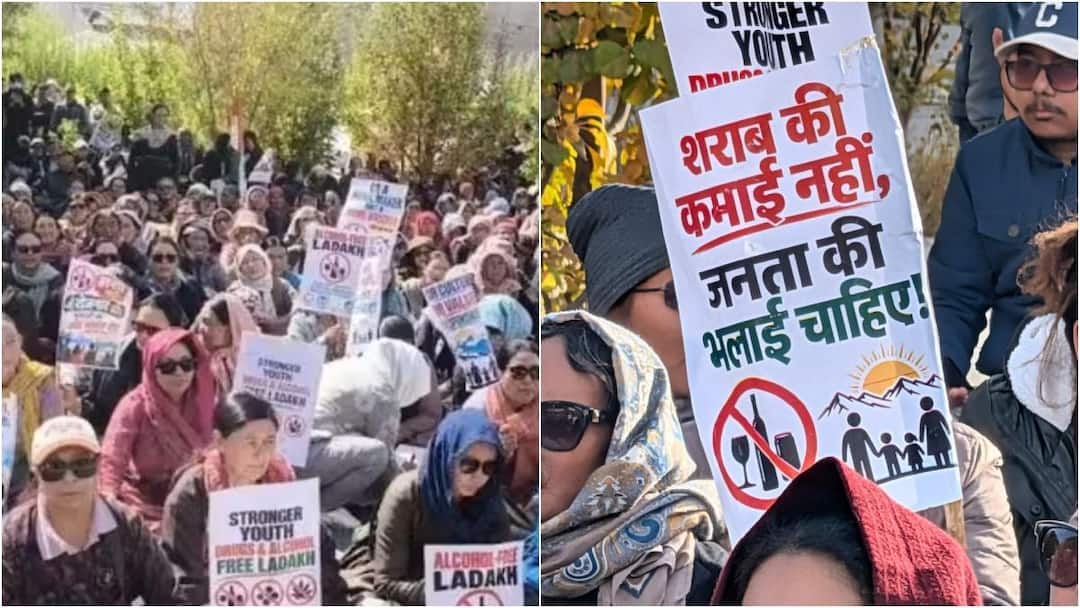
Women in Ladakh have launched a movement against alcohol sales, taking to the streets of Leh to demand a complete ban on liquor across the Union Territory. The protest has brought together people from different religions and communities, with women taking turns to stage a round-the-clock sit-in. They have vowed not to leave until their demand for a total prohibition on alcohol is met.
The agitation was triggered by the Ladakh administration’s new excise policy, which allows the number of liquor retail outlets in the region to increase from two to 20.
Women Demand Complete Ban On Alcohol Sales
What began as a protest against the opening of new liquor shops under the revised excise policy has grown into a broader demand for a complete ban on alcohol sales across Ladakh.
Despite the biting cold at night, women from Buddhist, Muslim and Christian communities have united in the protest. Members of both Anjuman Imamia and Anjuman Moin-ul-Islam are participating alongside Buddhist and Christian women. They are taking turns to stage a sit-in at NDS Park in Leh to ensure a continuous presence at the protest site.
Protesters Raise Concerns Over Local Traditions
Protesters and local leaders have accused the administration of ignoring local traditions and public sentiment by issuing liquor licences and allowing bars to open close to villages, homestays, guest houses, schools and religious places.
Women associated with several religious and social organisations, including the Ladakh Buddhist Association (LBA), Anjuman Imamia, Anjuman Moin-ul-Islam and the Christian community, are leading the agitation. Several men also joined the latest protest in support of the demand.
Led by the women’s wing of the LBA, the protesters said the large-scale commercialisation of alcohol posed a threat to Ladakh’s cultural fabric, public health and family safety. They warned that it could increase the risk of domestic violence and substance abuse among young people.
Addressing the gathering, representatives of various women’s organisations, the LBA president and other speakers expressed concern over the growing availability of alcohol and other intoxicating substances in the region.
They urged the government to impose a complete ban on alcohol sales and take effective steps to make Ladakh liquor-free. The protesters alleged that the Union Territory administration was introducing new rules without adequately consulting local residents or obtaining their consent, thereby disregarding public sentiment and local traditions.
They also called for a review of the new excise policy, taking into account the region’s religious values, social priorities and public concerns. The protesters demanded that the decision to open additional liquor shops be withdrawn.
Protesters Flag Wider Political And Administrative Issues
The demonstrators also raised concerns over amendments to the Ladakh Autonomous Hill Development Council (LAHDC) Act and other major political and administrative issues affecting the region. They stressed that local residents and their elected representatives must be consulted on important decisions concerning Ladakh’s future.
Women in Ladakh have been protesting for several months against the opening of liquor shops under the new excise policy. Various women’s organisations have repeatedly urged the government to amend the policy, stop alcohol sales and declare Ladakh a liquor-free region.
The agitation has received support from several religious and social organisations, including the Ladakh Buddhist Association, Apex Body Leh and the Kargil Democratic Alliance (KDA).
Through their sit-in, the protesters reiterated their demand for a complete ban on alcohol sales and urged the government to take their concerns seriously and reconsider the excise policy.
Sonam Wangchuk Questions Alcohol Policy
Well-known environmental activist Sonam Wangchuk has publicly criticised the Lieutenant Governor-led administration, accusing it of “firing alcohol cannons”.
Wangchuk questioned why the Centre was aggressively promoting the commercialisation of alcohol in a sensitive region such as Ladakh when states like Gujarat enforce strict restrictions on liquor.
What Has The Administration Said?
Chief Secretary Ashish Kundra and Excise Commissioner Romil Singh Donk had called an initial meeting to hear the demands of women representatives.
The administration has officially said that a broader consultation and a detailed review meeting will be held towards the end of October. The exercise is intended to help build a consensus on whether the excise policy should be withdrawn.
Disclaimer : This story is auto aggregated by a computer programme and has not been created or edited by DOWNTHENEWS. Publisher: abplive.com