

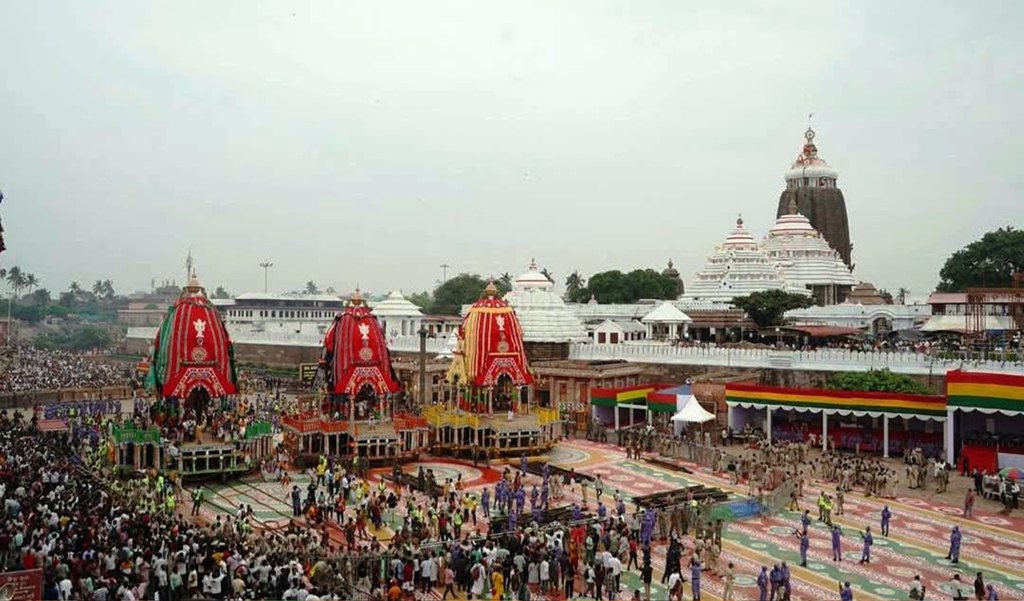
Bhubaneswar: Amid incessant monsoon showers, chants of “Jai Jagannath” echoed across the Grand Road (Bada Danda) in Puri on Thursday as the world-famous Rath Yatra of Lord Jagannath commenced with deep spiritual fervour, drawing lakhs of devotees from across India and abroad to witness one of humanity’s oldest and grandest religious spectacles.
Braving heavy rain, thousands of devotees gathered from the early hours, eagerly awaiting the divine moment when Lord Jagannath, Lord Balabhadra, and Devi Subhadra would emerge from the sanctum sanctorum of the 12th-century Srimandir to bless humanity during their annual sojourn to the Srigundicha Temple, revered as their birthplace.
The centuries-old festival began with a series of sacred rituals inside the temple, meticulously performed in accordance with age-old traditions preserved for generations by the temple servitors. The morning commenced with the Dhupa ritual at the Bhoga Mandap, followed by other ceremonial rites associated with preparing the deities for their annual journey outside the temple walls.
Several other important rituals, including Pahandi Bije (the ceremonial procession of the deities from Srimandir to their chariots) and Chhera Pahanra (the ceremonial sweeping of the chariots by Gajapati Maharaja Dibyasingha Deb), are scheduled to be performed before devotees begin pulling the decorated chariots at around 4 p.m.
The Pahandi procession, one of the most significant rituals of the Rath Yatra, will witness the Holy Trinity—Lord Jagannath, Lord Balabhadra, and Devi Subhadra—being carried out of the sanctum in a grand ceremonial procession amid the chants of devotees and the rhythmic sounds of traditional musical instruments. The deities will then be seated on their respective chariots—Nandighosa of Lord Jagannath, Taladhwaja of Lord Balabhadra, and Darpadalana of Devi Subhadra.
The revered Chhera Pahanra ritual, performed by the Gajapati Maharaja, will follow the Pahandi ceremony. During the ritual, the king ceremonially sweeps the chariots with a golden broom, symbolising humility, equality, and devotion before Lord Jagannath.
After the completion of all the rituals, the three majestic chariots will begin their grand procession from Srimandir to the Srigundicha Temple. Lakhs of devotees are expected to gather in Puri to witness the divine spectacle and seek the blessings of Lord Jagannath.
What is Rath Yatra?
The Rath Yatra marks the annual journey of Lord Jagannath, Lord Balabhadra, and Devi Subhadra from Srimandir to the Srigundicha Temple. The nearly three-kilometre procession is also known as Ghosha Yatra. During the journey, people of all faiths and communities gather to catch a glimpse of the deities seated on their chariots. It is believed that darshan of the deities during the Rath Yatra absolves devotees of their sins and helps them attain moksha (salvation).
The return journey of the deities to Srimandir after their nine-day stay at the Srigundicha Temple is celebrated as the Bahuda Yatra. During the festivities, the deities are adorned with magnificent gold ornaments in the ritual known as Suna Besa.
The chariots used during the Rath Yatra are built afresh every year using newly cut timber. Construction begins on the auspicious occasion of Akshaya Tritiya. The chariots are painted in vibrant colours and topped with canopies of red, yellow, green, and black. Lord Jagannath’s Nandighosa features red and yellow, Lord Balabhadra’s Taladhwaja is adorned in red and green, while Devi Subhadra’s Darpadalana is decorated in red and black. Each chariot has distinct architectural features and symbolic significance.
Rath Yatra is also regarded as a festival of universal brotherhood, transcending barriers of caste, creed, and religion. People from all walks of life, irrespective of their faith, are welcome to offer prayers and seek the blessings of the Holy Trinity.
Disclaimer : This story is auto aggregated by a computer programme and has not been created or edited by DOWNTHENEWS. Publisher: deccanchronicle.com





