On Sept. 9, the six-member board of Automattic—the company that owns WordPress, Tumblr, and other web-based apps—voted to put its CEO, Matt Mullenweg, on leave. The move seemingly came out of the blue: Mullenweg had just returned from his annual trip to Burning Man, and the board was made up largely of directors who had mentored Mullenweg for years.
And then, 33 hours later, Mullenweg was back in control, and the three directors who tried to sideline him were gone, along with the company’s CFO and its chief legal officer.
A remarkable level of secrecy surrounded the drama. None of the board members have publicly explained why they suddenly wanted him out of the company. Mullenweg has declined to describe why he was all but fired, or how he quickly got back control of the company. But Fortune’s Eva Roytburg investigated and got the whole story.
MORE FROM FORTUNE
Can AI Save Tinder and the Dating App Industry? – Fortune Video
‘Miami-Dade County is not Vice City’: GTA 6 is taking over Miami—and dividing the county – Cordell Jones
‘Circle back,’ ‘synergy,’ ‘boil the ocean’: The corporate phrases Gen Z doesn’t get, and what they say instead – Sasha Tuddenham
Atlassian’s Mike Cannon-Brookes: AI agents need a name tag—and a human to be accountable for their mistakes – Angelica Ang
‘I’ve never had a real job’: Shaq talks building his brand through ads, and says he hates ‘wealthy athletes’ who show off. It ‘makes me sick’ – Catherina Gioino and Joshua Hong
South Korea bets on five regional airports to spread its tourism boom beyond Seoul – Angelica Ang
Zoom and big financial firms add ‘Proof of Human’ badges from Sam Altman’s World to stop fraud and deep fakes – Jeff John Roberts
China’s economy grew 4.5% last quarter, yet its export boom risks being ‘a drag on world growth’ – The AP
LA CONTAGION
Putting a price on the “blow up” in France
French police lost control of multiple cities in France over the weekend, as demonstrators looted shops in Paris, stormed city hall in Marseille, burned down the city hall of Limoges, and torched the tourism office in Lyon. Thousands have been arrested. The rioters initially demanded more funding for education, but their protests morphed into a more general set of grievances. Many of them are waving Palestinian flags.
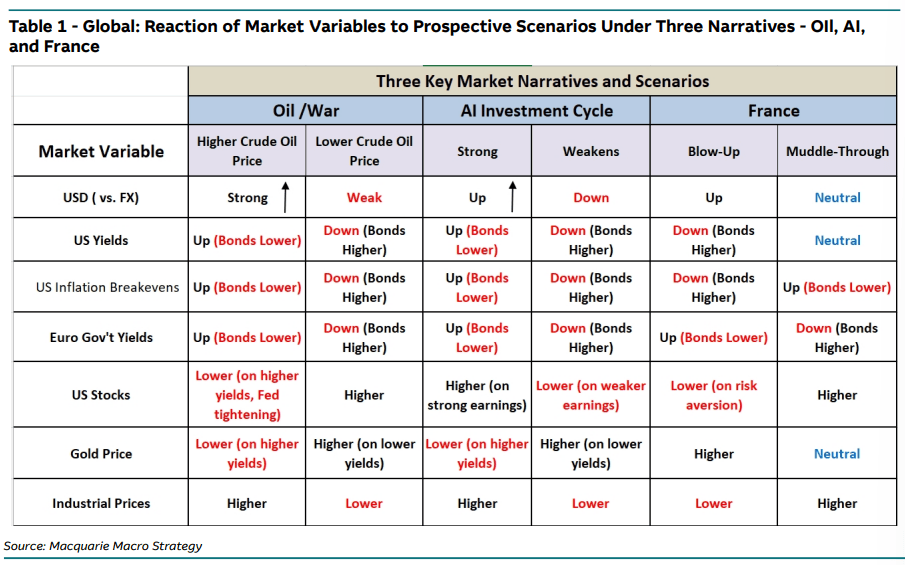
Wall Street, meanwhile, is trying to price a scenario in which France doesn’t get its act together, caves to the demands of the protesters for more spending, and worsens its national debt. So, “what would a ‘blow up’ in France look like?”, Macquarie’s Thierry Wizman and Gareth Berry asked in a note to clients. Here is what they think is on the cards:
- A “governance breakdown” maybe involving the dissolution of the National Assembly before the April election.
- Credit rating agencies downgrade France’s debt in November.
- “Widening of street protests and violence.”
- A further spike in French bond yields, possibly triggering contagion into other asset classes.
- And then, finally, “the election of a far-right populist administration, which sets off a more serious crisis of confidence in the state’s ability to enact legislation that will help bring fiscal austerity.”
They also produced this handy chart showing what will go up and what will go down on a disaster-by-disaster basis:
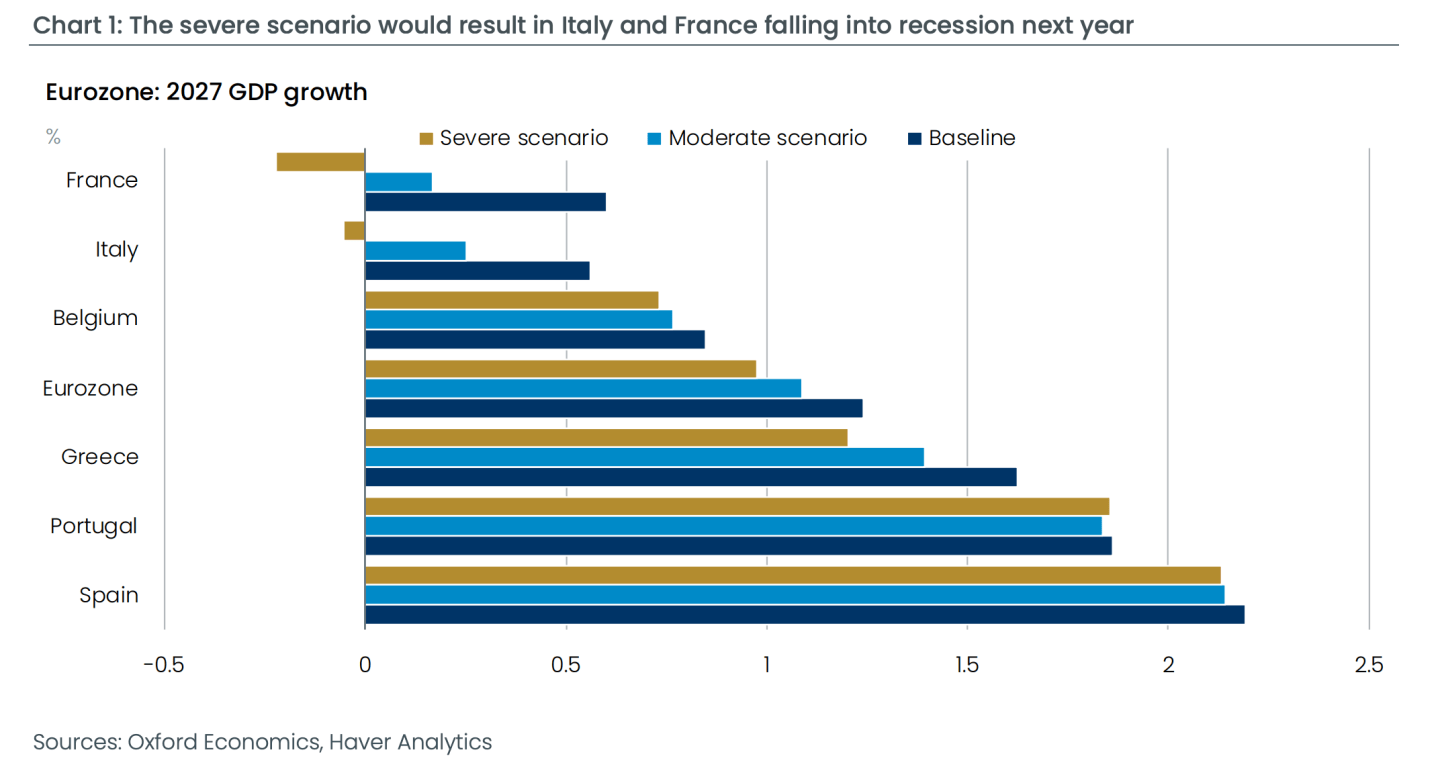
At Oxford Economics, Ricardo Amaro thinks that contagion would involve pulling both France and Italy into a recession. “If France suffered a fairly large increase in bond yields with some contagion to high-debt countries, the impact would be highly asymmetrical across the Eurozone. France and Italy would experience moderate recessions, while Spain, Portugal, and Greece would outperform,” he said in a note. “The Eurozone would avoid a recession.”
- Live coverage of the riots in France from the BBC here.
THE MARKETS
Buyers step in where angels fear to tread
Stocks struggled globally today as the price of oil rose to $108 per barrel. Asia was mixed, while markets declined in Europe. U.S. futures were up this morning following a tech-led selloff on Friday. Nasdaq futures were up strongly before the open in New York—suggesting that traders now believe last week’s dumpster fire was overcooked.
“Things are looking a lot cheerier than they were at the close on Friday. After yet another lurch lower for tech, buyers have once again appeared,” Chris Beauchamp, chief market analyst at trading platform IG, told Fortune.
“Amid all the doom-laden commentary we saw last week, it is easy to forget that the S&P 500 was at a record high just two weeks ago. Last week looks more like a healthy rotation than the beginning of something more dramatic, no matter how much many bearish types would wish it otherwise.”
Factoid: Today is the 39th anniversary of Black Monday, when the Dow Jones fell 22.6% in a single day. Watch a great archive video of the TV evening news on that day here.
- S&P 500 futures were up 0.47% this morning. The index fell 1.09% on Friday.
- In Europe, the Stoxx 600 was down 0.78% in early trading, and the U.K.’s FTSE 100 was down 0.87% before lunch.
- Asia: South Korea’s KOSPI was up 1.76%. Japan’s Nikkei 225 was down 0.62%. India’s Nifty 50 was down 1.19%. China’s CSI 300 was up 0.09%.
- Brent crude rose to $108 per barrel.
- Bitcoin was at $82,769.
More in-depth market coverage here.
CHART OF THE DAY
Why the Fed’s Warsh is being so patient with inflation
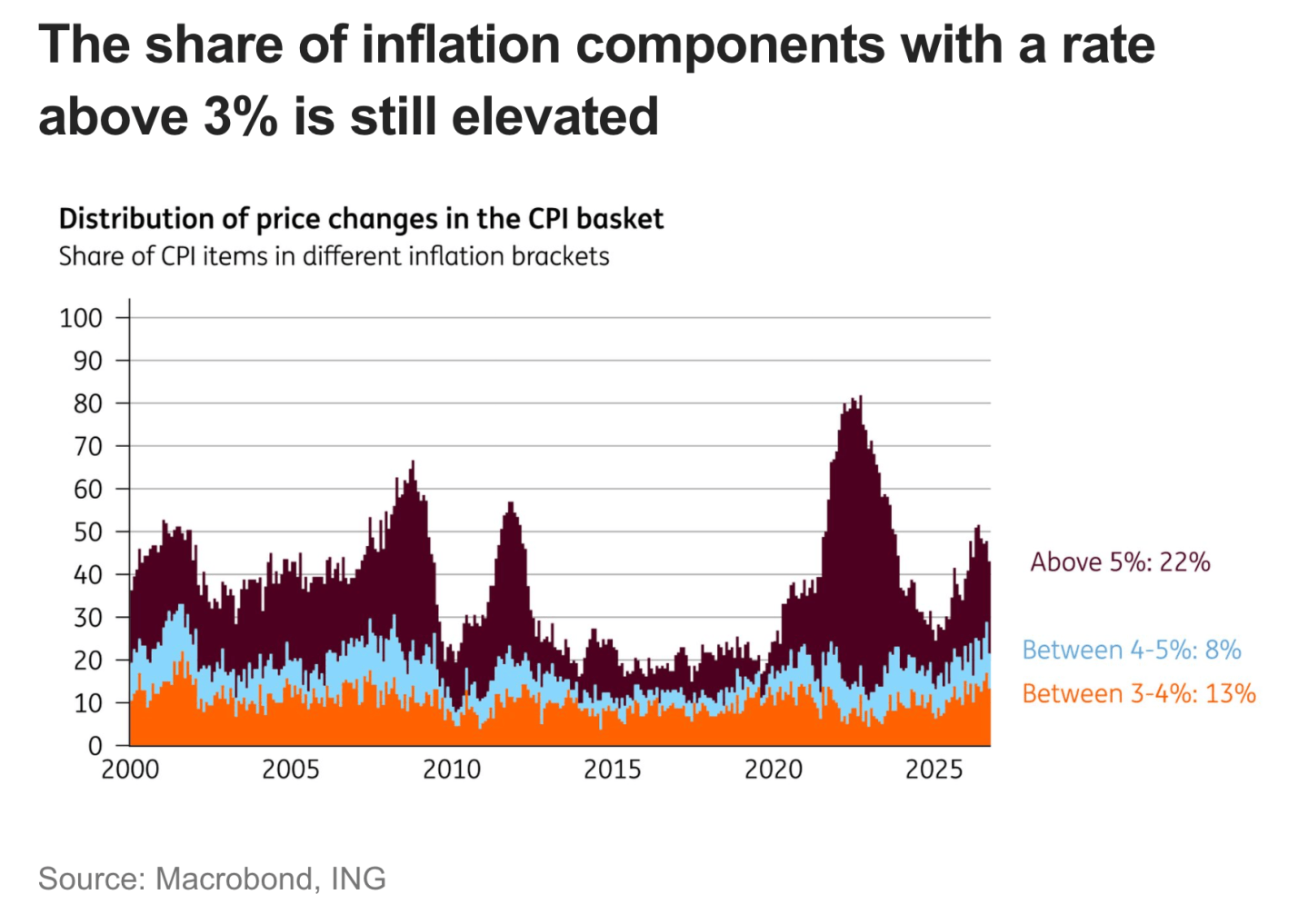
Inflation was 3.7% in September, up from 3.4% the month before. But Fed chair Kevin Warsh gave no hints that he would hike interest rates to fight it at his IMF speech in Bangkok last week. Why is he so sanguine? After all, “Warsh’s favored gauge of price pressures, the share of components with an inflation rate north of 3%, is still very elevated,” according to ING’s James Smith. The gauge is faulty, Smith argues, and many of the inflationary factors are about to be eased out of the system, he said in a recent note.
“This measure is highly flawed. All it really tells us is that tariffs have boosted a lot of small goods categories,” he wrote. “That effect should rapidly dissipate now that tariff refunds are flowing in after the Supreme Court decision earlier this year. There are other reasons for optimism, too. Rental costs, which make up a whopping 44% of the core inflation basket, should continue to gradually ease given the cool state of the U.S. housing market. Wage growth is down at 3%.”
“It’s not difficult to see how inflation gets much closer to 2% by the second quarter of next year, when the energy story also starts to filter out of the annual comparison,” he concluded. He forecasts that Warsh will hike only once more this year—in December.
NUMBER OF THE DAY
13%
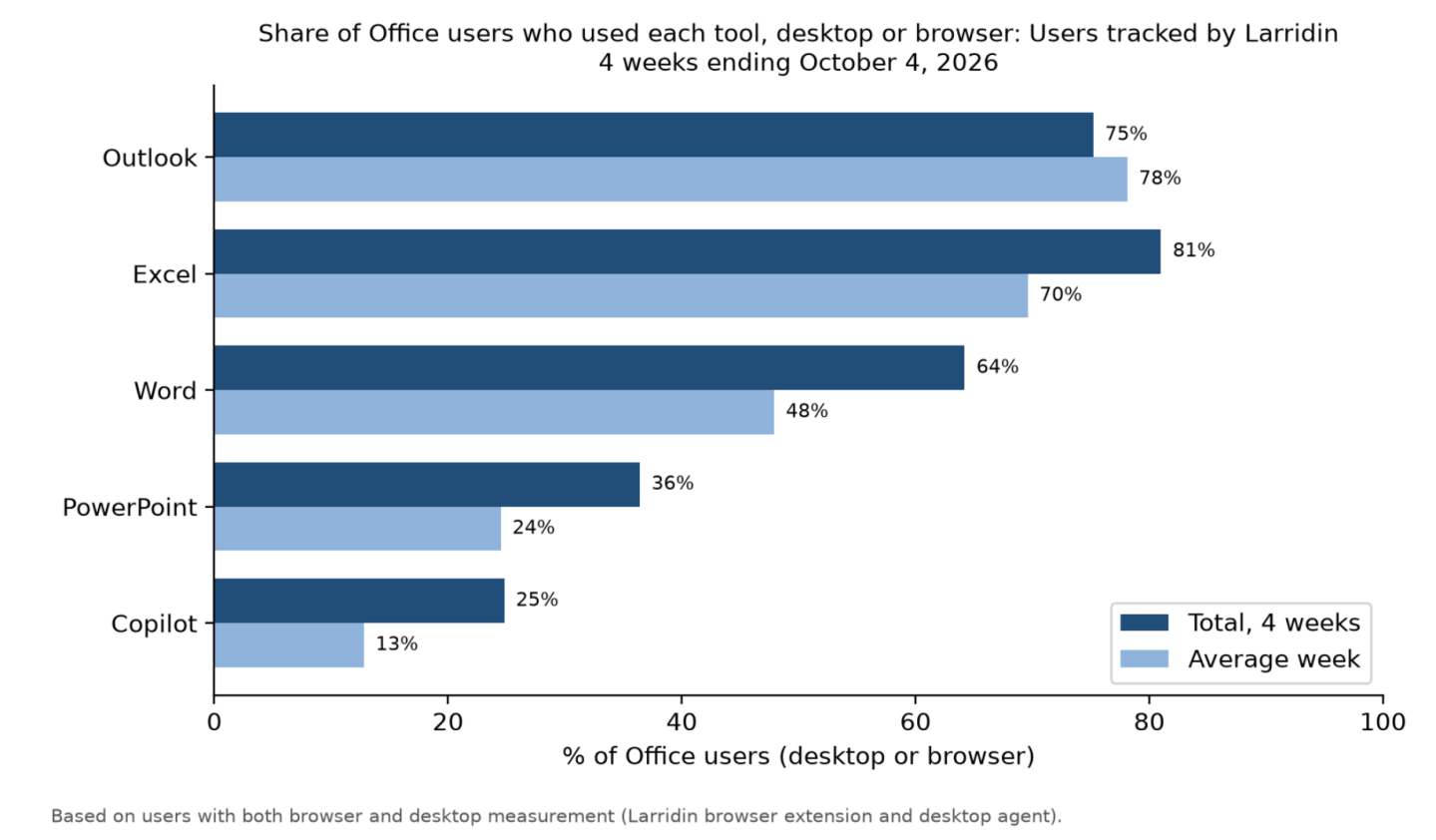
The percentage of Microsoft’s paying customers who use Copilot, the company’s AI model. Microsoft has said it has 30 million paid Copilot seats, but data from AI measurement platform Larridin shows that most employees don’t use it. Larridin found only 13% of Microsoft Office users accessed Copilot per week, and 75% didn’t access it for more than four weeks. By contrast, 70% used Excel and 78% used Outlook.
THE FRONT PAGES TODAY
Anthropic commits 5% of shares to ‘public benefit’ fund – FT
Putin reportedly suggests summit with Trump and Xi to decide fate of Ukraine – CNBC
Trump’s sinking approval leaves GOP candidates in a bind – Axios
A Hedge-Fund Billionaire’s Two Bitter Wars—Against His Wife and His Business Partner – WSJ
AI Firm Nscale Faces Investor Pushback Over IPO Valuation – Bloomberg
O.J. Simpson, a Secret Informant and a Decades-Old Mystery – NYT
ONE MORE THING
Despite making over $200,000 a year, many NFL referees still hold full-time jobs as attorneys, aerospace engineers, and college professors
From August to January, NFL officials travel weekly across the country—and sometimes abroad—to oversee some of the world’s most-watched sporting events. But when the final whistle blows, another job is often waiting for them the next morning, Preston Fore reports.
Many of the NFL’s 121 officials hold full-time jobs outside football: Clete Blakeman is a personal injury attorney in Nebraska, Brad Rogers is a senior lecturer at Texas Tech University’s business school, and Shawn Hochuli is a California-based financial advisor.
But these aren’t just side hustles to supplement their NFL paychecks. Referees earned an average of $205,000 a year in 2025, on top of a reported 10% increase in per-game pay in 2026. Many officials built careers in other fields before reaching the NFL—and continue to pursue them alongside football.
- Would you like to sponsor this newsletter? Contact advertising@fortune.com for details.
-
➡️ If you would like to receive this information in your inbox every morning before the markets open in New York, sign up here.
Disclaimer : This story is auto aggregated by a computer programme and has not been created or edited by DOWNTHENEWS. Publisher: fortune.com