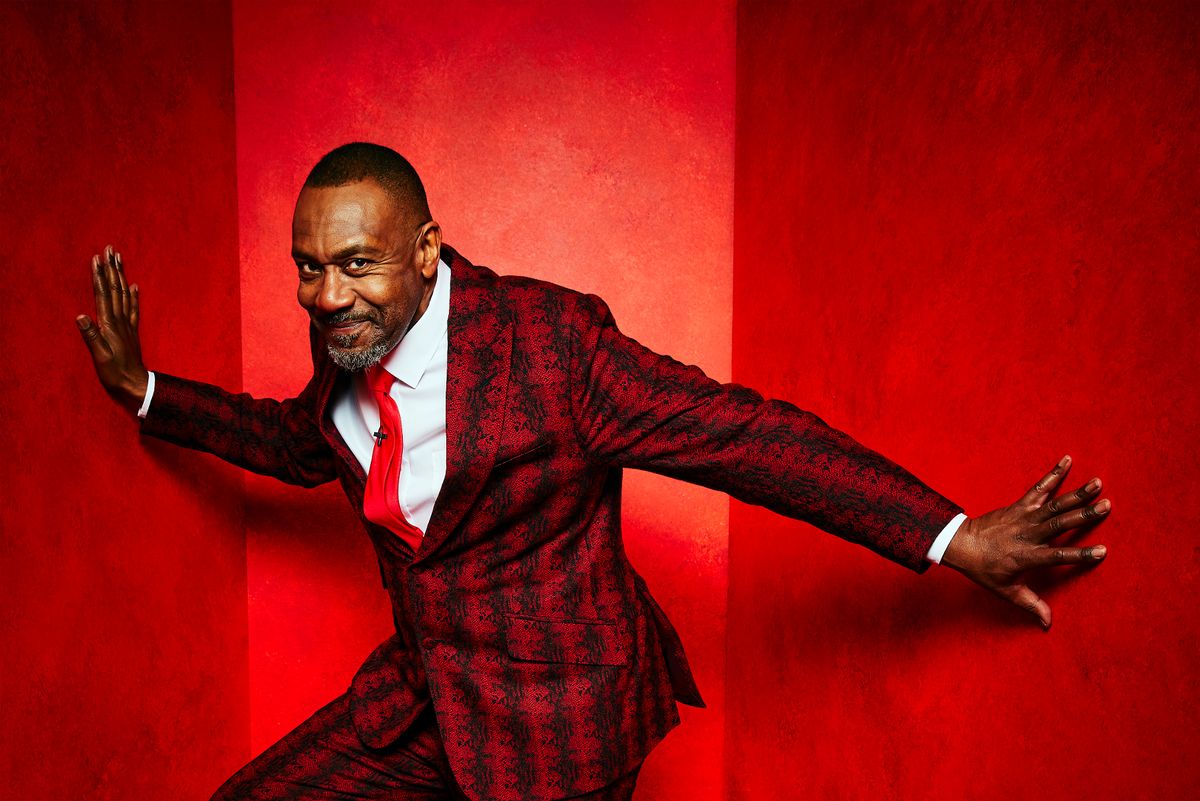
Comedy legend Sir Lenny Henry. has opened up on the moment he found out his dad wasn’t his biological father – and it turned his entire world upside down
Sir Lenny Henry has revealed the moment he found out his ‘dad’ wasn’t his real father felt like “being hit by a truck”. Born to Jamaican immigrant parents, Winifred and Winston, Henry was raised in Dudley in the West Midlands but later discovered that his biological father was actually Albert Green – a man he always thought was simply a family friend.
Speaking on Tuesday night as part of a series of events celebrating the 50th anniversary of London’s Riverside Studios, he lifted the lid on his colourful life and career, including his modest upbringing in Dudley – and the moment that “turned his world upside down”.
The beloved comedian, 67, said: “I had this bombshell dropped in my life, and I… played amongst the ruins – hoping it would all work out in the end. And you know what? It did.”
Explaining that his mother had come to England by boat in the mid-50s, at the behest of her cousin Clifton, who promised her she could get “good money” in Britain, her story went on to form the basis of his 2023 ITV drama, 3 Little Birds.
She left her husband and sons, Seymour and Hilton, behind in Jamaica until they could raise the funds to get them all over – but as Henry recalls, ‘Big Winny’ fell swiftly sick in cold, dreary Britain. “She caught pneumonia, thought she was going to die. And the person who was above her room in these digs was called Albert,” said Henry. “Albert knew she was sick, and he was very good. He’d make her soup. When she got better he said, ‘Let me show you around Dudley. You don’t know the place.’ “He showed her where to work – the factory she might get a job. He showed her all the pubs. He took her to dance halls in Birmingham. Eventually, they fell for each other – and I was the result.”
Lenny’s mum wrote a letter to Winston explaining the predicament she was in, which Henry recalled in his typically comical manner. “She wrote, ‘Dear Winston, you ought to know… things are happening over here. If you don’t want to be with me, you can stay where you are in Jamaica. But I’m expecting a baby.
“Obviously, it’s not yours. But I want to keep it. If you don’t want to be with me, that’s fine, you can stay there. But if you can forgive me, come over and we’ll make it work..”
Henry’s dad did come home and indeed made a go of it, but as the comedian recalled with a wry smile, he hadn’t quite “forgiven” – and he believes it’s what led to some of their furious arguments at home, which often got physical.
“Jamaicans fight with their fists,” he said, adding that one of his first ever memories was standing in his cot, watching on open-mouthed as his parents “punched each other’s lights out”.
His mum, he said, was extremely strict and would sometimes hit Henry and his siblings, though his dad never raised his hands to them. “I know people don’t like it. A lot of black journalists have criticised me for talking about it, but it’s my life, it happened to me. So I feel like I can talk about the time she hit me in the face with a frying pan, and it retained the shape of my face.”
Henry knew nothing of his biological father for many years. As he said, “Winston was my dad – he raised me.” He had seen Albert ‘around’, until at one point aged 10, his mum told him he needed to go and meet Uncle Bert’ on Fridays to help with some chores.
“I’d never met this guy before. I said, “Good evening,” and went in. He had the hat on, he made chicken and rice, and it was great. So I started to see him every Friday. I’d take chores like Cinderella – I’d hoover, clean the windows. He’d give me two and six, which was a Cadbury’s chocolate bar and a can of Coke — and that was the level of our relationship.”
That went on for a while until at the age of 12, Bertie’s son Lloyd told him the truth. “One day, Lloyd turned to me and said, ‘You’ve got no idea why you’re here, do you?’ I said: ‘No.” He said: ‘That’s your dad.'”
Recalling the physical effect of this bombshell news, Henry said, “I was starting to shake. It was like somebody flipped me upside down.”
It took him five minutes to run full-pelt home, and ask his mum if it was really true. “She was in the kitchen. She looked at me and slowly went, ‘Yes. We thought, let’s just get to know him first.’ And… that was that.”
Henry said his attitude towards Winston changed after that. “I respected him more, not less. You know those documentaries of kids during the war, playing on bomb sites, with stuff going on they don’t have any clue about? That was me.”
Speaking of his childhood home, Henry recalled how their corner terrace was actually built ‘directly above a cesspit.” “Our house was on top of everybody else’s waste in the street. In the rainy season we’d literally be walking through the whole street’s muck. Our mum bought it for three grand.”
Growing up, they had no toys or money, but Henry clearly recalls his childhood – where he shared a room until he was 14 – with amusement, and fondness. “Instead of G.I. Joe, we had Joe. Instead of a cool rocket, we got cheap ones with such sharp edges we could have sliced your palm!”
Racism was always a dark shadow, he recalled. As a teenager, he followed his mum’s wishes for him and his siblings to ‘integrate’ and eat food given to hm by friends’ parents “even if the portions are too small”.
Henry remembered three white friends who he became close to. “We’d go to these country pubs, and the place would empty out, people would just walk out – they didn’t want to be in the same room as a black person. I didn’t really notice or wonder at why the pub was half-empty – I just thought, we had more choice on the jukebox.”
Speaking of New Faces, the talent show he won in 1975 with a series of impressions – most notably Frank Spencer, which skyrocketed him to TV stardom at just 16, he says dad Winston cried happy tears, but only gave him one piece of advice. “Keep your feet on the ground.”
He’s relieved he survived the first years of his career after shooting to fame as a teenager, though he does have some regrets – namely, the BBC’s Black and White Minstrel Show.
“I’d make mistakes, sure. But that’s how you hone your craft. I was in a minstrel show, for Christ’s sake. I did a club tour and they were fantastic people. But it was just a weird dichotomy to be the only real black kid in a minstrel show. It hurt me a lot. It was tough, but I managed to survive that.”
Going on to discuss a varied career, which also saw him take on serious acting, including his acclaimed turn as Othello in 2009, Henry says his father’s advice about staying grounded has stayed with him. He still gets “huge moments of imposter syndrome” such as hosting the Olivier Awards in 2015 – when he was so nervous his partner, theatre director Lisa Makin, who he ‘s been with since 2013 following his marriage to Dawn French, had to mouth at him from the audience to “slow down”. The greatest lesson he’s learned in life and 50 years in showbiz, he says, is how failure is part of the journey – quoting playwright Samuel Beckett: “Ever tried. Ever failed. No matter. Try again. Fail again. Fail better.”
For what’s on at Riverside Studios, see riversidestudios.co.uk.
Like this story? For more of the latest showbiz news and gossip, follow Mirror Celebs on TikTok , Snapchat , Instagram , Twitter , Facebook , YouTube and Threads .
Disclaimer : This story is auto aggregated by a computer programme and has not been created or edited by DOWNTHENEWS. Publisher: mirror.co.uk