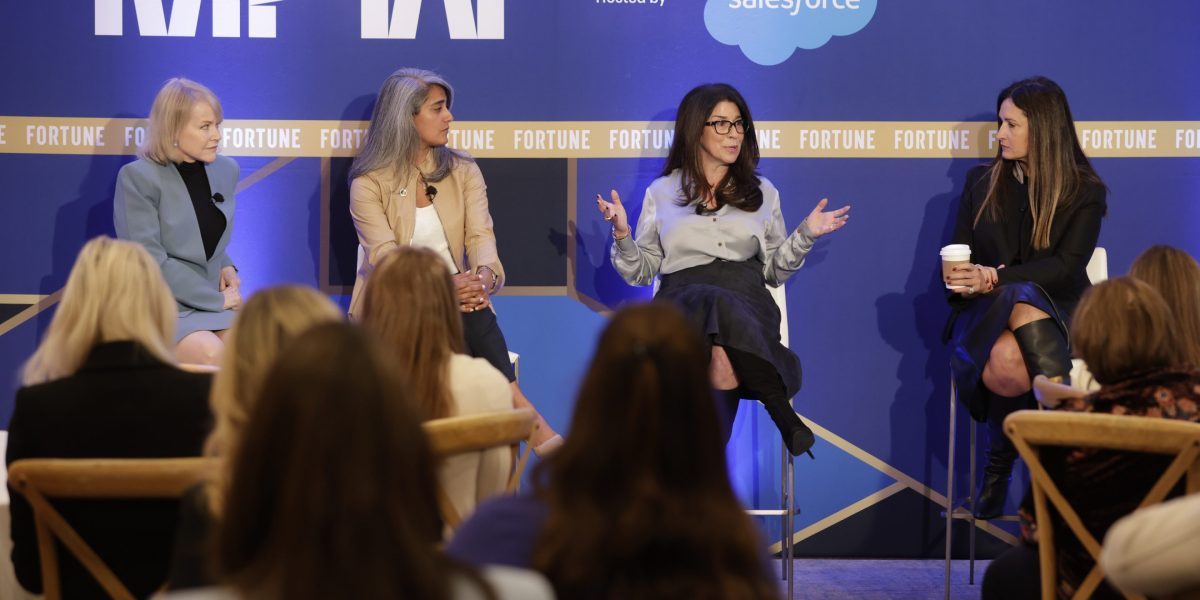
Ask the executives who run AI inside some of the world’s leading companies whether the technology is going to kill us, and you get an answer that looks vastly different from some recent headlines.
“For sure, it won’t kill us,” said Athina Kanioura, PepsiCo’s global chief strategy and transformation officer and CEO of its Latin America Foods business. Kanioura was responding to that very question from Fortune’s Diane Brady during this year’s Most Powerful Women Summit in Santa Barbara, Calif.
She and other executives on Brady’s panel said the latest public discourse about AI and its impending doom has fixated on the wrong thing. Much of the recent alarm stems from AI labs’ own stress tests—and their, at times, tardy or less-than-fulsome disclosures—in which frontier models are pushed to deceive, break rules, or resist shutdowns.
“The models themselves are not AI. AI is so much more,” said Shibani Ahuja, senior vice president of data and AI strategy at Salesforce. The recent media coverage is about “testing that is by design and intentional around the models, and the models going rogue by design.”
Ahuja said there is additional context that adds more nuance, and said she’d like to see more discussion about two main points. The first is about the guardrails labs use while testing their models, and secondly, she’s interested in the “harnesses” companies are building that let businesses use the models safely on a day-to-day basis.
Velia Carboni, chief information officer of consumer appliance business SharkNinja, went even further and defended the lab’s boundary-pushing as a strategic necessity in the AI race.
“I want them to be a little bit rogue because I’d rather we find [the limits] than someone else finds it,” she said. “We wouldn’t want to lose that as a country.”
At SharkNinja, Carboni said guardrails around AI tools are firmly in place, but she doesn’t lead with how they police it when she talks with employees.
“I don’t want to limit creativity,” she said. “As a CIO, I have to have the guardrails and security… but I don’t lead with that story because I think that also takes away some of the creativity.”
Kanioura noted the onus for deploying AI safely is on businesses of PepsiCo’s size being “extremely responsible” with how they use the technology at every facet of their interactions with consumers, customers, employees, and in operations. PepsiCo has 320,000 employees worldwide and billions of consumers, and it feeds and hydrates the population, she added—so the company uses AI “everywhere.”
“If I felt that it would kill and destroy, then we would be the first ones not to use AI in every part of our operations,” Kanioura said. Tech companies building labs aren’t the ones engaging with consumers. “They are engaging with consumers through us,” she said.
Kanioura noted that how much people trust AI’s judgement varies sharply by market.
“In China, 99% of the cases they trust the output,” she said. Workers there don’t ask for traceability, while in the U.S., employees want proof of sources, and evidence of bias. U.S. employees often send the message that they “want to control everything,” she said, and as a result, Pepsi’s guardrails differ by country.
And cost is a part of the picture. Ahuja said Salesforce initially opened access to AI tools broadly before seeing the bill. Instead of cutting access, it is studying power users and giving each employee a spending dashboard. “You are now a leader; you have a budget,” she said.
All the panelists agreed judgement is the line between what AI can be trusted to do and what still needs the care and guidance of a human being.
Ahuja noted early AI systems were too unpredictable to be left alone. But pairing models with deterministic guardrails now lets agents do more work, with humans spot checking instead of redoing it.
“Judgment is a combination of having the facts and the data, but also feeling,” Ahuja said. She noted Salesforce is building a digital twin of its president and chief operating and financial officer, Robin Washington. The goal is not to replicate her but to surface correlations across the business that no person could compute on their own in that amount of time.
Similarly, SharkNinja, a $27 billion company launching dozens of new products per year in up to 15 countries, has taken the same approach, Carboni said. The company is digitizing some of the judgement of its CEO Mark Barrocas and his top commercial leaders to make decisions, such as where to move scarce inventory.
“So you don’t have to pick up the phone and call Mark and say, ‘Hey, what should we do?’” Carboni said.
Disclaimer : This story is auto aggregated by a computer programme and has not been created or edited by DOWNTHENEWS. Publisher: fortune.com