
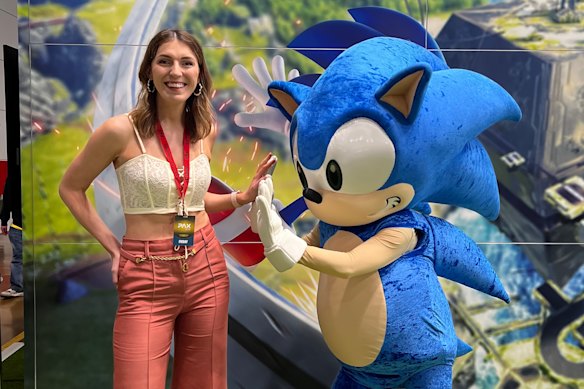
Melanie Bracewell has a hidden talent. At work, she’s a celebrated host and hilarious stand-up comic. At home, she’s a decorated gamer.
“I really got into this game called TFT [Teamfight Tactics]. At the beginning of this year, I reached Challenger, which means I’m top 100 in Oceania,” the Cheap Seats host says. “I go to PAX in Melbourne every year where they run casual competitions, but I don’t take it very casually … We’ve got a whole stash of medals now.”
She’s levelling up this year, having been invited to one of the world’s biggest TFT tournaments in Las Vegas. “I’m so excited. It’s this massive tournament that sells out in seconds, so it’s surreal that I’m going. I’ve never been to Vegas before, and it’s to go play video games.”
Bracewell loves video games, but they’re ultimately still just a hobby. For other Australians, though, gaming has become a full-time job – and a lucrative one at that.
Anathan “ana” Pham, a Melburnian professional Dota 2 player, won $4.62 million in a 2019 Shanghai tournament, making him the fourth-highest earner on the Esports earnings leaderboard. After about six years of competitive playing, Pham had reportedly made roughly $8.33 million and retired by 2021. He was only 21.
These wild trajectories aren’t surprising, says founding president of Esports Australia Darren Kwan. As the competitive arm of video games, it’s on par with physical sports such as the FIFA World Cup.
“Like other sports, there are referees, rules, a code of conduct,” Kwan says. “That’s why we call it the sport of playing video games because there’s the recreation side and then there’s the sports structure.”
Today, Kwan says there are about 300 million people worldwide with an interest in Esports, from collegiate gameplay to professional tournaments. The number of fans who tune into tournaments rivals that of major traditional sports. For example, The League of Legends 2023 World Championship peaked at more than 6.4 million viewers. Last year’s AFL grand final, by comparison, attracted a total national TV audience of 4.08 million.
Esports tournaments have gained significant lucrative backing, too. They’re sponsored by an array of brands, from Red Bull and Coca-Cola to Louis Vuitton and Mercedes-Benz. At this year’s Esports World Cup, prize pools ranged from $US500,000 to $US3 million. Meanwhile, the prize pool at the Valorant Champions, set for Shanghai this month, is $US2.25 million.
So, how is it that playing video games – long considered a mere pastime – has transformed into such a popular and lucrative sport?
Given the current size of the video game industry, a competitive branch was inevitable. Kwan says that 98 per cent of Australian households contain some kind of gaming device. Further, digital games development in Australia over the past decade increased by an average annual growth rate of 13.1 per cent.
“Interest in gaming begins in the schoolyard … But as generation after generation keep absorbing and getting involved in that culture, it’ll keep developing and will stand alongside those world sports,” Kwan says.
Esports is largely community-driven, with many games connecting players who share similar interests in leagues of various levels.
“It’s very inclusive, and that inclusivity isn’t just about physical ability,” Kwan says. “It’s also economic participation – there’s less travel involved. The power of the internet being so accessible for everyone, it puts people on a level global playing field.
“It’s also super accessible when you think of geography, like people in Melbourne and Sydney can be playing together every night. So, you’re really interconnecting communities who otherwise, if in other sports, might not have been able to.”
Australian Counter-Strike 2 player Vivienne Quach, known online as BiBiAhn, met most of her friends through Esports, including her partner, who she now lives with in Chicago.
“I was able to meet many people who I consider family now,” the 23-year-old says. “But also growing up, it was a nice escape because I wasn’t the best at school. Counter-Strike was pretty much the only thing I was talented in and that I enjoyed doing day-to-day. Esports has built pretty much everything around me.”
The origins of Esports
Competitive gaming can be traced back to the 1970s, with tournaments for early games such as Spacewar! This continued into the ’80s with Atari arcades. However, senior lecturer at the RMIT school of design Dr Emma Witkowski says it truly took of in South Korea with StarCraft (a type of Esport) and the ’net cafe boom.
“Just like football is the everyday sport of Brazil, StarCraft really became the everyday sport in Korea,” she says. “From there, sponsorship became the thing that drove it … We saw a sort of institutionalisation and really hectic commercialisation [of Esports], but also a growing community getting involved.”
The 2010s brought platforms such as YouTube and Twitch, which exposed a far broader demographic of people globally to Esports, further revolutionising the space.
When people hear the word “Esports”, however, they usually think about the exorbitant prize pools. Alex Richmond, an 18-year-old professional Fortnite player known as “alexfn”, won $39,000 from one competition at just 13. He went on to win eight Fortnite Championship Series – more than any other Fortnite player in the world.
“It’s more of an actual job opportunity now,” says Richmond, who plans to pursue Esports full-time after graduating. “When I was younger, Esports was definitely looked down upon. But now, there are more success stories of those who have gone into Esports and made a living from it.”
Brands have also recognised the opportunity Esports’ massive fanbase offers. Declan Willmott (aka “Resignz”), a 19-year-old Fortnite competitor from NSW’s central coast, says the Esports organisation he’s part of, PWR, is sponsored by Red Bull, video game controller brand Nacon and gaming equipment company RIG.
Esports has become a brand in and of itself, with players such as Willmott moving into Esports content creation houses around Australia to focus full-time on training and uploading Esports-related content online.
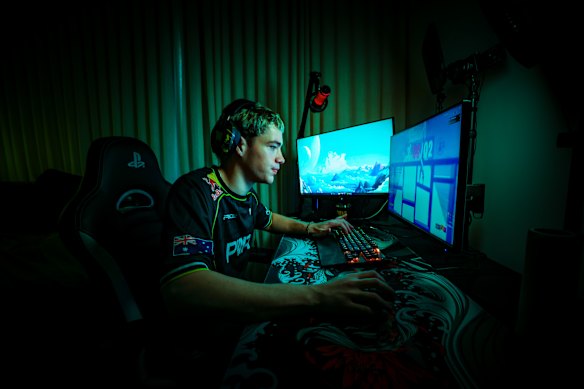
“Esports has 100 per cent changed my life and my family’s life,” Willmott says. “Financially, it has let me help my family. It’s even helped me help my friends. That motivates me to keep doing it,” says the gamer who began competing seriously in 2021 and boasts a world record in points and elimination in a Fortnite Championship Series.
The Australian Esports market is smaller than those of South Korea, Indonesia, China and the US, but Kwan says this is generally because of the country’s smaller population. Today, about 1 million to 2 million Australians are interested in some form of Esports.
Despite the smaller market, Australian Esports players rank as some of the best in the world.
“There are many global players who are Australian, some of whom play for international teams,” Kwan says. “We’ve probably got a higher distribution of pro players per capita than most countries, so we’re swinging pretty well on that front.”
However, many of Australia’s best players move to the US, Europe or Asia to seek greater opportunities or to join tier-one teams. Pham, for example, moved to Shanghai, and Quach moved to Los Angeles, then Chicago.
Gender diversity has also proven an issue, not just in Australia but globally.
“There’s a lot of female presence in Esports, especially when it comes to games like Valorant or League of Legends. But Counter-Strike, not so much,” Quach says. “It’s just the nature of the community – it’s not that welcoming. There are women who try to break through, and you have to cut out that negative side to just essentially play the game. There’s definitely a lot of work to be done in the CS2 community.”
Esports Australia chairperson Dr Emma Witkowski says much of it has to do with Esports spectators. While some games attract a more gender-diverse crowd, many audiences are still male-dominated. This, in turn, affects how players are perceived and supported.
“Who turns up really matters,” she says. “If women want to see more professionalisation of the women’s space, that’s where people need to put their dollars but also their eyeballs. The audience matters.”
Regardless of its teething issues, Esports has proven itself to be a behemoth in the professional sports space, one that will probably continue to grow as mega prize pools and glitzy sponsorships draw crowds. Officially no longer just a pastime, gaming is a world of opportunity.
Find out the next TV, streaming series and movies to add to your must-sees. Get The Watchlist delivered every Thursday.
Disclaimer : This story is auto aggregated by a computer programme and has not been created or edited by DOWNTHENEWS. Publisher: www.smh.com.au



