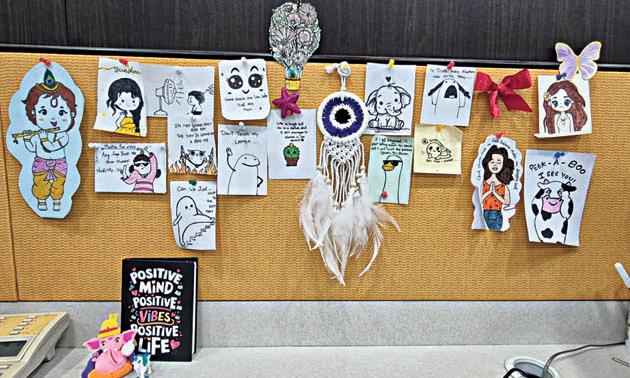
In a world where almost everything can be autotyped, saved and synced in a jiffy, some youngsters are choosing to slow down and reach for their notebooks. From neatly maintained journals to messy pages filled with thoughts, lists, sketches and half-finished sentences, handwritten diaries are quietly finding their way back into the lives of digital natives. Some write in the morning, others at night.
The resurgence of handwritten notes is not necessarily about rejecting technology, it is more about creating a ‘safe space’ where technology cannot follow. “I started journaling because I was tired of having everything on my phone,” says Aditi Sharma (24), who has been maintaining a handwritten diary for three years. “When I write, I don’t feel like I have to respond to anything. It is just my space.”
More Than A Note
Digital notes are undoubtedly convenient. A thought can be typed in seconds, searched later and accessed across devices. Yet, for some youngsters, that convenience is precisely what makes handwritten journaling attractive. “There is a sense of slowing down when you write by hand,” says Dr Jaya Vijay, psychologist. “It can create a deliberate pause between what a person is thinking and how they express it. For some people, that process can help with reflection and emotional expression.”
Real Page-turners
Research on journaling has found potential benefits in areas such as psychological well-being, although the evidence varies depending on the type of journaling and the condition being studied. For young people constantly surrounded by screens, a notebook can therefore become a small digital-free zone.
Mahi Khot (23), a journal keeper, says this is one of the reasons she continues to write by hand. “I keep my phone away when I journal. Otherwise, I will start writing and five minutes later I’ll be scrolling. With a notebook, there is nothing else to do except write,” she says. The habit also allows people to be unfiltered. A diary does not need to be grammatically correct, aesthetically pleasing or suitable for public consumption.
Beauty Of Imperfection
Perhaps one of the biggest differences between journaling and posting online is that nobody is expected to see the final output. There can be crossed-out sentences, terrible handwriting, unfinished thoughts, doodles and pages that make sense only to the person who wrote them.
For writer Rajas P, that imperfection is part of the charm. “A diary is one place where you don’t have to sound intelligent, articulate or even make sense. You can write badly, change your mind halfway through a sentence and leave a thought unfinished. That honesty is what makes handwritten journaling special,” Unlike a social media post, a handwritten page does not need an audience. It does not need likes, comments or approval.
The Stationery Pull
The revival of writing is also creating renewed interest in the things that surround it notebooks, fountain pens, coloured pens, stickers, washi tapes, planners and journals. Mayuresh Parmar, owner of Modern Stationery Store, says younger customers are increasingly looking at stationery as more than just a functional purchase. “Earlier, people mainly came looking for school or office stationery. Now, young customers specifically ask for journals, aesthetic notebooks, planners and different kinds of pens,” says Parmar. The trend reflects a broader shift towards stationery as a form of creativity and personal expression, with young consumers increasingly drawn to products that allow them to personalise their writing experience.
Social Media’s Irony
Social media has paradoxically played a role in making this offline habit visible. Images of carefully arranged journals, handwritten pages, stationery collections and “journal with me” videos have created an aesthetic around writing. But beneath the Instagram-friendly pages is a simpler motivation: the desire to have something that belongs only to oneself.
No Rules Attached
Not every diary is carefully curated, either. Some people write three pages every night. Others write only when they are overwhelmed. Some fill notebooks with gratitude lists and daily reflections, while others use them for angry rants, dreams, plans or things they would never say aloud. There is no format to follow and, perhaps, that is precisely the point.
A Record of Time
There is also something deeply personal about being able to return to an old notebook. Years later, a digital note may simply remain another file among thousands. A handwritten diary carries the physical evidence of the person who wrote it. The handwriting changes. The ink fades. The pages become worn. Together, they create an unintended record of time.
The Slow Comeback
Perhaps that is why the handwritten diary continues to survive despite everything that technology has made easier. Young people are not necessarily abandoning their phones for notebooks. They are simply drawing a boundary around a small part of their lives — one word at a time.
Read Between The Lines
• A handwritten diary does not buzz with notifications.
• Research on journaling has found potential benefits in psychological well-being.
• Writing has revived the sale of notebooks, fountain pens, coloured pens, stickers, washi tapes, planners and journals.
A diary is one place where you don’t have to sound intelligent, articulate or even make sense.”
Rajas P, writer
“There is a sense of slowing down when you write by hand. It can create a deliberate pause between what a person is thinking and how they express it.”
Dr. Jaya Vijay, Psychologist
Disclaimer : This story is auto aggregated by a computer programme and has not been created or edited by DOWNTHENEWS. Publisher: deccanchronicle.com