Citizens from a small group of countries can enter Germany freely and then apply to change their Schengen visas to longer-term residence permits. For everyone else it’s a bit more complicated.
There are two groups of nationals who can enter Germany freely without first obtaining a visa.
The first group consists essentially of European nationals — that is EU, EEA and Swiss citizens who enjoy full freedom of movement, not requiring either a visa or residence permit to enter, live, or work in Germany.
The second group are the citizens of countries listed in Annex II of the EU Visa Regulations, who are free to enter Germany as well as the Schengen Area for short stays.
But among this second group, the rules for applying for a visa to work or to study differ, with citizens of some countries able to exchange their short stay visa for a work or study visa directly in Germany while others need to apply from their home country through a German embassy or consulate.
So, for those thinking about moving to Germany for a longer stay, here’s who needs to apply ahead of time and who can just show up with a valid passport.
No worries for Europeans
As mentioned above, EU EEA and Swiss citizens have their right to reside in Germany enshrined in EU freedom of movement law.
They are not subject to the 90-day limit that applies to other nationals visiting the Schengen region, and are generally free to work and study.
Countries with visa-free entry for short stays
EU law maintains a list of countries whose nationals can freely enter the Schengen Area without a visa.
This is known as Annex II. Specifically it lists the “third countries whose nationals are exempt from the requirement to be in possession of a visa when crossing the external borders of the member states for stays of no more than 90 days in any 180-day period.”
This includes: Albania, Andorra, Antigua and Barbuda, Argentina, Australia, Bahamas, Barbados, Bosnia and Herzegovina, Brazil, Brunei, Canada, Chile, Colombia, Costa Rica, Dominica, El Salvador, Georgia, Grenada, Guatemala, Honduras, Hong Kong SAR, Israel, Japan, Kiribati, Macau SAR, Malaysia, Marshall Islands, Mauritius, Mexico, Micronesia, Moldova, Monaco, Montenegro, New Zealand, Nicaragua, North Macedonia, Palau, Panama, Paraguay, Peru, Samoa, San Marino, Serbia, Seychelles, Singapore, Solomon Islands, South Korea, St. Kitts and Nevis, St. Lucia, St. Vincent and the Grenadines, Taiwan, Timor-Leste, Tonga, Trinidad and Tobago, Tuvalu, Ukraine, United Arab Emirates, United Kingdom, United States of America, Uruguay, Vanuatu, Vatican City, Venezuela.
Nationals from all other countries must apply for a visa before they can legally enter Germany or the Schengen Area. For travel or a short stay this would be a Schengen visa (known as type C), and for longer stays or for work or study purposes this would be a German residence permit (or type D visa).
READ ALSO: EU agrees to launch digital-only Schengen visa application process
Who can enter freely for long-term stays?
Crucially not everyone who can enter Germany freely for a short term stay is entitled to change their Schengen visa for a longer-term residence permit within the country.
In most cases, applying for a national visa for long-term residence — such as an EU Blue Card, skilled worker permit, student residence permit or family reunification permit — must be done from a national’s home country.
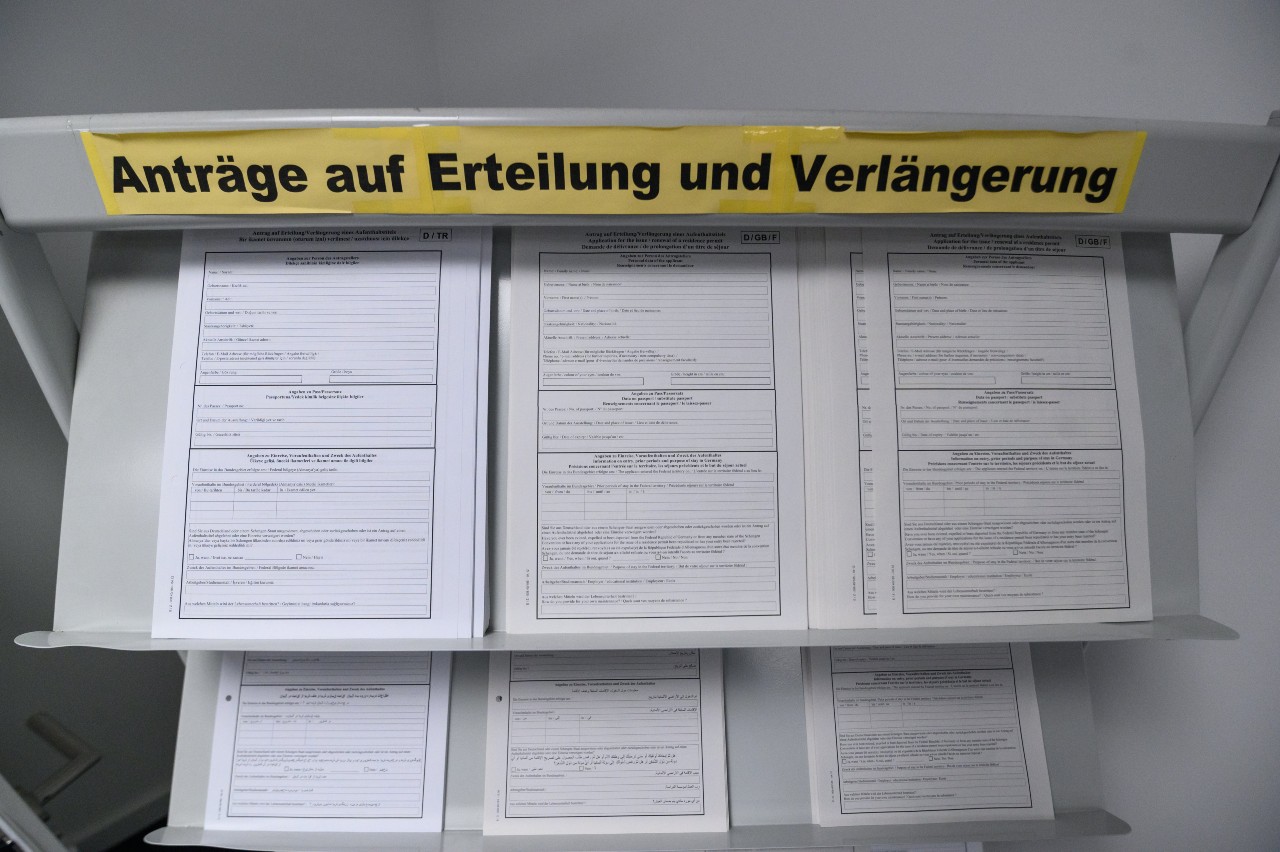
“Applications for issuance and extension” is written on a display stand with applications for residence permits. Any non-EU national planning to stay in Germany for longer than three months typically requires one. Photo: picture alliance/dpa | Jonas Walzberg
If a citizen from Argentina, for example, entered Germany without a visa for a short-term stay and then wanted to get a student residence permit to stay and study, they would need to return home to apply for that visa through their local German mission.
READ ALSO: Which residence permits qualify you for German citizenship?
A key exception here applies to citizens from just a few select countries; Australia, Canada, Israel, Japan, New Zealand, South Korea, the United Kingdom, and the United States.
Nationals of these countries are generally allowed to enter the country visa-free, and then may apply to change their visitor’s visa to a long-term national residence permit at an immigration office (Ausländerbehörde) in Germany.
Documents to carry
For nationals who qualify for visa free entry into Germany, at minimum you’ll need to carry your passport with you when you enter the country. Your passport needs to be valid for the length of your entire stay, ideally with at least three months validity beyond your planned departure date.
In some cases border authorities could request additional documentation to prove the purpose of your visit e.g. a conference registration or invitation letter for business travel, or documentation of a relationship for family visits.
Proof of sufficient funds to cover your stay, accommodation arrangements, travel health insurance and a ticket for onward travel could also be requested by border authorities. Visitors are generally expected to be able to provide these documents if requested.
For nationals requiring a visa to enter, or those coming with a D-type visa already applied for at home, you will need to bring your visa (or related paperwork) with you in addition to your valid passport.
ETIAS requirements incoming
An incoming change related to entry requirements is the implementation of the European Travel Authorisation and Information System (ETIAS).
ETIAS is a required pre-travel screening system linked to a traveller’s passport. It does not really change the rules around entry requirements as explained above, but adds an online authorisation step that must be completed before departure.
Airlines will be required to verify ETIAS authorisation before allowing passengers to board.
The implementation of ETIAS has already been postponed several times, but is expected to come into force by April 2027. So travellers planning to visit Germany from then on should factor in the ETIAS application regardless of their visa or exemption status.
READ ALSO:
Disclaimer : This story is auto aggregated by a computer programme and has not been created or edited by DOWNTHENEWS. Publisher: thelocal.de