LIV Golf was built on a foundation of defiance, greed, “grow the game” platitudes and — most significantly — unfathomable waves of money. But when the money ran dry, the defiance became an unsustainable strategy, the platitudes were as meaningless as a well-struck shot on a driving range.
LIV Golf has officially begun winding down via bankruptcy, bringing an end to the most disruptive era of any major American sport in decades. The final clear-the-course horn sounded in a New Jersey courtroom on Thursday morning after the league’s would-be creditor declined to offer LIV a lifeline. The wind-down process designed to address the demands of the league’s creditors will begin in the coming days.
Advertisement
BC Partners Credit, which had reached a tentative agreement to fund “LIV 2.0” with up to $300 million, withdrew that offer after LIV was unable to convince enough big-name players to sign on. Jon Rahm, Sergio Garcia, Graeme McDowell and numerous others decided not to follow LIV into its next iteration; Brooks Koepka and Patrick Reed had already cut ties after their contracts ran out.
The Financial Times reported that about 30 players had committed to the league’s new vision, a global, player-owned golf tour, with another 10 players — including some star names — on the fence about joining. But that apparently wasn’t sufficient for BC, which determined the league was no longer a viable operation.
The breakaway golf series, initially funded by Saudi billions, altered the entire trajectory of golf, drawing battle lines between colleagues, injecting billions into the sport, increasing purses, changing the makeups of the Ryder Cup and all four majors, and, eventually, reshaping the PGA Tour’s entire schedule. But after Saudi Arabia withdrew its financial backing, LIV Golf simply couldn’t continue as an independent operation in the high-stakes, high-cost world it had helped create.
LIV Golf took the sport on a wild, expensive ride, one that fundamentally altered every element of the game. Its impact on golf, as a sport and as an institution, will last long after anyone remembers what a “Range Goat” was, but not in the way its founders intended.
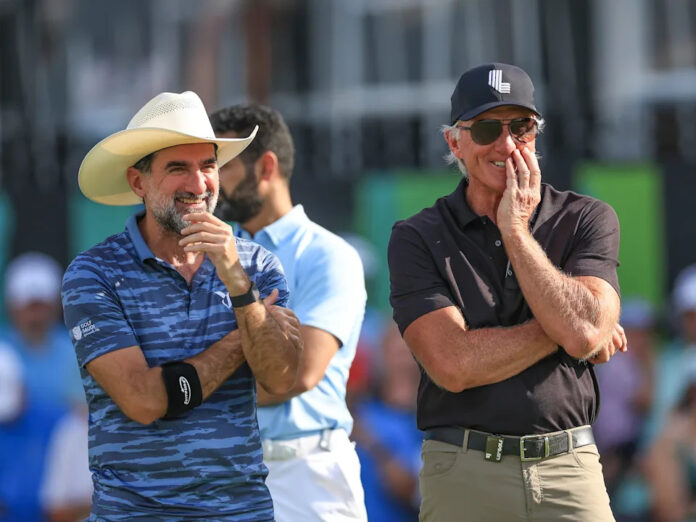
Yasir Al-Rumayyan, Chairman of Saudi Arabia’s Public Investment Fund, with Greg Norman during a 2024 LIV event in Dallas.
(David Cannon via Getty Images)
The arrival of LIV Golf
Truthfully, with its rebellious, in-your-face, golf-but-louder origins, LIV Golf was always doomed right from the start. Golf as a pursuit is intensely individual, golf as a sport is overwhelmingly personality driven, but golf as a business is, and has always been, an establishment, risk-averse, lower-case-c conservative operation.
Advertisement
So when LIV Golf — funded by Saudi Arabia’s Public Investment Fund, personified by noted provocateur Greg Norman — thundered into the golf world in 2021, it hit like a bowling ball thrown on a table of pimento cheese sandwiches. Limitless money! Chill attitudes! Live music! So much money! Dance parties! Neon everywhere! And did we mention the money?
The LIV plane almost never made it off the runway. Phil Mickelson gave away the entire game in late 2021, declaring that he was willing to go into business with the “scary motherf—s” — a phrase that now lives in golf infamy — of Saudi Arabia to take a bite out of the PGA Tour’s imperial dominance of the game. After considerable PR damage control, and more shovelfuls of Saudi riches, LIV began playing tournaments in 2022 with a distinctive roster of players.
LIV’s value proposition — sure, stick it to the man, whatever, but mostly the money — attracted many of golf’s most notable antagonists, along with known but past-their-prime stars drawn by a payday impossible to achieve anywhere else on earth. Dustin Johnson, Bryson DeChambeau, Brooks Koepka, Patrick Reed, Ian Poulter, Lee Westwood — each did the same performative “I have no comment” dance before acknowledging that, yes, they would be taking an eight- or nine-figure payday to jump to LIV.
In LIV’s earliest days, the breakaway circuit’s Saudi backing generated the most heat, with critics pointing to Saudi Arabia’s horrific human rights record. Players drew criticism from 9/11 remembrance organizations, and fumbled their justifications for taking Saudi money in cinematic ways. LIV was a prime example of sportswashing, using soft-power initiatives like sports to help scrub up the image of the autocratic petrostate.
Advertisement
And for a short while, it worked. With rare exception, LIV didn’t exactly draw massive crowds, either in person or on television. But the boundless wealth of the Saudi regime behind LIV was enough to catch the PGA Tour’s attention. Then-PGA Tour CEO Jay Monahan and Rory McIlroy, among others, framed the distinction between the two tours in moral terms, between tradition and short-term gain, between legacy and blood money. Lawsuits and accusations between the two tours flew, forcing everyone involved to pick a side.
However, the truth was far more complicated, and the moral stances far more fragile. The Tour realized that it was being drawn into an unsustainable financial arms race, and in June 2023, the PGA Tour and the Saudi PIF announced a cessation of legal hostilities and a “framework agreement” for future cooperation between the two.
The framework agreement caught the entire golf world by surprise. The fact that the framework agreement amounted to absolutely nothing, however, did not. The PGA Tour went ahead and sought outside investment to reduce its potential reliance on the PIF; LIV Golf went ahead and poached several players, most notably then-world No. 3 Jon Rahm, with hints that more defections were soon to come.
They weren’t.

Jon Rahm initially denied any intention on joining LIV Golf, but in late 2023 he made the move, which seemed to give LIV momentum.
(Manuel Velasquez via Getty Images)
Cracks beginning to show
Even as LIV continued to make steps toward legitimacy — Koepka had won the 2023 PGA Championship while a member of LIV, and DeChambeau captured the 2024 U.S. Open, and the majors agreed to extend limited invitations to LIV members — the breakaway tour couldn’t get traction in the United States. Events in both South Africa and Australia drew significant crowds, suggesting there was an unmet hunger for tournament golf in those nations. But stateside, LIV events dwindled toward irrelevance.
Advertisement
Through 2024 and 2025, some signs of hope emerged for LIV and its advocates. The Official World Golf Rankings agreed to give ranking points to certain LIV players, offering them a pathway back into the majors. And earlier this year, Augusta National chairman Fred Ridley thanked LIV by name in his closing remarks, an indication of the perch that the tour had ascended.
But at the same time, there were troubling signs. Just before the holidays in late 2025, Koepka began pursuing a path back onto the PGA Tour, and Reed followed soon afterward. The Tour offered a one-time-only pathway back for certain notable LIV members — Rahm and DeChambeau in particular — but no other player followed.
Then, in April of this year, the hammer dropped. Just days after the end of the Masters, the PIF announced it would be pulling all funding from LIV, effective at the end of this season. The move came as a total shock to LIV officials, who were forced to scramble for potential investment to keep operating as a leaner, less flush organization.
And the hits kept coming. Neither Rahm nor DeChambeau seemed publicly thrilled with the state of affairs at LIV. Although DeChambeau got involved with discussions with outside investors, he’s also a free agent and untethered contractually to LIV Golf. When the Saudis’ wealth vanished, so too did his leverage and his incentive to stay with LIV. The cancellation of one summer tournament under dubious circumstances, the mounting small-scale lawsuits, and the conspicuous lack of investor announcements all combined to darken the clouds over LIV.
Advertisement
Late in July, Cleeks captain Martin Kaymer indicated that there were serious concerns about whether the tournament’s season-ending championship would even happen at all. More ominously, the Asian Tour, which had been aligned with LIV, entered into a long-term agreement with the PGA and European tours, effectively cutting LIV out of the international tournament circuit.
Although LIV had sought to employ an open-door policy — its players could play on other tours in addition to their LIV commitments — the other tours didn’t reciprocate. The PGA Tour had a longstanding suspension in place for any player who teed it up in a LIV event, and when the DP World Tour also blocked LIV players from its tournaments in October, LIV lost yet another perk for its players.
From there, it was only a matter of time.

“Golf, But Louder” is shown on signage near the 17th hole during day three of LIV Golf: Greenbrier at The Old White Course on August 18, 2024 in White Sulphur Springs, West Virginia.
(Isaiah Vazquez via Getty Images)
LIV’s legacy
So what did LIV Golf bring to the game, and how did LIV change the game?
Advertisement
The circuit’s “Golf, But Louder” slogan never really stuck; turns out that most galleries and TV viewers prefer golf tournaments that focus on actual golf, not a Chainsmokers concert or a petting zoo. On a broader scale, LIV’s emergence turned golf into a cold, bloody pursuit of money, with tournaments and tours alike touting the massive sizes of their purses … which was good news for the players, not so much for the fans.
More broadly, LIV forced the PGA Tour to take a hard look at how it’s done business for the last 50-plus years. The result: an entirely new PGA Tour schedule with two different tracks of players, “champions” and “challengers.” The best and most notable players will definitely benefit from this new framework that begins in 2028, the lower-ranked ones, probably not.
On a less mercenary note, LIV’s greatest legacy is that it demonstrated there’s interest in golf far beyond the traditional American-European axis. LIV events in the Southern Hemisphere topped six figures in attendance; any tour that’s able to meet that need will surely thrive.
LIV Golf enriched players and destroyed reputations, forcing new perspectives on the game at great cost. It’s definitive proof that creating a legitimate rival sports league at this point in the industry’s growth is effectively impossible. It laid bare the mercenary soul at the heart of the sport. It deprived certain players of prime competitive years on the PGA Tour, but also made those players astronomically wealthy.
Advertisement
For years to come, LIV will be a case study in hubris and ambition, the power of wealth against the power of legacy. In the end, legacy won out … though not before millions were earned, and billions were spent. Golf is quieter now, but forever changed.
Disclaimer : This story is auto aggregated by a computer programme and has not been created or edited by DOWNTHENEWS. Publisher: Sports.yahoo.com