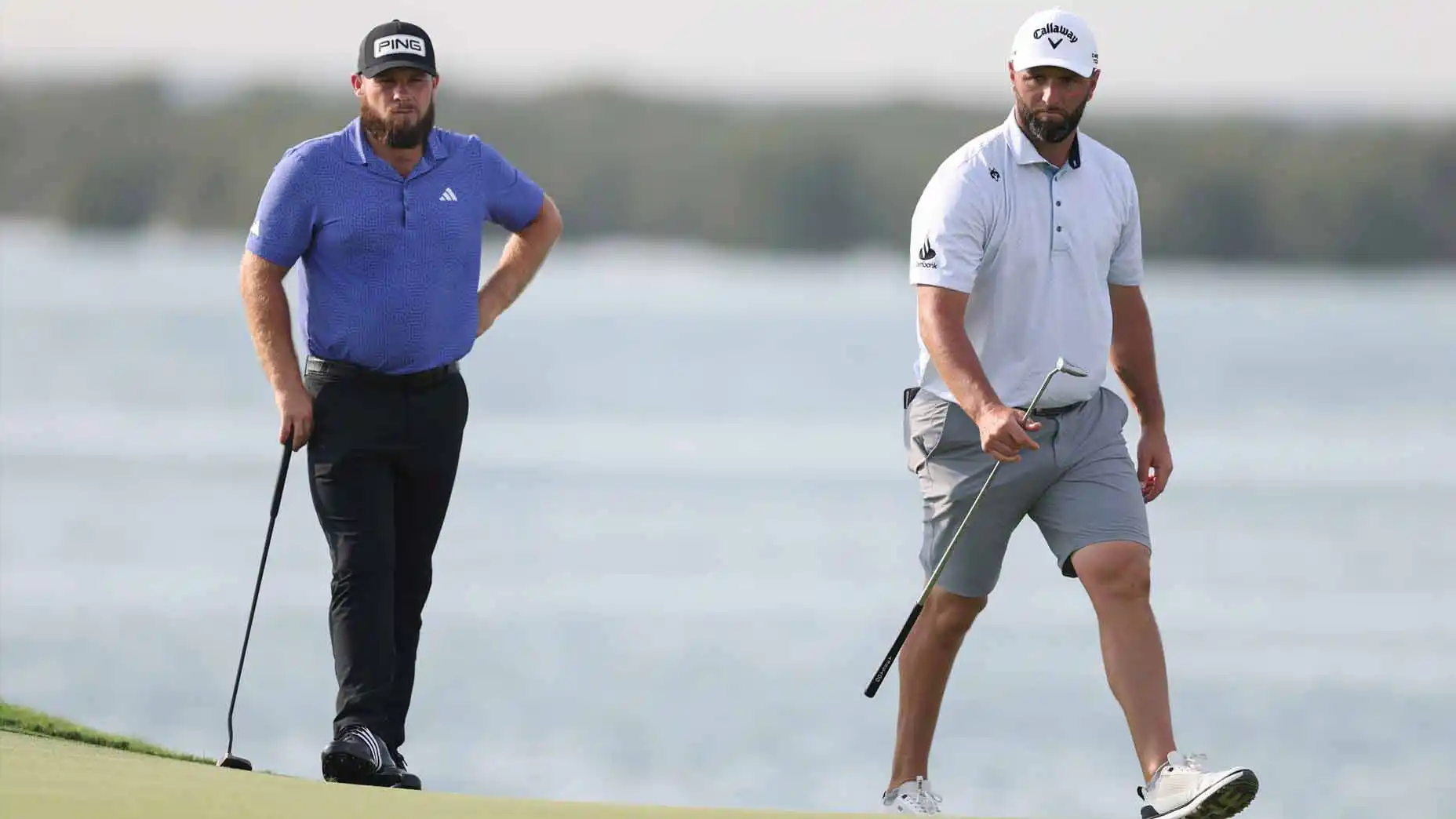
Facing what would become golf’s biggest question, Xander Schauffele said he wasn’t sure where he stood. Jon Rahm’s attorney had just announced his client’s departure from LIV Golf, and Schauffele, one of the faces of the PGA Tour, was asked about a road back for defectors like Rahm. He didn’t divulge his feelings on the matter, but his explanation for the obstacles ahead once the LIV threat officially ended would prove prescient one month later.
“I’ve got no idea,” Schauffele said at the Baycurrent Classic last month. “There are 225 guys with Tour cards and if you sat down and interviewed all of them, you’re going to get probably three or four boxes of how guys feel. Some guys don’t care, some guys are really ticked off, some guys want them to have a huge fine, some guys would let them back tomorrow. Where I stand in those boxes, I don’t really know. I’m in the sort of, I try to mind my own business most times.”
One month later, LIV’s lawyers announced the league was entering the liquidation process of bankruptcy and that LIV 2.0 would not be happening as planned. As the rebel league went from existential threat to dust-covered relic, players in Abu Dhabi and Los Cabos were asked about a path back for Rahm, Bryson DeChambeau, Tyrrell Hatton and everyone in between. As Schauffele noted, the world of pro golf might be coming together, but opinions on its biggest question are divided.
Rory McIlroy and Justin Rose have said they’d welcome LIV defectors back. Scottie Scheffler said that “penalties” must be paid, but he would like “some” of the LIV guys back. At the World Wide Technology Championship, a player on the other end of the spectrum had a different opinion.
“Go back to Q-school,” Erik van Rooyen told Golfweek’s Adam Schupak in Mexico. “We were told initially that if you played LIV, you would be banned from the PGA Tour, and the story just kept changing. They gave the finger to the Tour. If you’re that good, go get it done.”
In Abu Dhabi, player director Adam Scott agreed that players who left should have to earn their way back to the tour they want to play on, be it the PGA Tour or the DP World Tour.
“I think the fairest thing is that they all re-establish themselves in the system that they want to go to,” Scott said. “They left and gave up those privileges. So, you know, I think they should re-qualify themselves.”
Just before the end came for LIV, I asked Adam Scott about how their players should be reintegrated back into the PGA Tour and DP World Tour.
He thinks they should have to qualify: pic.twitter.com/Wbh2UbOCay
— Ben Parsons (@_benparsons) November 5, 2026
Lucas Glover said he’d welcome back guys like Rahm and DeChambeau if they meet the criteria set out by the PGA Tour. But like Scheffler, Glover doesn’t think the path back should come without a payment.
“I do think penalties need to be served,” Glover said in Mexico. “I don’t know what the stipulations will be. I’m not sure the Tour does, either. I’m not being coy about it. I just don’t know, and I don’t think they do either.”
This week in Abu Dhabi, Rahm teed it up for the first time since he announced his decision to leave LIV. When asked about 2027 and whether he plans to play a full DP World Tour schedule or try to return to the PGA Tour, Rahm said he hadn’t yet engaged the PGA Tour in discussions about his return. He understands that the “Returning Member Program,” which allowed Brooks Koepka to return and which he turned down, is likely not available to him, but he’s willing to pay whatever price commissioner Brian Rolapp sets to return.
“Obviously, Brooks was able to go back through certain circumstances,” Rahm said. “I don’t know if the possibility of that would be open for me or not, but if I have to fulfill a one-year suspension, I think it’s a pretty good position to be and worst-case scenario, I get to play on a wonderful tour for a whole year.
“Most likely, yeah,” Rahm said when asked if he’d take the Koepka deal if it were offered to him now. “Why not? Yeah, but it’s a big if. I seriously doubt I get offered the same deal that Brooks did. But yeah, if I got offered exactly the same penalties as him, I probably would do it, yes.”
Koepka had to make a $5 million charitable donation, forfeit player equity grants on the PGA Tour for five years and was ineligible for sponsor invites to the Signature Events in 2026.
The PGA Tour has not issued a statement since LIV announced it would be winding down, but Rolapp’s previous statements about the issue show he understands the tightrope he will have to walk with a membership that is littered with opinions about the players who left their tour, the value they bring if they return and what a proper punishment should be.
“When it comes to LIV players or anyone else who wants to be on the Tour. One, the Tour is built on meritocracy. Every player, whether they’re already here or they’re trying to be here, they’re going to earn a place based on their performance and on their success. That’s a core principle of the sport, and it certainly is of the PGA Tour,” Rolapp said in August. “Two, the Tour is a membership organization. It has rules. Those rules exist for lots of reasons, for fair, competitive reasons. They exist so we can actually create the Tour as you know it. Rules matter. Three, rules only matter if they’re enforced. So accountability and discipline are essential to any organization, and certainly for the integrity of the Tour and for the game, especially in a game that prides itself on rules and integrity.
“Those are guiding principles for us. Rules matter. Again, I’ve been very public that I want to do what’s best for the PGA Tour, and that’s still my guiding principle. Whatever happens, those will be the guiding principles.”
At the time, Rolapp’s comments came under a hypothetical scenario. LIV was still trying to trudge forward without the backing of the Saudi Arabian Public Investment Fund. They hoped to retain most of their talent and launch LIV 2.0. Rolapp said the Tour would only speak to players who could show they had no further contractual obligations to any other tour. They would have those conversations as they came but Rolapp made it clear that the deal Koepka took was no longer on the table. His focus has been on the future of the PGA Tour and not a battle with LIV that Tour won.
But that future focus now includes answering the sport’s most pressing question. For years, the golf world has talked about unification. With LIV waving the white flag, it’s time to figure out how that happens. It’s a question with no easy answer — at least not one that will make everyone happy.
Disclaimer : This story is auto aggregated by a computer programme and has not been created or edited by DOWNTHENEWS. Publisher: golf.com