From the time I met a guy playing a violin near Pershing Square in 2005, and followed him to the Skid Row slab of pavement where he spent his nights, I’ve listened closely to what mayors promised to do about homelessness in Los Angeles.
All of them were going to fix the problem.
Antonio Villaraigosa.
Eric Garcetti.
Karen Bass.
None of them came close.
Each of those mayors invested vast sums of money and manpower and each of them made inroads. To be fair, they collectively helped thousands of people turn their lives around. But the problem is not finite, the waves keep coming, and more than 40,000 people are currently homeless in the city.
That’s one of the primary reasons Mayor-elect Nithya Raman will get a chance to do what her predecessors could not. In the most recent year of accounting, homelessness increased slightly in the city but declined significantly in Raman’s council district.
So Bass is out, and Raman is in after a contentious campaign in which Raman attacked the Bass strategy (which she helped implement) as too costly and ineffective.
“Here’s my promise,” Raman said in a video on her campaign website. “When I’m mayor, we’ll cut tents and encampments in half by the Olympics, and bring everyone in tents and encampments indoors by the end of my first term.”
Really?
Bear with me, because I’m about to explain why I have some hope that Raman might do a better job on homelessness than her predecessors. But I cringe when I hear such grandiose proclamations.
Why?
In 2006, I attended a Skid Row news conference where a gaggle of politicians including Villaraigosa touted a 10-year plan to end homelessness in L.A. County.
In 2013, Garcetti vowed to end chronic homeless, and in 2018, he said: “We can cut this problem in half in five years. And in 10 years … we can end life on the street.”
In 2023, Bass told a CNN audience that by the end of her term as mayor: “My goal would be, really, to end street homelessness. … There’ll still be people in shelters and interim housing, but to at least not have people dying on our streets.”
Have you noticed how these kinds of amped-up promises have played out?
I don’t mean to discourage lofty goals, but we’ve been let down time after time, feeding cynicism. We’re just looking for significant progress, not a miracle.
The hard truth is that homelessness is the result of a raft of problems beyond any mayor’s full control. It begins with an economy built for stark disparity, with the crippling cost of housing, and with untreated mental illness and drug addiction. A mayor can’t magically clear the decks without help from federal, state and county allies, and from strong partnerships on the City Council.
But none of that excuses the paltry returns on big investments. Mayor Bass’ Inside Safe program moved about 6,000 people into motels and other forms of interim housing as of this past spring at a cost of $300 million, and 41% of them had returned to homelessness by the end of May.
Raman wants to mothball that program and use short-term rental vouchers she claims will be far less expensive and more effective. She wants to open doors for City Controller Kenneth Mejia to audit every dollar spent on homelessness. She says she’ll demand a full accounting of county services, use Medi-Cal funds for more street medicine teams, invest in shared housing and case management.
“City Hall has put together a patchwork of programs, agencies, and dollars that were never required to prove they work together, or work at all,” Raman says on her homelessness strategy page. “No agency or program has been required to demonstrate results. No department or office has been put in charge of monitoring the spending.”
Putting a plan on paper is one thing. Pushing it through the teeth of the City Hall grinder without the wholesale shredding of good intentions is a tougher trick. And it remains to be seen whether Raman can wrangle the support of council members who shunned her and unanimously endorsed Bass.
But Raman has a few things going for her, including a penchant for defying expectations. She blitzed two incumbents, first to win a council seat and then to bounce Bass. Then there’s her urban planning education and her work as one of the co-founders of the SELAH Neighborhood Homeless Coalition. That gave her a street-level study of the challenge as well as the disjointed government response, and she then led the City Council’s homelessness committee.
“I think that situational awareness” will serve her well, said Louis Abramson, a Hollywood resident and Rand researcher who serves as chair of the SELAH board. “She’ll be able to argue from a perspective of expertise.”
Abramson is also hoping Raman will be able to deliver more affordable housing.
“She’s … proven to be uniquely tolerant of the political risks of being a YIMBY, of making Los Angeles a place that can fit everybody who wants to live here,” Abramson said.
At SELAH, and in Raman’s council district, building meaningful relationships with clients has been a central mission. That’s not always fast or easy. Some people are ready to reach for a helping hand; others are severely damaged in multiple ways, and it takes time.
I learned long ago that recovery is not linear. Sometimes it’s one step forward and two steps back. And as one social worker suggested to me, we’re so preoccupied with getting people in the front door, we barely notice when they slip out the back door.
Reversing homelessness does not end with a temporary address. Long-term case management is critical, and so is a sense of purpose and belonging. The formerly homeless people I recently met at Chrysalis, all of them working now, and all of them housed, were a testament to this idea.
I’d love to see Raman find more ways to turn able-bodied homeless people into a workforce that can help address the city’s many needs. I’d love to see her encourage more people to contribute by volunteering for organizations like SELAH, or for faith-based groups and non-profits.
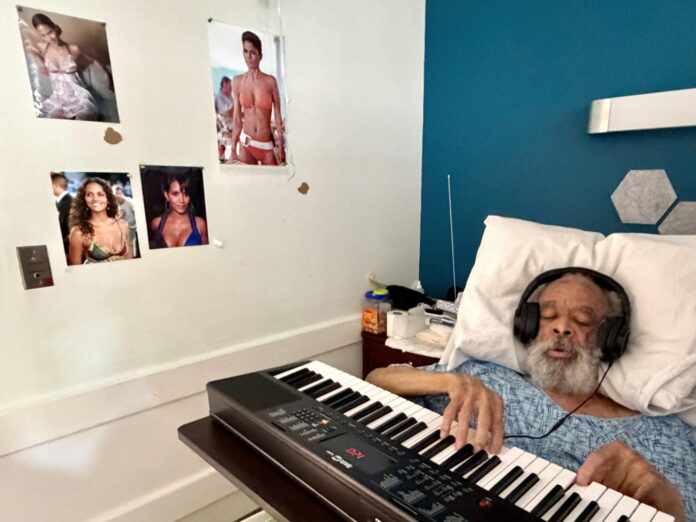
Nathaniel Ayers works on music in his nursing home quarters, inspired by fellow Cleveland native Halle Berry.
(Steve Lopez / Los Angeles Times)
In the case of my friend Nathaniel, the musician, it took me, his friends in the L.A. Phil and various outreach workers a year to convince him to move indoors 21 years ago. He is in a nursing home now, where he listens to music for hours every day and has kept a gallery of photos on his wall, including Beethoven, Bach, and another person with a “B” last name.
Actress Halle Berry.
“She’s beautiful,” Nathaniel said one day when we were going over a list of famous people from Cleveland, his hometown, and he decided that Berry deserved a prominent place on his wall of fame.
My relationship with Nathaniel, Abramson said, “is not an ancillary thing. It is THEE thing. I have come to believe that the human relationship is the necessary pre-condition to this working out.”
True enough, we are too predisposed to think of the ongoing human catastrophe in purely statistical terms. But there’s more truth in people’s stories than in their status, and more community buy-in when we recognize ourselves in each other.
For the 40,000 Nathaniels of Los Angeles, and nearly 4 million of their neighbors, here’s hoping the next mayor of Los Angeles can make a difference.
steve.lopez@latimes.com
More to Read
Disclaimer : This story is auto aggregated by a computer programme and has not been created or edited by DOWNTHENEWS. Publisher: latimes.com