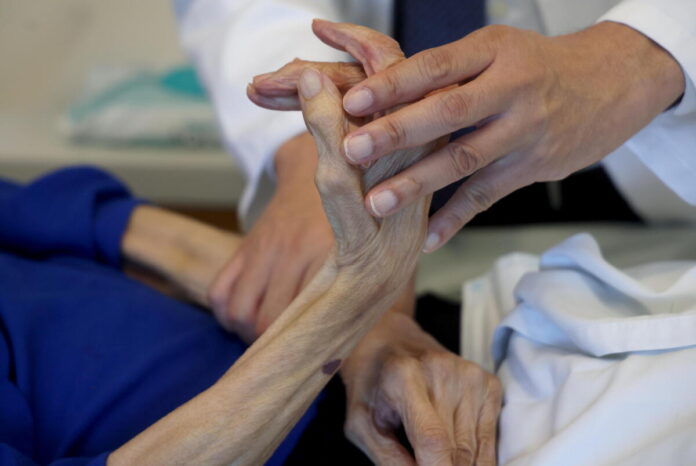
Dr. Zaldy Tan, author of a new book with profound insights into aging, memory loss and resilience, was examining an 84-year-old patient with vascular dementia last week in a suite at Cedars-Sinai Medical Center.
The patient’s daughter and primary caregiver, Adai Lamar, updated Tan on her mother Jessie’s condition, and then stepped away to tell me about her own journey. There came a point earlier this year, Lamar said, when she did the same thing I did when my parents’ memories were fading.
She began to wonder if she, too, was at risk of cognitive impairment.
“You get very scared [about] any of the smallest things,” Lamar told me.
Like forgetting a word, which Lamar can’t afford to do as a morning radio show host on KJLH-FM (102.3).
“I had read that symptoms start happening anywhere from 20 to 30 years before you get your diagnosis,” said Lamar, who thought, “Yeah, let me jump in and get ahead of it.”
Dr. Zaldy Tan examines the hands of Jessie, 84, who suffers from vascular dementia.
(Genaro Molina/Los Angeles Times)
That’s when she met Tan, director of the Cedars-Sinai Memory & Healthy Aging Program, which helps identify people who might be at risk of memory loss and advises them on how to slow or prevent development of Alzheimer’s and other forms of dementia.
As I’ve written previously, quoting Tan and other experts, there is no cure for dementia. But there are prescription drugs that can delay the advance in the early stages, or treat symptoms in later stages. And there’s now plenty of evidence on how to reduce risk by controlling diabetes and hypertension, and by getting plenty of sleep and exercise and maintaining a healthy diet.
“When I came to see Dr. Tan, I was 25 pounds heavier,” Lamar said. “I was not getting any sleep because of my mom. I was just trying to do it all. And … he was able to put my mind and heart at ease that there was something I could do to make sure I didn’t go down that path.”
Lamar learned to her relief that vascular dementia is generally not hereditary (although risk factors such as vascular disease can be inherited), and that she suffered no cognitive impairment.
Tan’s book, “What to Remember When You Are Forgetting: How to Thrive with Memory Loss, Alzheimer’s, and Other Dementias,” is packed with insights from more than two decades of practice and research.
Every type of memory loss, at every stage of the disease, is thoroughly explained.
We all forget things, at every age. Where did I leave my keys? Where are my glasses? What was the title of that book, or that movie, or the name of the familiar actor in the leading role?
But which things are normal forgetting, associated with aging, and which things are signs of trouble?
“Pausing mid-sentence to recall a name or word may seem worrisome to some, but for most people it’s just a sign of normal cognitive aging,” Tan writes. “Delay in information retrieval, such as the name of an acquaintance, a movie, or a famous person, becomes more common as one gets older and does not necessarily signal an underlying memory problem.”
Tan told me he wanted to help readers determine “when it’s the right time to seek help and when it’s the right time to not worry about it.” But for those who do need help, an early evaluation is key to effective treatment or to identify reversible causes of memory problems.
“Conditions such as depression, lack of sleep, a low-functioning thyroid, and vitamin B12 deficiency can lead to memory loss that mimic the early stages of dementia,” Tan writes.
At its worst, cognitive impairment can be a horrible, life-altering disease for patient and loved ones. In my last conversation with my mother, she abruptly announced that she didn’t know who I was and asked me to leave the room. A year ago I lost a friend who would smile through a conversation and show faint signs of recognition, but then forget about the visit the next day.

Dr. Zaldy Tan spends a warm moment with Jessie, 84, who suffers from vascular dementia.
(Genaro Molina/Los Angeles Times)
“I don’t know too many people whose lives have not been touched by memory loss or dementia in some way,” Tan told me before examining Jessie, who is at a moderately advanced stage of the disease.
His book is filled with detailed accounts of patients who responded in different ways to their diagnosis. There’s Ed, for instance (Tan changed patient names for his book), a screenwriter and director who slept late, isolated himself from the world, skipped meals and “confessed that he preferred to stay home because he would be embarrassed to bump into an old friend or colleague and fail to recognize them.”
And then there’s Pearl, a former nurse Tan had diagnosed, three years earlier, with mild cognitive impairment.
“I’d worried she might spiral into despair over her memory loss,” Tan wrote. “Instead, she took to the skies and seas. … Her calendar is packed with travel plans with friends and family for the next 18 months. … Besides traveling, she’s taking piano lessons, learning Italian, and ballroom dancing. … In her free time, she volunteers as a docent in the … Getty Museum.”
Jessie was living in Texas until her condition worsened, and Lamar took her mother into her home in West L.A.
“I’ve learned more about my mother … than I knew about her ever in life,” Lamar told Tan. She said she had taken her mother to Disneyland a while back, and her mother enjoyed watching the parades in person, but also enjoys videos of Disney parades. And she loves talking about her granddaughter, Hannah.
“If that little girl knew how much I use her name,” Lamar told Tan. “Hannah wants you to take your medicine. Hannah wants you to relax.”
“You’re doing the right thing in terms of replaying the good memories,” Tan said.

Dr. Zaldy Tan asks patient Jessie to identify animals on his chart at Cedars-Sinai Medical Center.
(Genaro Molina / Los Angeles Times)
Lamar had brought a bag of fresh blueberries to her mother’s appointment with Tan. First Lamar fed Jessie the blueberries, and then Tan took over. Jessie told Lamar that she’d like to eat some butter beans and cornbread later on. Her memories of favorite foods has remained intact, like images preserved in a dusty family album.
At the end of his book, Tan paints a beautiful picture of a visit to his parents’ home near Eaton Canyon. He notes that his mother is still healthy in her mid-80s, but lost two sisters to dementia. He writes about the January 2025 fire that spared his parents’ home but destroyed so many others, along with native vegetation and lovingly planted gardens.
“Alzheimer’s and other forms of dementia start as a tiny spark, sending embers to land on random, unsuspecting people,” Tan writes. In his parents’ yard, he spots “a fresh, red-barked branch shooting out of the scorched manzanita — a sign of life returning.”
He reflects on the many patients he has helped navigate the advancing haze.
“I see them, and tip my hat to all people like them who are living life to the fullest while holding on to the best of their fading memories. Memories may fade, relationships may change, people may leave, but the heart never forgets.”
More to Read
Disclaimer : This story is auto aggregated by a computer programme and has not been created or edited by DOWNTHENEWS. Publisher: latimes.com