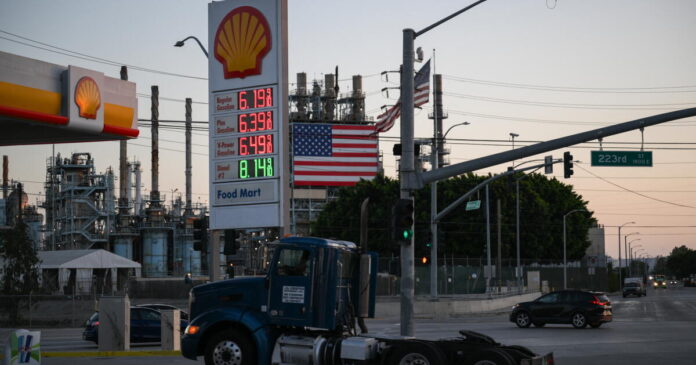
The economics of trucking are deteriorating fast — and it’s particularly bad in California.
Fresno-based Jagroop Singh Deol operates two gas-guzzling rigs. One hauls refrigerated produce from California to the Midwest and brings back pet food, meat and auto parts. He drives another truck himself that transports goods for Amazon.
At the start of the year, a full tank of gas cost $1,000. Now, Deol pays over $1,600. His business is bearing the brunt of California’s record diesel costs, which are 32% above the national average.
“We’re not making money,” Deol said. “Trucking isn’t a stable business.”
In his two-decade career, Deol’s fortunes have ebbed and flowed. The 2008 recession reduced him from an owner to a driver, whereas the 2020 pandemic boom made him millions. Now, he is hunkering down again, downsizing his fleet from five to two. He says he may have to leave the industry entirely if diesel prices keep rising.
The average price of a gallon of diesel in California reached $8.35 this week, up more than 60% from a year ago, according to the American Automobile Assn. The national average was $6.32.
Gas prices have been steadily rising all year, and truckers now pay $3 more than the average price a year ago. The price increase trickles down to all goods sold across the economy.
President Trump’s policies have run roughshod over the trucking industry. Just as the industry began recovering from a multiyear freight slowdown, the administration began cracking down on immigrant drivers earlier this year, exacerbating the impact from the erratic tariff announcements.
It has taken the biggest hit after the war with Iran sent gas prices soaring, hurting the beleaguered industry that hauls 70% of all freight in America.
To temporarily relieve price pressure, the Group of Seven wealthy nations on Oct. 2 agreed to release 100 million barrels of emergency oil reserves over the next four months.
Trump took credit for the European diesel release, as surging oil prices and affordability have become a contentious issue ahead of the midterm elections in November. Trump reassured supporters at an election rally that “oil prices will come tumbling down.”
“While big oil companies have seen their profits nearly double this year, the sharp increase in diesel cost has quickly eaten up what little margin mom-and-pop trucking businesses have left,” said Lewie Pugh, executive vice president of the Owner-Operator Independent Drivers Assn.
Small-business truckers make up more than 90% of trucking companies in America, according to the association.
Such truckers work load to load and often can’t raise rates when fuel prices spike, the way their larger competitors can. Between August and September, at least 16 freight companies across the country filed for bankruptcy amid record diesel prices.
Last week, Gov. Gavin Newsom allowed the early introduction of the cheaper winter-blend gasoline to be sold at gas stations to ease price pressure for Californians. Typically, the more expensive summer blend goes on until the end of October.
The Trump administration is expanding the use of a tax-exempt fuel used in the agriculture industry — so-called red dye diesel — to be used by on-road trucks to ease costs.
Avninder Singh, chief executive of Roadies, said diesel prices crossing $8 in California have eliminated the profit margins for his midsize company based in Bakersfield. His monthly fuel costs jumped to $450,000, wiping out all profits.
“We have literally no margin on it. Like we are running and not making any money,” Singh said. “Everything is going towards fuel.”
Singh now yearns for prewar fuel prices of $4 per gallon, when filling up the tank cost $1,200. Today, he pays $2,400 to fill a tank.
“Any American trucking company cannot survive at $8 a gallon,” Singh said. “We are literally losing money.”
Truckers are now having to employ ways to manage high costs.
Singh has urged his drivers to strategically fuel up in Arizona, where fuel prices are a couple of dollars cheaper, before reentering California to save on costs.
He has introduced bonuses for drivers who can squeeze more mileage by reducing idling and driving more slowly.
Owner-operator Deol uses battery-powered electric air conditioning systems installed on both his trucks so he can turn off the engines and avoid idling.
“If we sleep, if we park, we can turn off the motors,” he said.
Contributing to the price rise is a shortage of drivers, driven by the administration’s crackdown that began in 2025. The Department of Transportation has since removed 28,000 drivers for failing their English-speaking test and canceled more than 30,000 licenses that it said were illegally issued to immigrant drivers. It also closed hundreds of commercial driver training schools.
Truck supply has decreased due to safety enforcement, said Shelley Simpson, CEO of J.B. Hunt, one of the largest trucking companies in America, in a July earnings call.
Singh said canceling the commercial driver licenses reduced the pool of immigrant drivers, forcing him to pay more to attract American drivers — an increase from $0.45 to $0.80 per mile for a driver.
This meant hauling for Walmart rose from $2.50 to $4.50 per mile due to driver shortages and diesel prices, which will soon be reflected in what customers pay, said Singh, who has halved his fleet to 100 in the last year.
“Your lettuce will go from $3.39 to $3.59 a pound in a week. You won’t even notice that because you don’t pay attention,” Deol said.
Deol said that since the crackdown, his workforce has shifted from about 200 Indian drivers to roughly 20. He now employs about 230 American drivers.
This change in the mix of drivers has also affected routes, he said, because many American drivers prefer to be home after four or five days, so the company now runs fewer coast-to-coast trips.
Since May, spot prices paid for transporting goods have been increasing, despite the overall volume of shipments at the ports remaining flat. Deol said that, although freight prices had risen after the driver shortage, his company’s costs rose faster than customers’ rates could catch up.
The dwindling payouts have started to affect his lifestyle. His wife and two kids used to visit the Bay Area twice a year for shopping, but that’s down to just one trip in the last three years. He has halted trading in his car that’s been driven more than 100,000 miles.
“Sometimes we are stuck,” Deol said. “We need to wait it out.”
More to Read
Disclaimer : This story is auto aggregated by a computer programme and has not been created or edited by DOWNTHENEWS. Publisher: latimes.com