

Empathy ★★★★
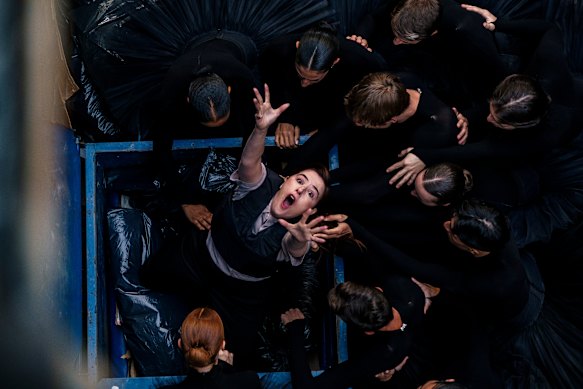
This compelling French-Canadian drama has a striking opening: an otherworldly ballet performance on the bitumen of a city street. No explanation, no framing – just graceful movement where bodies are navigating a harsh surface. Once you start watching Empathy, however, it makes all the sense in this trying world.
A study of the ongoing struggle and residual trauma that lurk inside the complexities of personal mental health, the show is bittersweet and moving. It pushes and pulls at you – toes scrape on that bitumen – but the experience is liberating.
The creator and star of the series is Florence Longpre, a leading light in Quebec’s niche French-language television industry whose previous successes, such as Audrey’s Back and Can You Hear Me, have had little opportunity to find an Australian audience. Hopefully Empathy changes that, as Longpre brings a reservoir of deeply held emotion to her performance as Suzanne Bien-Aime, a Montreal psychiatrist trying to make a difference for the patients – and herself – at a psychiatric hospital for the criminally insane.
Working with director Guillaume Lonergan, a long-time collaborator, Longpre has crafted a series that stays a beat off most drama’s familiar rhythms. A scene that usually might be a small indicator, such as Suzanne’s chaotic preparation for her first day of work, is stretched out into something uncomfortable yet telling. Lonergan’s visual grammar moves between the intimate and the vast, so that you feel close to a character and then realise they are just one person adrift amid so many.
To offer some parallels: Fleabag’s use of sharp humour as a means of keeping others at bay, the painful professionalism of Giri/Haji and, most of all, the heightened anguish and hopeful release of Six Feet Under. There is no shortage of conventional elements in this 10-part series, whether it’s the slow, painful revelation of what Suzanne herself is trying to cope with, or a steady flow of wounded patients that she meets and gets to work with, but they’re worked into the narrative with a keen, cumulative eye. Neither the patients nor Suzanne are suddenly saved.
When she’s warned that the patients at the Mont-Royal Psychiatric Institute are hopeless cases, Suzanne replies, “I’m a hopeless case, too”. But her dedication to her new career is obvious, and scenes of diagnostic introduction and professional evaluation have a lengthy, authentic back and forth. Patients might be living with hallucinations, racked by psychosis or struggling after severe depression. But the staff, and the show itself, believe the facility can help, and it’s always portrayed as part of a functioning medical system.
The personal mirror is Suzanne’s own relationships, which basically consist of alcohol (consumed off-duty); a sister who she’s close with, Astryd (Sofia Blondin); and an accomplished mother whose patience appears to have flinty limits, Guylene (Linda Malo). Among her new work colleagues there is a bond with Mortimer Vaillant (French comic Thomas Ngijol), a veteran orderly who shadows Suzanne as a guide and bodyguard in their secure wing.
The awkwardness in the pair’s budding rapport is genuine, and invariably strained by circumstances. That’s typical of Empathy. The show can be profound but also disarmingly casual. As Suzanne’s layers are stripped away you’re left with a fascinating essence: mordant, wounded, but striving to go forward. It’s a journey you want to experience. This unheralded success can be painful but never punishing. That’s a valuable distinction.
Empathy is streaming now on SBS On Demand.
Want more TV? We’ve got you.
 Craig Mathieson is a TV, film and music writer for The Age and The Sydney Morning Herald.Connect via X.
From our partners
Disclaimer : This story is auto aggregated by a computer programme and has not been created or edited by DOWNTHENEWS. Publisher: www.smh.com.au


