Most golfers practice without a plan, spending their precious practice time hitting the wrong clubs and working on the wrong shots, leaving them wondering why their scores don’t improve.
The reality is that two thirds of a solid round of golf comes down to your performance in just three key areas: putting, wedge play and driving. By understanding where your strokes actually come from — and striving to do these ordinary things extraordinarily — you can build a practice plan that addresses each of these areas. Work backward from the green, set clear and measurable goals and bring a game-like mindset to every session. When you practice shots you’re actually hitting on the course, improvement becomes intentional rather than accidental.
Check out below for a breakdown of each of these three skills, with tips for how you can improve each.
<figure class="youtube-facade" data-content="
“>
Part 1: Putting
Setup basics
1. Grip: Place the putter grip in the fingers of the lead hand, running from the base of the index finger to just under the lifeline of the palm. The trail hand mirrors the lead hand, with palms facing each other and both thumbs resting directly on the flat front edge of the grip. This alignment discourages wrist rotation and encourages a pendulum motion driven by the shoulders.
2. Ball position: Set the ball slightly forward of the center of your stance—approximately underneath the logo on the chest of your shirt. This allows the putter to contact the ball just past the low point of the arc, producing a slight upward strike that gets the ball rolling end over end immediately. If the ball is too far back, it will skid and have an inconsistent roll.
3. Stance width: Set the feet hip width apart. This stance width helps provide a stable base while allowing the upper body to move freely. Your weight should be distributed evenly, with a slight bias toward the balls of the feet.
4. Head position: The head sits slightly behind the ball at address, reflecting the forward ball position. This rearward tilt encourages the ascending stroke path. The head stays here throughout the stroke—any forward drift disrupts both arc and face angle at impact.
5. Shaft lean: The shaft should be roughly vertical at address, pointing between the center of the head and your ear. Excessive forward lean de-lofts the putter and creates skid, and too much backward lean adds loft and causes bounce. A neutral shaft angle preserves the putter’s loft and allows for a consistent roll.
The stroke
The length of the putting stroke should be governed by the distance to the hole, not by how hard you accelerate through impact. A common fault among rec players is a short backstroke paired with a quick, jabbing forward stroke, which produces inconsistent pace and direction. The goal is a backstroke and followthrough that are roughly equal in length, and the pace of the putterhead remains smooth and consistent.
Backstroke: The putterhead moves back, low to the ground, driven by the rocking of the shoulders. The hands and wrists remain passive with little to no hinge.
Impact: The face should be square to the start line at the moment of contact. The hands remain even with or slightly ahead of the putterhead. Avoid any flipping of the wrists — the relationship between the arms and shoulders established at address should remain stable.
Post-impact: The follow-through is slightly shorter than the backstroke as the putterhead naturally decelerates after contacting the ball. The face stays square as long as possible before rotating naturally with the arc.
Post-impact: The follow-through is slightly shorter than the backstroke as the putterhead naturally decelerates after contacting the ball. The face stays square as long as possible before rotating naturally with the arc.
Longer putts: For longer putts, extend the backstroke while maintaining the same smooth tempo. Resist the urge to accelerate more aggressively through the ball to add distance. Simply rely on a longer backstroke.
Shorter putts: A compact stroke with equal-length backswing and follow-through is most reliable on short putts. Keep the tempo identical to longer putts — only the stroke length changes.
Read and speed drill
Speed and read are the two variables that determine whether a putt goes in the hole. Most missed putts result from poor speed rather than misread. This drill trains both simultaneously, using a simple tee as a reference point to develop feel for entry angle and distance control.
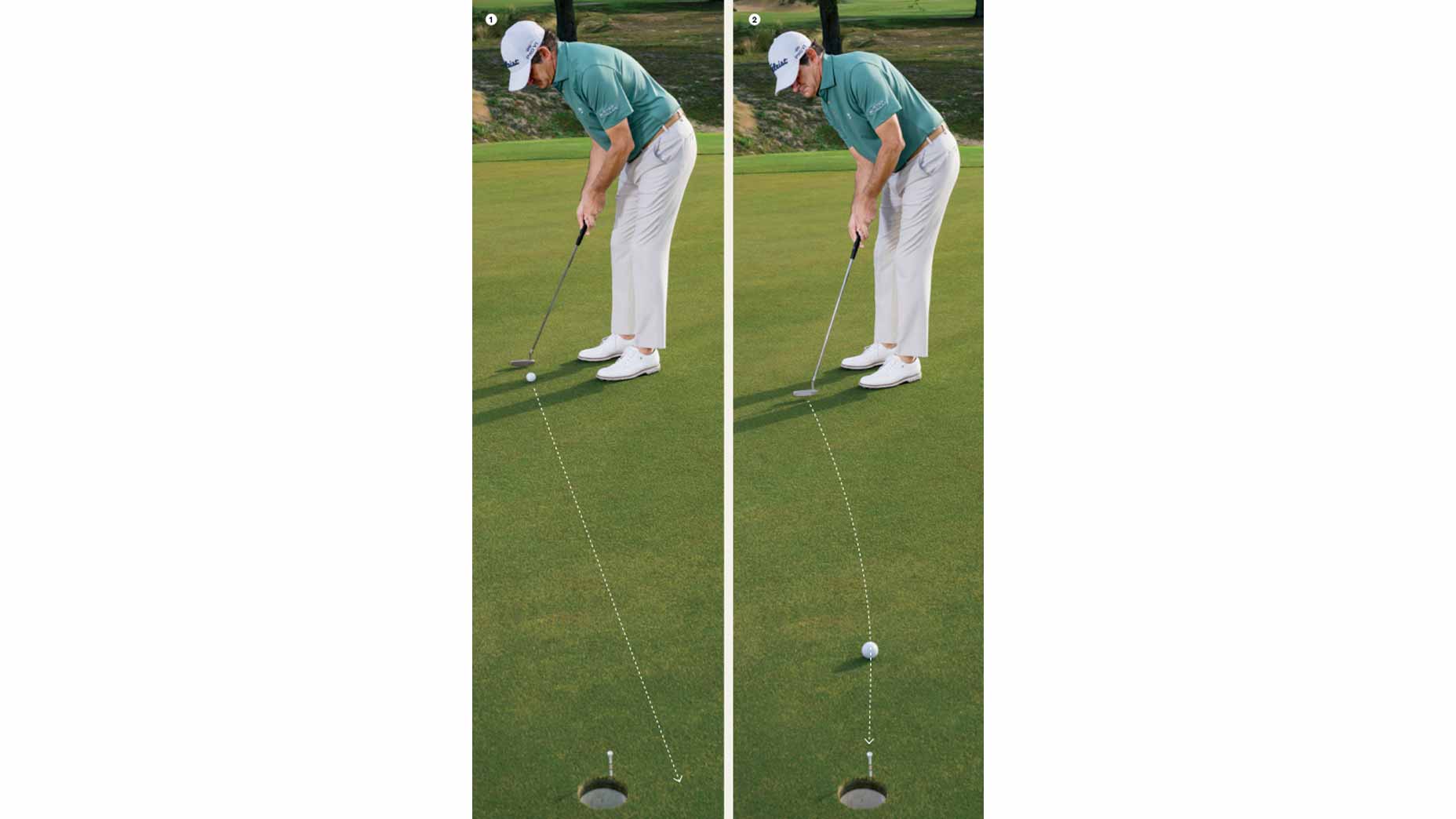
Entry point: Identify the spot on the rim of the hole where the ball needs to enter. For a straight putt, the entry point is the center back of the cup. For a breaking putt, it shifts to the high side. Committing to a specific entry point moves focus from the entire hole to a precise target, improving read accuracy and start line direction.
Start line: With entry point determined, identify your starting direction. This is a straight line where you want to start the ball on breaking putts [1]. Committing to a start line, rather than relying on the hole as the only reference, produces more decisive alignment and better directional control.
GOLF Magazine
Setup: Address the ball with the tee positioned just ahead of your peripheral vision on the target line. Align the putter face to the start line, then step the feet into position. Aligning the face before the body consistently produces better setup accuracy than trying to establish both simultaneously.
Match tee and speed: Based on green speed and slope, adjust the tee position to reflect the correct entry point. Then practice aligning to your straight line and committing to that start [2]. The tee keeps both read and speed connected — the right entry point only works when the speed matches the read.
Part 2: Wedge play
Distance wedge
Distance control with wedges is key for shooting lower scores. With such a high percentage of approach shots played from wedge range, this is a real opportunity to hit the ball close, convert up-and-downs and create more birdie chances.
Setup: Research points to an ideal launch angle of approximately 30 degrees for these shots, and the setup is designed to produce exactly that. A narrow stance with 60 percent pressure forward helps control swing size. Position the ball slightly back of center — roughly one ball back — to encourage clean contact and a lower, penetrating flight. Open the stance slightly to maintain proper alignment.
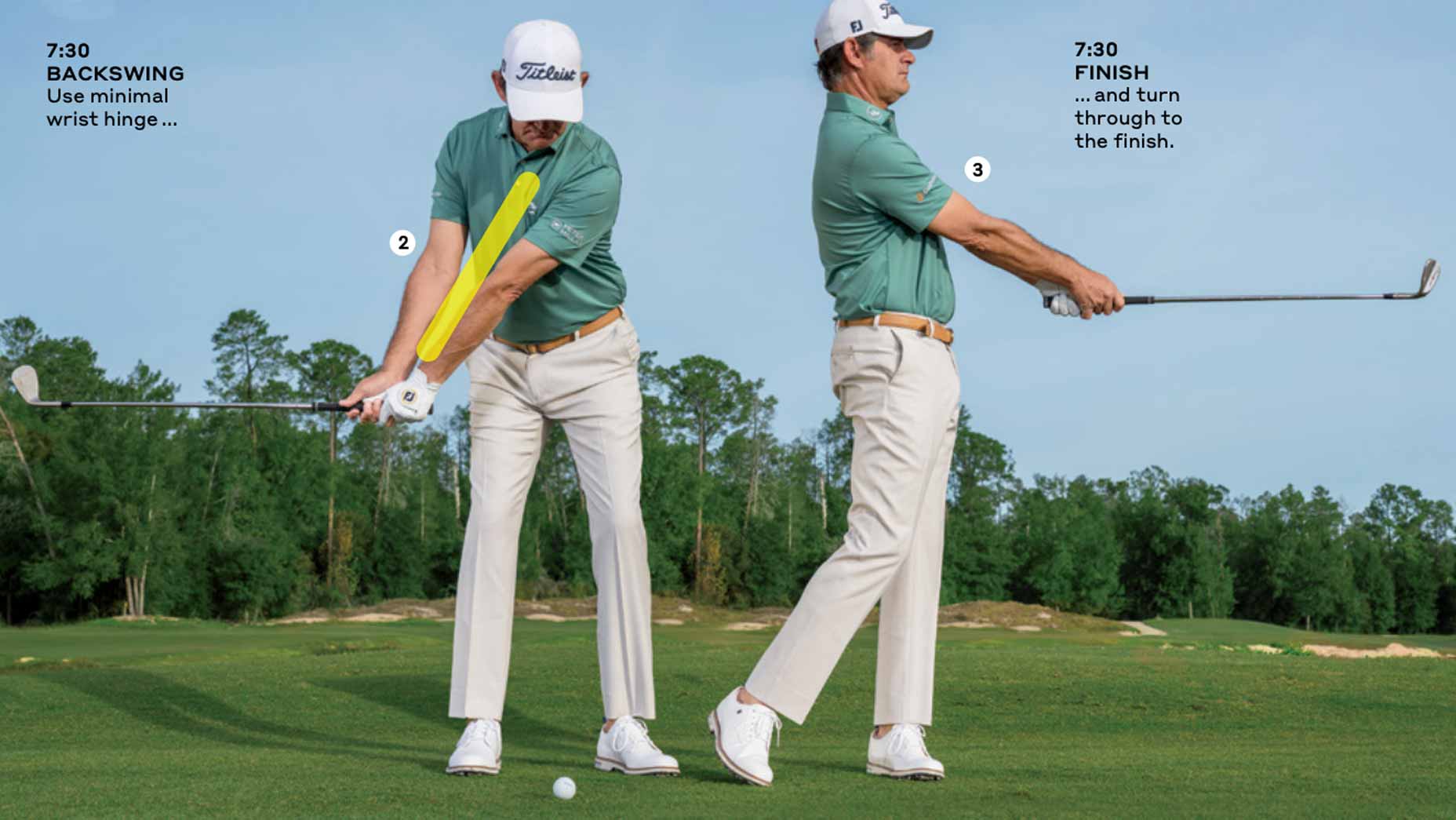
Swing clock: Using the clock system — the lead arm as the hour hand of a clock — vary the length of the backswing from 9:00 to 7:30 to 11:30. As backswing length changes, so does distance. Calibrate yardages using a launch monitor or measured targets, and complete this process with each wedge to build a complete distance arsenal.
GOLF Magazine
7:30: The lead arm swings to 7:30 — perfect for a short pitch. Wrist hinge is minimal, turn is limited and the finish is low and abbreviated.
9:00: The lead arm reaches parallel to the ground. The wrists hinge fully, the torso rotates approximately 45 degrees and the finish mirrors the backswing length.
11:30: The lead arm extends to 11:30 — just short of a full swing. The transition should be unhurried, and the finish matches the backswing length.
Finesse wedge
Finesse wedge shots should be used close to the green (inside 30 yards) when you need to control carry distance, trajectory and spin simultaneously.
Feet: Use a narrow, flared and open stance. Flaring the front foot encourages turn, which is an essential ingredient for the shot. The open alignment complements every other element of the finesse wedge setup, keeping the motion connected and consistent.
Weight: Favor the lead foot with about 60 percent of your weight. This position encourages a descending blow and promotes consistent contact. Avoid any pressure shift during the swing. Lead-side bias should be maintained throughout.
Club: Select the highest-lofted wedge in your bag for max height and stopping power. At address, the shaft points toward the lead hip. Varying club selection allows you to adjust launch angle and total distance with the same motion.
Face: Maintain and open face throughout. The most common error is rotating the forearms through impact to square the face, but this de-lofts the club and produces a low, running shot. Keep the face pointing up.
Motion: The backswing is controlled and compact. The downswing is driven by the body rather than the hands. Swing the club along the feet line — left of the target — while keeping the face open.
Finish: Finish tall with your weight forward. The hands should not rise above waist height. Let the body control the finish, not the momentum of the arms.
Part 3: Driver
Driver basics
The driver demands a fundamentally different setup than any other club in the bag. The address position must be adjusted to promote a shallower, ascending angle of attack. If you want maximum distance, you have to launch the ball in the air rather than driving it into the ground.
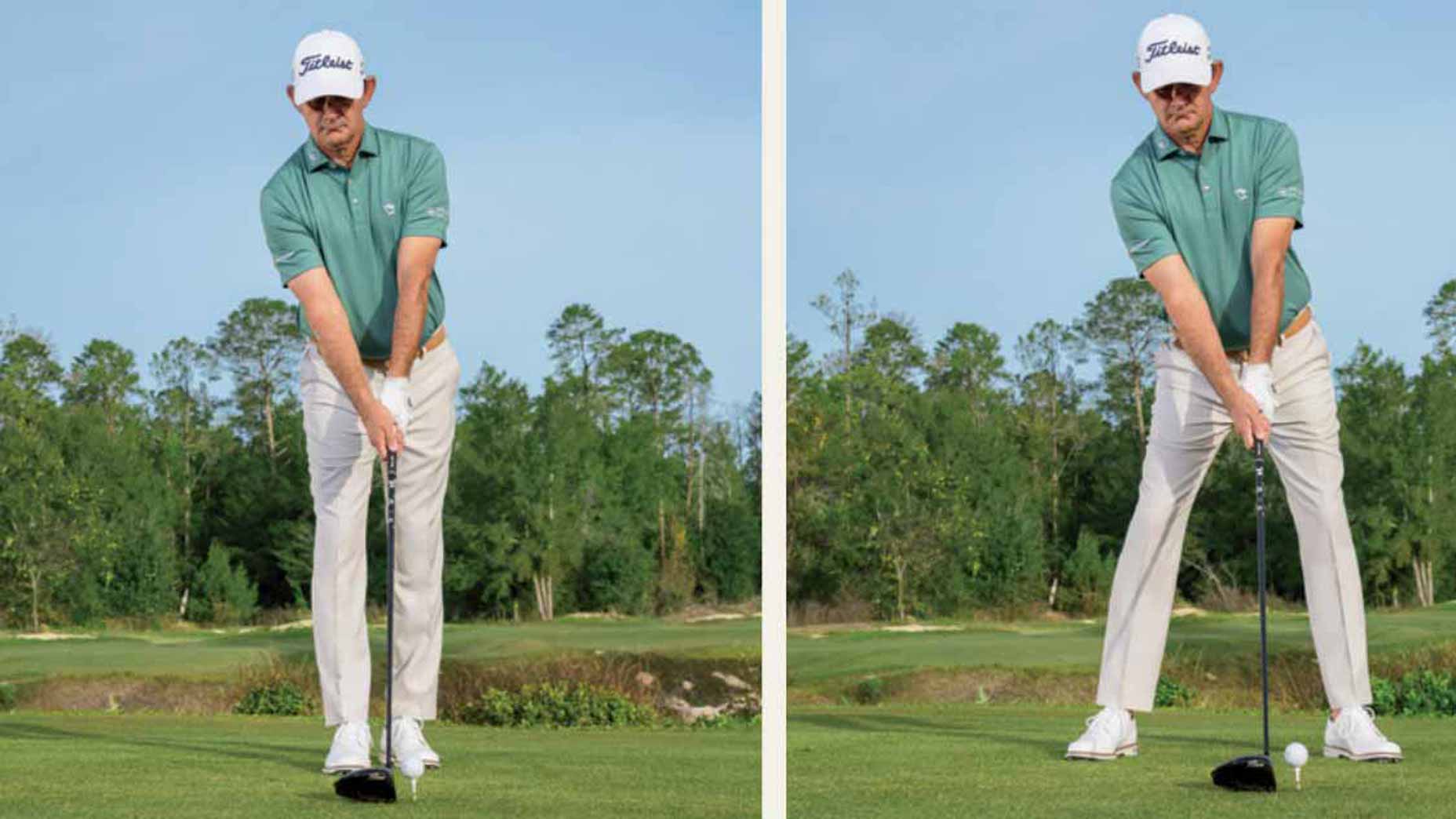
1. Grip: Establish the grip before setting the rest of the stance. After you’ve grasped the club, place the clubhead behind the ball with the feet close together.
2. Stance: Take your first step out with the trail leg. This will position the ball forward in the stance, aligning with the lead armpit. The lead hip should sit slightly higher than the trail hip at address, tilting your spine angle slightly away from the target. This facilitates a proper pivot on the backswing and an upward strike on the ball. The arm structure is equally important for hitting solid drives. At address, the lead arm should be long and extended, while the trail arm remains soft with the elbow pointing toward the trail hip.
GOLF Magazine
3. Swing: As the lead arm swings across the chest during the backswing, allow the trail arm to fold naturally, getting the hands properly positioned underneath the club. The shoulders turn fully, while the lower body remains stable and loaded. This creates the leverage needed to generate power on the downswing.
4. Release: As the clubhead approaches impact, the wrists and hands should rapidly unhinge. This powerful, uninhibited release of the club through impact transfers that stored energy out toward the clubhead, culminating with maximum speed at impact.
Disclaimer : This story is auto aggregated by a computer programme and has not been created or edited by DOWNTHENEWS. Publisher: golf.com