TEHRAN – After being dropped from Ed Sheeran’s US tour and facing rejection from nine major American arenas, the Grammy-winning rapper is turning his concerts into a platform for Palestinian solidarity.
For many musicians, a successful career means sold-out concerts, international tours and a growing audience. For American rapper Macklemore, however, the past few months have brought a different kind of challenge: how much is an artist willing to risk for something he believes in?
The Grammy-winning rapper, whose real name is Benjamin Hammond Haggerty, has become one of the most recognizable voices in the American music industry supporting Palestinian rights. His outspoken criticism of Israel’s military campaign in Gaza has now had direct consequences for his career. He was removed from British singer Ed Sheeran’s US tour after calling for a free Palestine during a stadium performance. More recently, he announced that nine major American arenas had refused to host his planned benefit concerts for Palestine.
But rather than backing down, Macklemore has taken his message to the stage, organizing a series of fundraising concerts in Europe and promising to continue his campaign.
His story is no longer just about music. It has become a question of artistic freedom, solidarity, and the price of speaking out.
Macklemore’s most significant musical statement on Palestine came in May 2024, when he released “Hind’s Hall,” a protest track inspired by the pro-Palestinian student demonstrations taking place at universities across the United States.
The song was named after Hamilton Hall at Columbia University, which student protesters renamed in memory of Hind Rajab, a five-year-old Palestinian girl killed in Gaza in January 2024.
Rather than treating the student demonstrations as a campus controversy, Macklemore placed them within the wider context of the war in Gaza, American military support for Israel, and the growing demands for a ceasefire.
His lyrics challenged the silence of powerful institutions, questioned the treatment of protesters, and called attention to the suffering of Palestinians. He also criticized the music industry for remaining largely silent about the conflict.
Importantly, Macklemore announced that the proceeds from the song would go to UNRWA, the United Nations agency providing assistance to Palestinian refugees.
The track quickly attracted international attention and became an anthem for many supporters of the Palestinian cause. It also demonstrated that Macklemore was prepared to use his commercial success and public visibility for something beyond entertainment.
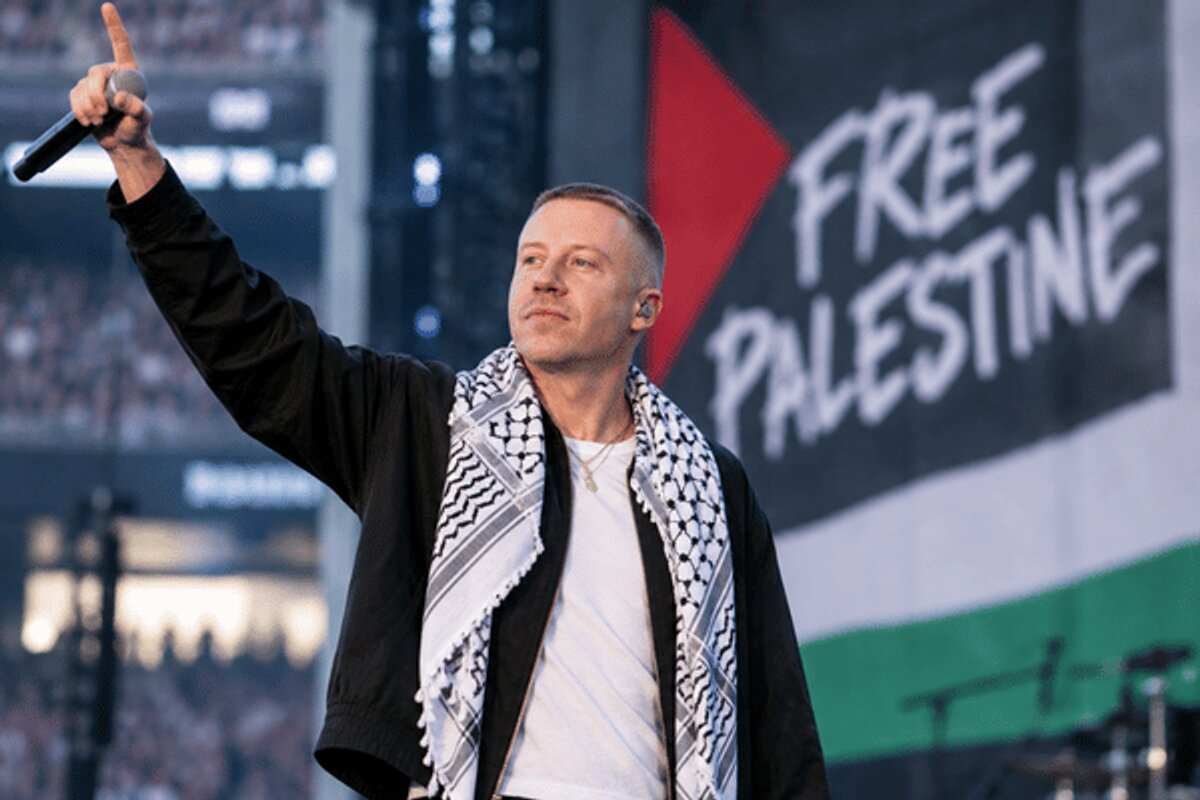
On September 4, 2026, Macklemore appeared as an opening act for Ed Sheeran at MetLife Stadium in New Jersey, and in front of a huge audience, he used his time on stage to deliver a message that had become central to his public identity. “Free Palestine,” he told the crowd.
He explained that one of the main reasons he had wanted to join the tour was the opportunity to stand before stadium audiences and make those words heard. He wanted Palestinians in Gaza and the occupied West Bank to know that they had not been forgotten.
He also performed “Hind’s Hall,” accompanied by images connected to the destruction in Gaza and pro-Palestinian demonstrations.
The reaction was immediate. Some pro-Israel organizations criticized his remarks, and the Israeli American Council launched a petition calling for his removal from the tour. Macklemore’s supporters, meanwhile, saw the performance as an example of an artist using a major platform to speak about a humanitarian crisis.
On September 14, Macklemore confirmed that he would no longer appear at the remaining US dates of Sheeran’s tour.
According to the tour promoter, Messina Touring Group, venue owners had indicated that they would not allow concerts to take place if Macklemore remained on the lineup. The promoter said the decision followed discussions with stakeholders.
Macklemore subsequently explained that the controversy had placed Sheeran in a difficult position, while maintaining that his responsibility to speak about Palestine was more important than preserving professional relationships.
Sheeran later clarified that he had not personally made the decision to remove Macklemore. He said he was appalled by the suffering in Israel and Palestine but wanted to use his platform to bring people together through music.
The incident nevertheless raised an uncomfortable question: if an artist can perform freely until he expresses solidarity with Palestinians, how secure is freedom of expression in the music business?
For Macklemore, leaving Sheeran’s tour did not mean abandoning the stage. Instead, he began organizing the “Free Palestine Tour,” a series of benefit concerts intended to raise funds and bring artists and supporters together around Palestinian rights.
The European leg included performances in Dublin, Paris, and London in October. The Dublin concert alone attracted around 13,000 people, with tickets selling out within minutes. Palestinian flags, keffiyehs, and solidarity messages were visible throughout the event.
The concerts also featured other musicians, activists, and public figures, including artists who had withdrawn from Sheeran’s tour following Macklemore’s removal.
The response demonstrated that his message had found an audience well beyond his usual fan base.
However, bringing the tour to the United States proved considerably more difficult.
On November 6, Macklemore announced that nine major American arenas had declined to host the benefit concerts. The list included Madison Square Garden in New York, Barclays Center in Brooklyn, the Kia Forum and Crypto.com Arena in Los Angeles, and Chase Center in San Francisco.
According to Macklemore, his team had initially been offered available dates through the end of the year. He claimed that the situation changed once venue representatives learned that the proposed events were fundraising concerts for Palestine.
He described the experience as an example of intimidation and suppression, arguing that powerful commercial interests should not determine which humanitarian causes artists are permitted to support.
The venues’ explanations have not all been made public. MSG Entertainment, for example, cited limited availability and argued that Macklemore was not an arena-level performer. Nevertheless, the rapper’s announcement has renewed discussion about the influence of venue owners and commercial organizations over artists’ public expression.
For Macklemore, the distinction between having access to a stage and having permission to speak freely on it has become increasingly important.
Of course, his position has attracted criticism, particularly from organizations that consider some of his language offensive or antisemitic. Macklemore has rejected the accusation that criticism of Israel’s government and its military actions amounts to hostility towards Jewish people. During his September performances, he specifically addressed Jewish audience members, stressing that his message was about peace, equality, and human dignity for all.
That distinction matters. Opposing the policies of a government is not the same as expressing hatred towards a religious or ethnic community.
His European concerts showed that music can bring together people from different backgrounds, nationalities, and communities around a shared humanitarian concern. They also demonstrated that an artist does not necessarily need the approval of the biggest commercial venues to reach an audience.
There is something particularly meaningful about the contrast between the nine American arenas that reportedly turned down his concerts and the thousands of people who gathered to support the European shows. The buildings may belong to corporations and wealthy owners, but the music ultimately belongs to the people who listen to it.
Macklemore has chosen to use his platform to remind audiences that Palestinians are not simply distant names in a news report. They are people whose lives, families, homes, and futures matter.
And as his “Free Palestine Tour” moves beyond the European stage, his message remains unchanged: Palestinian lives matter, solidarity matters, and speaking up should never be treated as an act that an artist must apologize for.
SS/SAB
Disclaimer : This story is auto aggregated by a computer programme and has not been created or edited by DOWNTHENEWS. Publisher: tehrantimes.com