
Even by the eye-popping standards of chief executive pay, the riches amassed by Macquarie’s top bankers are exceptional.
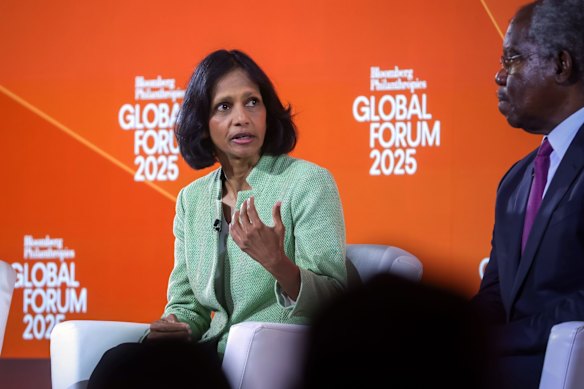
When Macquarie Group chief executive Shemara Wikramanayake departs in November, she does so with about $370 million in shares, the fruits of a four-decade career with the investment banking giant. She has another $89 million in deferred share units which are yet to vest.
While it’s difficult to compare executive payouts, each with unique share packages, short-term incentives and bonuses, Wikramanayake will leave Macquarie with one of the most valuable stakes held by a CEO who is not a founder in Australian corporate history.
Founders such as Fortescue’s Andrew Forrest or WiseTech’s Richard White hold stakes in their companies worth billions.
But over the past few years, several high-profile corporate leaders have left the companies they were leading with hefty packages. Virgin boss Jayne Hrdlicka, who left the airline last June, was on track to collect around $50 million based on shares she retained in the company.
Budget jewellery retailer Lovisa raised eyebrows last year when departing chief executive Victor Herrero left with a $39.5 million pay packet, despite the group not even cracking the top 100 companies by market valuation.
After last year’s annual general meeting, where Lovisa shareholders delivered a fifth straight strike against the company’s remuneration report, Monaco-based billionaire owner Brett Blundy likened it to a Ferrari.
“Not everybody can drive a Ferrari and get the best out of that. And we have to win.”
In Lovisa’s case, those notoriously high salaries were part of Blundy’s push for aggressive global expansion.
Meanwhile, Wikramanayake’s payout is a reflection of the remuneration structure which earned Macquarie that slightly grandiose “millionaires’ factory” nickname, whereby high-performing staff are given a share of profits they generate, distributed as shares in the company. It’s a model that has made many of the bank’s top executives fabulously wealthy.
Shortly before Wikramanayake’s predecessor Nicholas Moore retired in 2018, this masthead reported that he owned $247 million worth of shares in the company – and these shares will be far more valuable today if Moore has held them, given the sharp increase in Macquarie’s share price since then.
All of this is playing out in a landscape where direct termination payouts to departing chief executives have steadily declined across the top listed companies in Australia. Expensive golden parachute arrangements have been reined in since changes were made to the Corporations Act in 2009, which expanded the power of shareholders to curb termination payments deemed excessive.
Research from the Australian Council of Superannuation Investors, which publishes an annual survey of executive pay, found that the total of termination payments received by ASX100 chief executives fell to a record low of $8.38 million in 2024, down from $83 million in 2008, before the laws were changed. That year, former Santos boss John Ellice-Flint received an $18.3 million package based on share options which vested upon his departure. ACSI’s most recent survey found that termination payments rose again in the 2025 financial year, driven by a single $5.88 payment to Rio Tinto chief executive Jakob Stausholm when he departed the mining giant last year.
Where those departure payouts are share-based, companies still have the option to claw back a portion of the package, an issue that has reared its head recently in the case of a few embattled executives.
Alan Joyce received an $18 million payout when he left Qantas in 2023 amid a haze of controversy, but the board later stripped $9 million from his entitlements.
Last year, former ANZ boss Shayne Elliott sued the bank after it stripped $13.5 million from his bonus after he retired following a string of regulatory failures. He dropped the Federal Court action in February, leaving the future of a potential $8 million in future bonuses owed to him unclear.
This has not always worked.
“It’s a lovely idea, but experience tells me that once the money goes out the door, it’s much harder to claw it back,” said Helen Bird, a corporate law and governance expert at Swinburne University.
When former Rio Tinto boss Jean-Sebastien Jacques left the mining company after presiding over the disastrous destruction over ancient Indigenous rock sites at Juukan Gorge, he was docked a $4.9 million annual bonus after a shareholder revolt, but still left with 445,000 worth of shares, based on his status as a “good leaver”, a portfolio now worth around $60 million, despite a tattered reputation.
But Wikramanayake is unlikely to face such backlash from beyond the corporate grave, even if 25 per cent of shareholders voted against the company’s remuneration report at last year’s AGM, delivering a first-ever strike.
During her eight-year tenure, Macquarie’s market capitalisation soared 149 per cent, and her departure announcement came days after the share price reached a record high of $258.41.
The Business Briefing newsletter delivers major stories, exclusive coverage and expert opinion. Sign up to get it every weekday morning.
 Kishor Napier-Raman is a senior business writer for The Sydney Morning Herald and The Age. Previously he worked as a CBD columnist and reporter in the federal parliamentary press gallery.Connect via X or email.
From our partners
Disclaimer : This story is auto aggregated by a computer programme and has not been created or edited by DOWNTHENEWS. Publisher: www.smh.com.au