Macron also talks about the continuing support for Ukraine on energy infrastructure and its fight to stop Russia’s shadow fleet.
He says he is happy that the G7 ends with “such convergence” on Ukraine, which he hails as “real progress”.
He then moves to other topics, including the situation in the Middle East, stressing the G7’s backing for Trump’s Iran deal, and to efforts to fight Ebola.
I will keep monitoring for more Ukraine and Europe lines.
We still think we are going to hear from Donald Trump this afternoon, too, before he leaves for Paris and the said dinner at the Palace of Versailles.
I am keeping an eye on this for you.
Macron takes a few questions on the deal with Iran and his views about the strait of Hormuz and Lebanon.
But in the penultimate question, he also gets asked about his relationship with Donald Trump, with the journalist suggesting Macron is on a charm offensive to get the US president on side – including through their formal dinner at the Palace of Versailles tonight.
Macron says he was always very open about areas where the pair disagreed – for example on Greenland or Ukraine – but it’s the nature of diplomacy that you work to figure it out. But whenever they agree on something, they follow through on that agreement.
He says the last two days show how much can be achieved when discussions are still being held, despite some past disagreements.
He says what matters is that he defends France’s interests, and, of course, hosting a dinner at the Palace of Versailles is part of broader diplomacy.
And on that point, we end the presser.
Macron says the discussions were “extremely frank” and “useful,” but ended with people’s positions “evolving” to help them “re-align” on Ukraine.
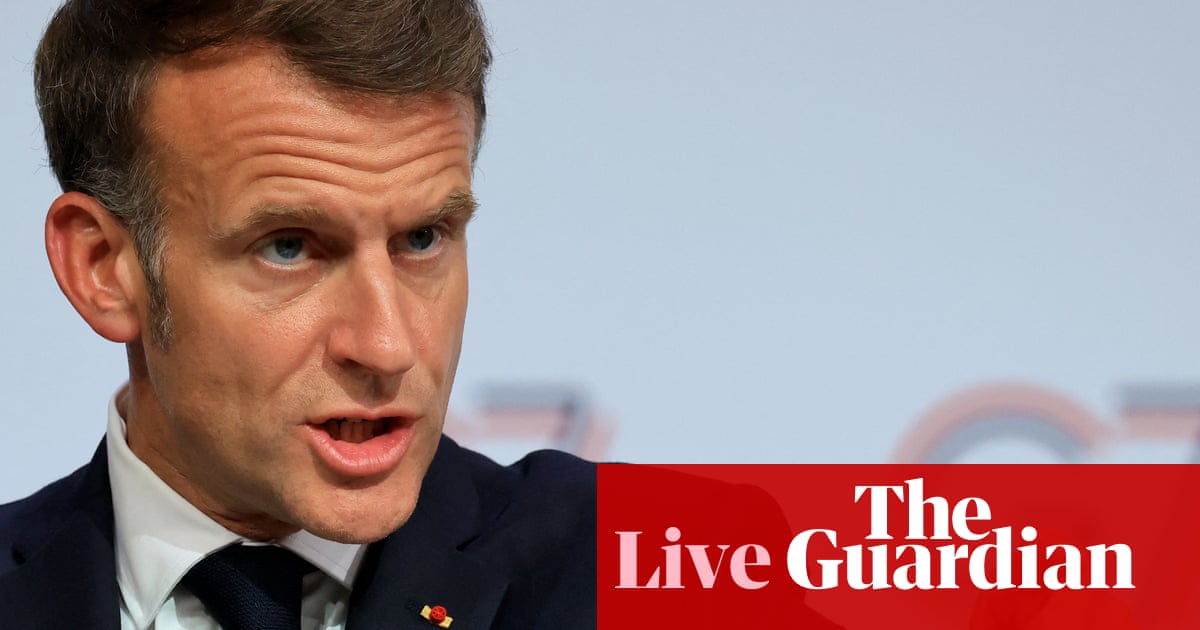
Here’s a picture of Macron taken during this press conference.
Macron defends the agreed wording on Ukraine, saying it goes quite far in its support for Ukraine.
He says the agreed language marks “a very profound shift in approach,” including a “clear willingness” of the US to work with Europeans to support Ukraine.
He also criticises Russia for showing no real intention to engage with the peace process.
Macron ends his statement talking about digital and AI.
He focuses on the need to protect children online – a big part of his political legacy in France – and to responsibly regulate AI.
“We all want innovation,” he says, but cannot ignore the risks to our democracies and societies.
He says key AI models must not fall into the hands of authoritarian regimes.
There is also a brief summary on other topics, but then he turns to Q&A – which kicks off with a question on Ukraine.
Macron also talks about the continuing support for Ukraine on energy infrastructure and its fight to stop Russia’s shadow fleet.
He says he is happy that the G7 ends with “such convergence” on Ukraine, which he hails as “real progress”.
He then moves to other topics, including the situation in the Middle East, stressing the G7’s backing for Trump’s Iran deal, and to efforts to fight Ebola.
I will keep monitoring for more Ukraine and Europe lines.
Turning to Ukraine, Macron says the leaders had an “in-depth” discussion on Ukraine, which allowed to “find significant areas of agreement.”
He stresses their “unwavering support for Ukraine,” and notes that “the balance of power has profoundly shifted in recent months” as “Ukraine is advancing and resisting; Russia is retreating.”
He says the leaders have agreed to increase the provision of air defence capabilities and systems to help Ukraine even further.
He also says the leaders backed Ukraine’s request for licensing arrangements so they can produce some of that equipment themselves.
Meanwhile, Macron says the G7 summit was a success, stressing it was held “against an extremely difficult backdrop of a fragmented world” – but it was a “moment of unity” as the leaders focused on areas for cooperation.
Oh, that’s tasty.
Meloni also says that she will propose a single EU negotiator for Ukraine when the EU leaders meet for an EU summit in Brussels later this week.
She says the negotiator should come from “a medium-sized country,” not one of the largest countries.
One to watch.
Separately, Italy’s Giorgia Meloni is briefing the media, too.
She says that the G7 leaders reached an agreement with Trump over Ukraine, stressing this “cannot always be taken for granted.”
It increasingly looks like this morning’s agreed G7 statement (9:29) on Ukraine should be seen as a win for Europe.
Meloni also says there was an overall “good climate” of talks at the summit.
France’s Emmanuel Macron is now finally speaking.
You can watch along below, but I will bring you all the key lines here.
Trump is also speaking on the Iran deal a lot, saying he has been doing all sorts of deals “all my life.”
“I’ve gone into deals that were 100% and they don’t happen. I’ve gone into deals that there was no chance of getting them done, and it happens, and they happen easily. So, you never know what deals do, but you’re going to find out pretty soon. I think it will be done.”
He also hails his relationship with Indian PM Modi, declares the US would always be there to defend India if needed, and talks up potential trade and cooperation opportunities.
And that’s it. As ever, more on that on the Middle East blog.
And I’m going back to waiting for Macron.
Trump also gets asked about Nato’s help in the strait of Hormuz.
He says “we don’t need them,” but “if they want to,” they can do it.
Trump gets asked if he thinks Putin is responsible for the war in Ukraine.
He says:
“I don’t want to comment on that, because I’m trying to get it settled, and that doesn’t make it easy.”
Trump also gets asked about whether he is going to impose further sanctions on Russia.
He says:
“We are looking at that, we’re seeing how far the price of oil comes down. It’s really tumbling, I guess, 74, 75 right now, … so it’s down, it’s soon going to be at the number that it was four months ago.
It’s pretty amazing, and on top of that, we will have an Iran without a nuclear weapon, which I can tell you, the prime minister [Modi] feels very strongly about that too.”
Meanwhile, US president Donald Trump is speaking at a bilateral meeting with Indian PM Narendra Modi.
He immediately gets asked for an update on Ukraine, and he says:
“Well, I had very good talks with President Zelenskyy and with President Putin, and we’d like to see that one end.
I ended eight wars, and to be honest with you, I thought this would have been one of the easier ones, but they’re not liking each other too much, and that makes it much more difficult.”
We are still waiting for the post-G7 pressers.
We will bring them live as soon as they start.
Polish prime minister Donald Tusk said the killing of a Russian artist who was critical of president Vladimir Putin has the hallmarks of a political assassination, AP reported.
Robert Kuzovkov, known by the pseudonym Semyon Skrepetsky, was shot and killed at close range near his home in the eastern Polish city of Biala Podlaska on Monday.
“Everything points to this being a political murder,” Tusk said at a news briefing in Warsaw.
“But we must wait for evidence or more concrete indications. Because if that was the case – if it was ordered by Russia – then it is an extremely serious matter internationally. It would constitute state terrorism.”
Tusk said the victim had been offered state protection by Polish police and security services amid concerns about his safety, but had declined the offer.
“The case is difficult. If there’s a hired killer involved, it’s unfortunately not easy to identify such a person,” he said.
Disclaimer : This story is auto aggregated by a computer programme and has not been created or edited by DOWNTHENEWS. Publisher: theguardian.com