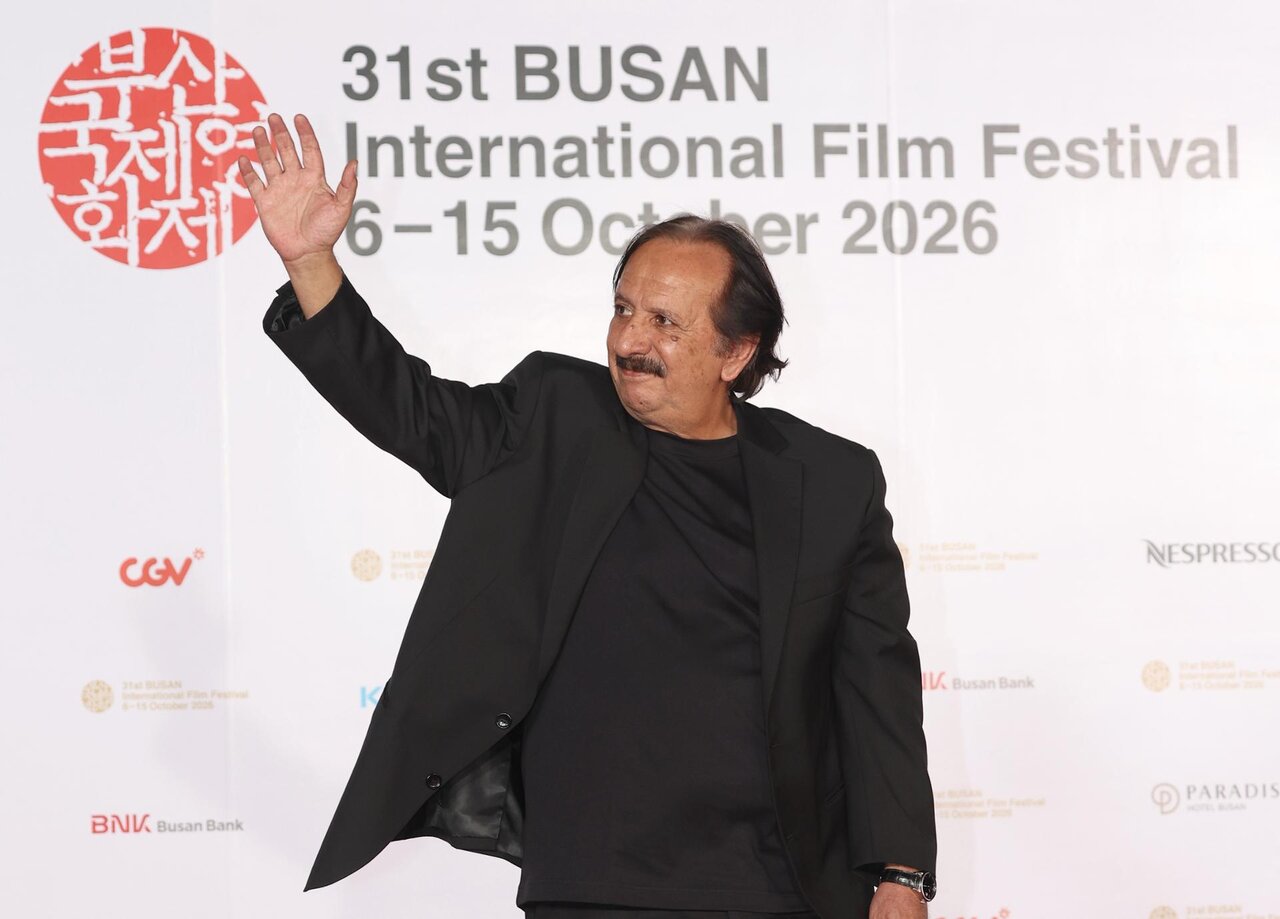
TEHRAN – Majid Majidi received the Best Film Award at the 31st Busan International Film Festival (BIFF) on Thursday for his latest film “Midday Meal”.
Winning the award, the renowned director secured a direct entry for his film, which had its world premiere at the festival, for consideration at the upcoming Academy Awards, Honaronline reported.
Starting this year, the grand prize winner under the Busan Award competition section automatically gains qualification to submit for the Best International Feature Film category at the Academy Awards. The Best Film Award also comes with a cash prize of 50 million won ($37,180).
Iran has already chosen Babak Khajehpasha’s “Land of Angels,” a drama about children enduring the war in Gaza, as its official submission for the 99th Academy Awards. But “Midday Meal” now has an open, alternate route to the race.
At the closing ceremony of the festival, jury president Zhang Yimou, Chinese filmmaking legend, praised “Midday Meal” as the ideal film and noted that all seven jury members agreed unanimously on the selection. Buzz around Majidi’s movie had been building on the ground in Busan all week, with many predicting — correctly — that it would take home the top prize.
Receiving the award, Majidi expressed his gratitude to the festival. He said it was an honor to receive such a huge prize on his first visit to Busan, adding that the energy came from the love of his late mother.
He dedicated the award to the “brave people of Iran” who are “still resisting oppression” and “never give up”.
Referring to economic sanctions imposed on Iran, the Iranian filmmaker said, “For 48 years, our people have been subjected to the harshest economic sanctions, to the extent that even access to medical assistance for treating children with cancer has been denied. Despite this, they have not surrendered.”
Majidi also referred to military attacks on Iran, saying, “You have all witnessed how, when they realized that the Iranian people would not surrender, they repeatedly subjected our country and cities to the most intense and brutal bombardments.”
He went on to describe the killing of children on the first day of the attacks, saying, “On the first day of the attack, 168 innocent children were torn apart, and the bodies of some of them were never found.”
Referring to attacks on homes, universities and residential areas, as well as the deaths of thousands of people, Majidi questioned why the Iranian people should have to pay such a price.
“What do you think our people’s crime is? They simply want to be independent, and we will stand firm to the very end,” he said. “I wish for a future with no more war, full of peace, love, and friendship,” he concluded.
Earlier in the festival, Majidi spoke at length at a press conference about how he had nearly declined the invitation to travel to South Korea because he felt depressed and exhausted by the dire situation at home. He ultimately decided that the trip would allow him and his film to convey “some kind of small message from my people to the people of other nations and other places.”
“Midday Meal” dazzled critics in Busan with its powerful, parable-like storytelling and assured visual style. The film follows Davoud Soulan (Mohammad Rahimi), a contract teacher in a remote village in southeastern Iran whose hopes of securing a permanent government job are jeopardized when a wealthy benefactor dies and the free lunches that keep his impoverished pupils coming to school disappear. Determined to save both his school and his future, Soulan resorts to increasingly desperate measures, including dangerous cross-border fuel smuggling, as his natural decency comes into conflict with his modest ambitions.
The film continues Majidi’s longstanding thematic preoccupation with the moral pressures faced by people on society’s margins, as seen in earlier festival-winning works like “The Color of Paradise” (1999) and “Baran” (2001).
For “Midday Meal,” he assembled an entirely nonprofessional cast through street casting in the region, setting their performances against the stark, otherworldly landscape of Iran’s so-called Martian Mountains.
Majidi and cinematographer Houman Behmanesh capture much of the drama with a gliding camera, often placing their protagonist against the region’s rugged, otherworldly landscape. The film gradually takes on the quality of an enigmatic existentialist parable.
The film marks the first time Majidi has been invited to Busan, having previously played Cannes, Berlin and Venice over the past 35 years. He is Iran’s most submitted filmmaker to the international category of the Academy Awards, landing a nomination in 1999 with “Children of Heaven” and making the shortlist in 2021 with “Sun Children”.
With its humanist approach to social realism and its particular focus on child welfare, “Midday Meal” is of a piece with Majidi’s oeuvre, which includes such films as “The Color of Paradise” and the 2020 Venice competition entry “Sun Children”; he remains best known internationally for his 1998 film “Children of Heaven,” the first Iranian production ever to be nominated in the category today named Best International Feature.
SS/SAB
Disclaimer : This story is auto aggregated by a computer programme and has not been created or edited by DOWNTHENEWS. Publisher: tehrantimes.com