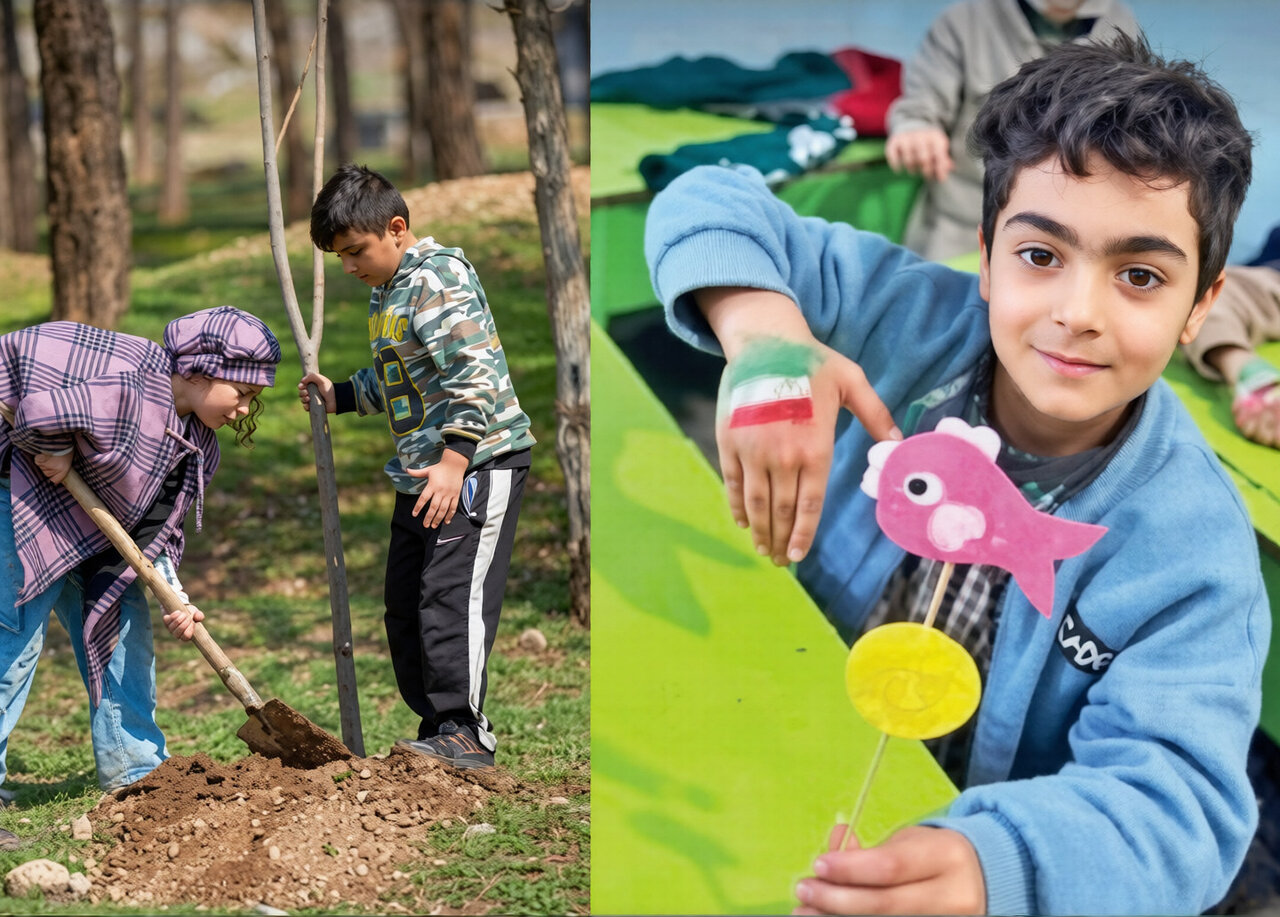
TEHRAN – The Department of Environment (DOE) has held the closing ceremony of an environmental storytelling project, titled ‘Makan’s Mission’, to honor students martyred in the US-Israeli war against the country.
Launched in May in cooperation with the Ministry of Education, the initiative was named after Makan Nasiri, one of the 168 schoolchildren killed in a deadly US strike on Shajareh Tayyebeh Elementary School on February 28, the first day of the imposed war.
The project portrayed Makan as a young environmental advocate whose mission was left unfinished following his martyrdom, encouraging other students to carry on his path and continue his efforts to protect the environment.
The project is actually a subcategory of an earlier project that aims to train eco-friendly students, or environmental helpers. Both projects aim to enhance the students’ environmental literacy.
Addressing the ceremony, Hadi Kiadaliri, the deputy head of the DOE for education and public participation affairs, highlighted the profound importance of environmental education at an early age, saying that environmental education for children is an investment in the country’s future, IRNA reported.
The cultivation of good environmental habits has to commence at a very young age; in addition to fostering awareness and knowledge among children, it is essential to strengthen their emotional affinity with nature, he added.
Referring to environmental challenges in the country, Kaidaliri said a significant part of our country is located within an arid and semi-arid climate, with low vegetation. Nevertheless, Iran boasts valuable biodiversity, including species unique to the country, and ecosystems that date back to millions of years ago. Therefore, protecting Iran’s environment is of particular importance.
Highlighting the role of children in bringing about lasting changes in society, Kiadaliri noted that one reason for the persistence of environmentally damaging behaviors is that many are bound by habits. Therefore, good habits have to be developed from childhood.
To teach children appropriate habits, giving mere advice is insufficient; instead, establish environments in which proper behavior is reinforced by positive outcomes and improper conduct leads to negative consequences. This way, children learn to make sound decisions and take on greater responsibility for their choices in the future.
Education is not merely about acquiring knowledge. Many may possess extensive environmental knowledge, but it does not necessarily result in appropriate environmental behavior. Children have to recognize their role in tackling environmental issues.
The official went on to say that investing in environmental education and the upbringing of children is not an expenditure, but an investment in the future.
The more we invest in educating the younger generation today, the less we will have to spend on improving environmental damage and correcting improper conduct in the future.
Accordingly, cooperation among the DOE, the Ministry of Education, and the Institute for Intellectual Development of Children and Young Adults (IIDCYA) is a critical necessity for the development of a broad educational movement and engaging students in environmental conservation.
Addressing the unveiling ceremony of the environmental storytelling project in May, Kiadaliri said the project to train eco-friendly students kicked off in the Iranian year 1375 (1996). Back then, it was limited to a few provinces. However, the project faced some challenges that highlighted the need for its revision.
In January 2023, the DOE and the Ministry of Education unveiled the logo and the poster of the national plan for the project.
Highlighting the role of education in developing values such as responsibility, the official said teaching environmental issues to children will contribute to instilling eco-friendly behaviors in them, which will later turn into sustainable habits. Investing in children will enhance lifelong social outcomes.
If adults are responsible for current changes, children will play the same role in the future. The training needs to be constant and accessible, he added.
For his part, Education Minister Alireza Kazemi noted that the integration of environmental teachings into textbooks, from preschool to high school, is on the agenda to help promote the culture of preserving the environment.
The educational courses will not be limited to students; they have the capacity to train parents and teachers, as well.
Apart from textbooks that involve formal training, the Ministry of Education focuses on informal training that would promote students’ social participation in practice.
The official also announced the ministry’s readiness to expand training by establishing a vocational training center to provide practical skills in the environment sector, and even utilize available capacities to organize educational courses.
Education is the key to bringing about any change in the economy, culture, and social life; therefore, providing skills and training and proper behaviors will play a key role in improving the current situation, Kazemi highlighted.
The official went on to say that students who are environmental helpers have to be introduced and lauded; they should be allowed to have a more influential role, and feel more responsible for participating in environmental conservation programs.
In February, DOE and the Education Ministry discussed the possibility of developing a national education curriculum to promote environmental responsibility and awareness among children.
Referring to the inefficiency of short-term and incoherent teaching, Mohammad Medadi, an official with the DOE, said that achieving sustainable development and boosting the country’s resilience are not possible without institutionalizing an environmentally friendly attitude and lifestyle in society. So, educational approaches need to be reviewed, he added.
Environmental protection education should be taught from preschool to high school. In addition to scientific training, it should focus on ethical aspects based on cultural, religious, and social teachings.
The initiative also aims to train and empower parents and teachers, the official further noted.
MT/MG
Disclaimer : This story is auto aggregated by a computer programme and has not been created or edited by DOWNTHENEWS. Publisher: tehrantimes.com