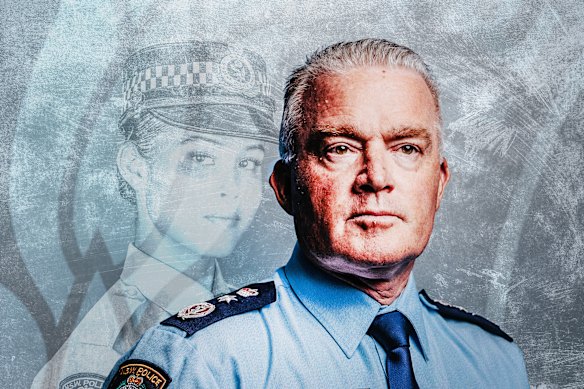
In a wide-ranging interview with the Herald on the first anniversary of his swearing-in, the commissioner reflects on a year marked with tragedy and adversity.
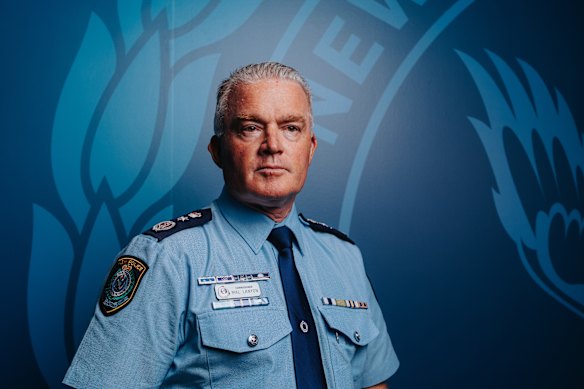
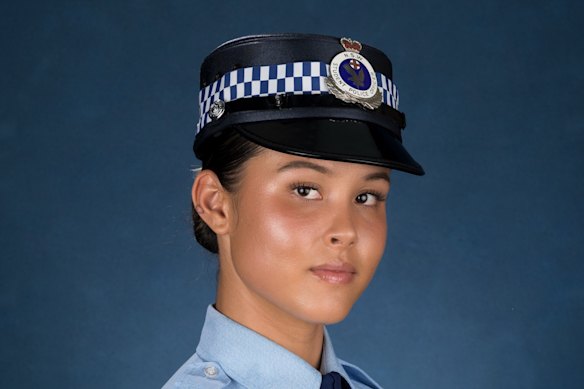
A week has passed since Constable Mia Lay was killed, and NSW’s police commissioner, Mal Lanyon, is grappling with how best to express the first death of an on-duty officer in more than a decade. For Lanyon, who returned early from leave after learning of the 20-year-old’s death in the early hours of September 25, the gravity of the tragedy is difficult to put into words.
Of the major challenges that Lanyon has faced in his first year at the top of the state’s police force – the killing of 15 people during the Bondi Beach terror attack last December; the deaths of innocent people wrongly targeted in Sydney’s escalating gangland conflicts; and the ever-present task of recruiting and retaining police officers – Lay’s death in a high-speed crash in Sydney’s inner south may be the most personal; the loss of a member of what Lanyon calls the “blue family” often hits the hardest.
“To lose one of my officers in a circumstance like that, someone who was going about doing her duty to protect the community, has an impact on me,” Lanyon tells the Herald in a wide-ranging interview on the anniversary of his swearing-in as NSW’s 24th police commissioner. “Losing her, someone so young with such a bright future, obviously has an impact.”
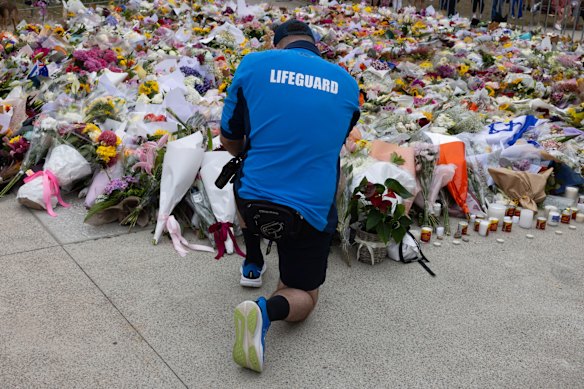
In policing circles, many regard Lanyon’s first year as the state’s top officer among the hardest any commissioner has faced; two-and-a-half months after his appointment, father and son Sajid and Naveed Akram opened fire on the Bondi Jewish community’s annual Chanukah by the Sea festival, killing 15 innocent revellers and injuring dozens more, including two police officers, in Australia’s worst terror attack.
“I think innocence was lost in Sydney and NSW through Bondi,” Lanyon says, recalling the frantic hours after the shooting. “The overall impact that had on the community of Sydney, I think, and NSW, and to be honest, Australia, was overwhelming. I think everyone was shocked by it. I think everyone was dismayed by it.”
The attack, Lanyon feels, changed the fabric of Sydney: “In our younger generation, there will be children, certainly from the eastern suburbs, who will be scarred by that event for many, many years,” he says. “You can’t forget what happened there … there’s never going back to pre-Bondi in my mind.”
Beyond Bondi, the past 10 months have presented a new wave of challenges for police, who are working to keep pace with a rapidly evolving organised crime landscape. Amid the waves of violence, Lanyon has faced growing community concern stemming from a series of mistaken-identity killings linked to conflict over control of Sydney’s illicit drug market.
The targeting of innocent people has mounted pressure on him and NSW Premier Chris Minns, who has introduced a suite of law changes to combat organised crime, including harsher penalties for children committing serious offences, as what is shaping as a law and order election next March approaches.
Diverting teenagers, some as young as 14, who are increasingly involved in organised crime, has so far proved an unsolvable problem for police forces across the country and remains a priority for investigators in NSW, as does the apprehension of exiled organised crime figures pulling the strings of Sydney’s underworld from the safety of foreign jurisdictions.
Since last June, detectives working under Taskforce Falcon, a 150-strong operation launched after the mistaken-identity killing of Sydney plumber John Versace last May, have arrested more than 850 people and laid more than 2200 charges – a sign, Lanyon says, of officers’ commitment to community safety.

“No one who wants to commit these sorts of offences should feel they’re doing so with impunity,” he says. “No one should believe that we aren’t going to target them.”
For Lanyon, a former homicide and organised crime detective, the disregard for human life that has become a hallmark of current gangland conflicts is cause for concern. “There was a certain honour to the way they conducted themselves,” Lanyon says of the seasoned criminals he investigated. “If there was going to be violence, there were rules about not targeting family, not targeting family members.”
The alleged kidnapping and murder of 85-year-old Chris Baghsarian in February – regarded by senior police as a sign the goalposts had shifted – was unimaginable a decade ago, Lanyon says. “That never would have happened before. That is not something we would have seen,” he says.
As his officers focus on those causing the most harm to the community, Lanyon has at times been forced to look closely at those inside his organisation. The actions of police at February’s Town Hall protest against the visit of Israeli President Isaac Herzog are the subject of a months-long investigation by the state’s policing watchdog, the Law Enforcement Conduct Commission, which is examining allegations of excessive force and heavy-handedness. Public hearings are expected to be held in the coming months.
Both domestic violence and organised crime remain a priority for Lanyon, as does reducing the state’s road toll, which is expected to reach 300 this year. He says that despite concerted police efforts to monitor driver behaviour, including speed, fatigue and drink-driving, the number of deaths on NSW roads has climbed. “Road trauma is something that continues to concern us,” Lanyon says. “We can actually reduce the road toll. Losing 300 people a year is something that should be simply unacceptable to the community, particularly when we can control it.”
Looking beyond his tenure as commissioner, Lanyon says his focus is to oversee the maturation of NSW Police and implement a succession plan that leaves the force in the hands of capable leaders.
Work on that front has begun; in recent months, a reshuffling of the state’s most senior officers and the retirement of others has reshaped the hierarchy Lanyon inherited from his predecessor, Karen Webb, who resigned three and a half years into her five-year term after intense media scrutiny over her handling of a series of major scandals embroiling the force.
In a year marked with tragedy and adversity, there are positives Lanyon takes away. Despite the current shortfall of 2500 personnel across the state stretching police on the ground, 2026 is the first time in five years that more officers have joined NSW Police than left.
That the last three classes to graduate from the force’s Goulburn academy were the largest in more than a decade indicates that things are moving in the right direction, says Lanyon, who has visited more than 50 police stations across NSW in the past year. “Recruitment and retention as a broader organisation issue is something that I’ve got to focus on because the more police we have on the street, the more supported the officers that are currently here doing a great job are, but certainly the better service the community gets,” he says.
The outpouring of community grief over Lay’s death, Lanyon says, is indicative of how NSW views its men and women in blue. “I think everyone can see her as their own daughter,” says Lanyon. “It’s had a massive impact right across the board.”
As the police force on average becomes younger, less experienced officers are facing situations beyond their years, Lanyon says.
“My job’s going to be to continually improve the organisation,” he says. “I want to work on what we’re doing at the moment. If there are better practices, we will pick them up. If we can make improvements on things we currently do, we want to do that.”
Start the day with a summary of the day’s most important and interesting stories, analysis and insights. Sign up for our Morning Edition newsletter.
Disclaimer : This story is auto aggregated by a computer programme and has not been created or edited by DOWNTHENEWS. Publisher: www.smh.com.au