White crusty build-up on your taps and kettle? Tap water levels of hardness vary significantly across Germany.
If you’ve moved to Germany, you may have noticed a white, chalky residue around your taps, shower head and kettle. That’s limescale (Kalk), and it’s caused by calcium and magnesium dissolved in tap water. Water with lots of these minerals is called “hard” water.
Hard water is safe to drink, but it’s a nuisance at home. Limescale builds up in kettles and coffee machines, so you’ll need to descale them more often. It can also mean using more detergent and cleaning products.
How hard your water is depends on where you live in Germany.
How hardness is shown in Germany
German water hardness is given in °dH (Grad deutscher Härte). You’ll see this on your water bill or your local water company’s website. The higher the number, the harder the water:
Soft: below 8.4 °dH
Medium: 8.4 to 14 °dH
Hard: above 14 °dH
READ ALSO: Would you drink the kebab water in Berlin?
How hard is the water across Germany?
The average water hardness across Germany is about 15 °dH, according to wasserhaerte.net, based on 4,628 locations with their own measurements. The LIMPEO map (below) puts the average a little lower, at 12 °dH (“moderately hard”).
Either way, a large part of the country sits at or above the medium range.
Where is the water hardest?
There are exceptions, but water tends to be harder in the south and east where it can pass 20 °dH. The reason is limestone in the bedrock. By federal state, the highest averages according to wasserhaerte.net are in:
- Saxony-Anhalt: 21 °dH
- Berlin: 19 °dH
- Mecklenburg-Western Pomerania: 18 °dH
- Brandenburg, Bavaria and Thuringia: 17 °dH
Many of Germany’s major cities have hard water, meaning above 14 °dH. Wasserhaerte.net also lists the cities that visitors to the site look up most often, and gives a figure for each based on a single postcode in that city.
On that basis, Frankfurt am Main and Mannheim are the hardest at 20 °dH, followed by Berlin at 19 °dH and Wiesbaden at 18 °dH. Cologne comes in between 15.6 and 18.1 °dH, and Munich at 16 °dH.
Nuremberg sits right on the 14 °dH threshold, while Stuttgart is the softest of the group at 11 °dH, in the medium range.
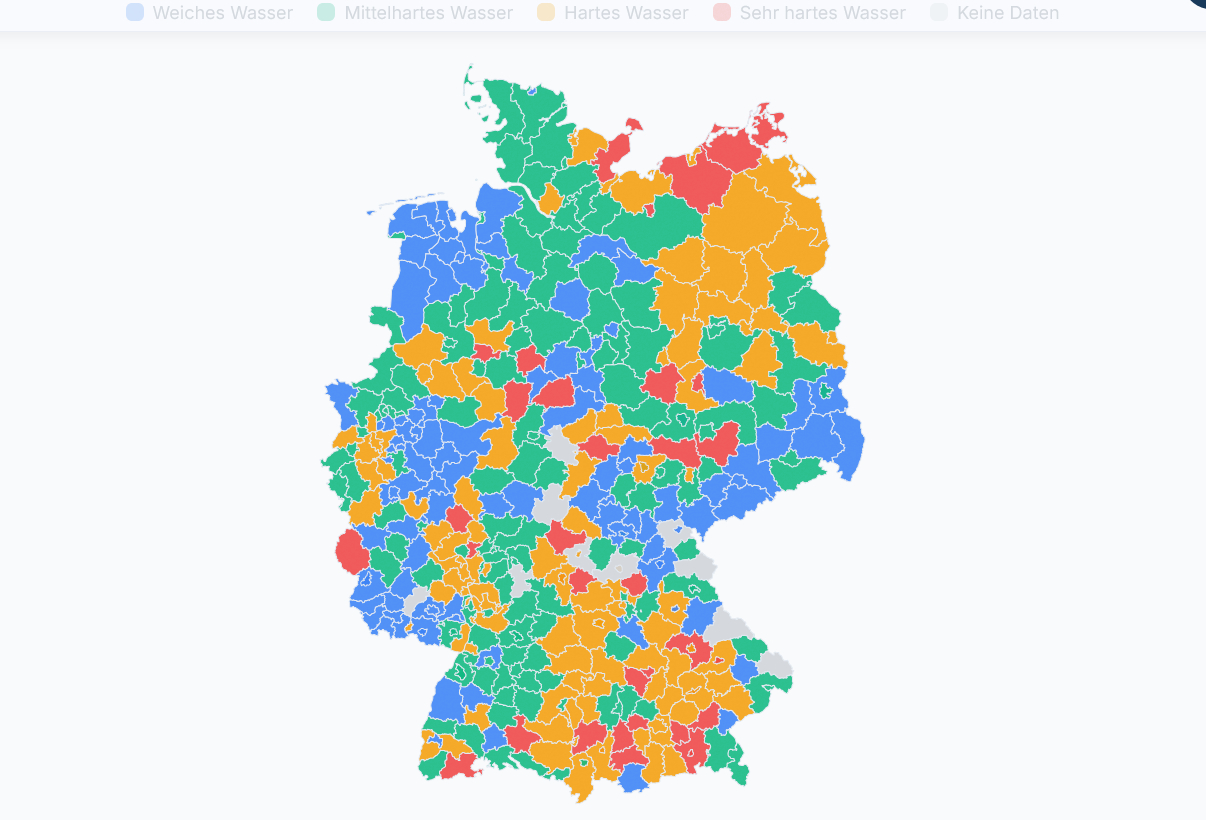
Water hardness map of Germany. (Source: Water Hardness Map by LIMPEO)
The map above is a screenshot of an interactive map showing water hardness across Germany. Blue shows soft water, green is in between, orange is hard water, and red is very hard water.
The interactive map covers 390 regions in Germany. Of these, 105 are classed as soft, 143 as medium-hard, 106 as hard and 36 as very hard. The values are regional averages, so your own tap may differ.
Where is the water softest?
The north and west tend to have softer water. Among the federal states, Bremen has the lowest average at 8 °dH, followed by Saarland at 10 °dH, and Hamburg and Saxony at 11 °dH each. Dresden records 8 °dH, and Sittensen in Lower Saxony 7.9 °dH.
The contrast comes down to geology. Rainwater that seeps through limestone picks up lots of calcium and magnesium. Where the rock is granite or sandstone, hardly any minerals dissolve, so the water stays soft. Across the country, hardness ranges from under 1 °dH to over 46 °dH.
Is hard water safe to drink?
The Bavarian Consumer Advice Centre (Verbraucherzentrale Bayern) says drinking water with high hardness poses no health risks. Calcium and magnesium are important parts of our diet, though the amount we get from water is small compared with food. It calls the idea that hard water calcifies your blood vessels a “widespread misconception”.
Some people notice a distinct taste, which doesn’t go away when the water is heated. Coffee and tea drinkers may spot it.
But the real downside is limescale. It builds up in pipes, water heaters and appliances, which can make them less efficient and shorten their lifespan.
READ ALSO: How healthy are people in Germany?
Can you do anything about hard water?
Limescale starts to become noticeable at around 8.4 °dH. In hard-water areas, it may be worth investing in a water softening system (Enthärtungsanlage in German).
This is essentially a unit that removes the calcium and magnesium from your water before it reaches your taps. It is normally installed where the water enters the property, so everything downstream gets softened water. That includes your boiler, pipes and appliances, which helps protect them from limescale.
For a more targeted approach, anti-limescale filters can be fitted to showerheads or taps, while regularly descaling kettles, coffee machines and other appliances with citric acid or white vinegar can help remove existing deposits.
It’s worth noting that ordinary jug filters don’t necessarily soften water, and boiling water only removes some of its temporary hardness.
With reporting by Emma Albright.
Disclaimer : This story is auto aggregated by a computer programme and has not been created or edited by DOWNTHENEWS. Publisher: thelocal.de