
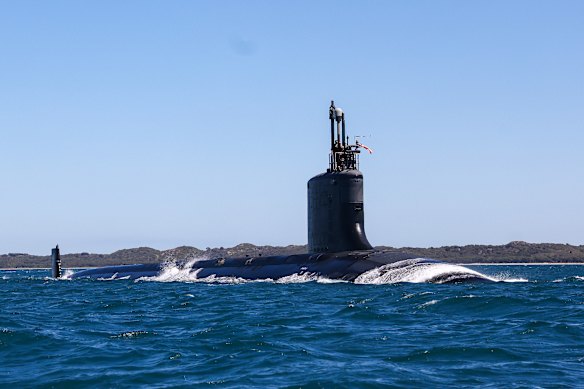
Defence Minister Richard Marles says taxpayers will save money by ditching a plan to acquire a new and upgraded nuclear-powered submarine from the United States, but experts warn Australia will receive a less capable vessel with a shorter lifespan under the AUKUS shift.
Marles and US Defence Secretary Pete Hegseth on Saturday said the last of three Virginia-class submarines Australia plans to buy from the US will now be second-hand rather than a new boat as originally planned.
Under the AUKUS plan announced in 2023, Australia was to buy a mix of new and second-hand submarines from the US. The vision was for two second-hand US submarines to arrive beginning in 2032 and the third submarine was to be a new and improved Block IV Virginia-class boat.
All three vessels will now be used submarines that may already have been in service for years, and possibly over a decade, each.
Marles said the shift was primarily about reducing risk and complexity, but he said it would make a “significant” reduction to the purchase price of the final US submarine.
“It definitely helps,” Marles told reporters at the Shangri-La Dialogue in Singapore when asked about the cost impact of the move.
“This is a very expensive program obviously, and so we are trying to find every cost-effective option as we walk down this path.
“So this is a very useful financial contribution to the cost of the overall program.”
The decision is widely believed to be linked to senior Pentagon official Elbridge Colby’s AUKUS review, which was completed at the end of last year but has not been made public.
Colby had previously expressed concern that providing Virginia-class submarines to Australia could deplete the US Navy’s reserves, given sluggish American production rates.
Marles, Hegseth and British Defence Secretary John Healey said in a statement that the decision was about “simplifying supply chain management, operational and maintenance requirements, and maximising cost efficiencies”.
The government estimates the total cost of the AUKUS scheme will be between $268 billion and $368 billion over three decades, making it the biggest defence procurement project in Australian history.
Opposition defence spokesman James Paterson said: “This appears to be a significant change of plan for acquisition of Virginia-class submarines … I will be seeking an explanation from Defence at Senate estimates this week about why this change was made and what the implications are.”
Former senior defence official Michael Shoebridge said: “This is bad news. The new Virginias are more capable and easier to maintain … The US aren’t building enough submarines so they are keeping the more capable ones for themselves.”
The new Block VII submarine Australia had been slated to acquire from the late 2030s has been described by trade publication Army Recognition as “one of the final and most advanced versions of the Virginia-class submarine, with improved stealth, greater use of unmanned underwater systems, and enhanced capability for long-range strike and seabed operations”.
Virginia-class submarines are estimated to cost $US5 billion ($6.95 billion) each to produce, including weapons, according to the US congressional research service.
Marles said there had long been debate about whether Australia should seek to acquire a new submarine from the US, as this could mean the Australian navy would be operating four different types of submarine at once: the Collins-class submarine, two types of Virginia-class submarine and the new SSN-AUKUS nuclear-powered submarine being developed between Britain and Australia.
“What we will have here is a much simpler pathway,” he said.
“It will mean that the Virginia-class submarines that we are acquiring will all be of the same type, and I cannot overstate the significance of that, both in terms of the submariners who are operating them, but also the people who are working on them to sustain those submarines.”
Greens senator David Shoebridge said it was ridiculous for Marles to paint the decision as a win for Australia, describing AUKUS as a “dud deal” for Australia.
“You cannot make this stuff up on AUKUS,” he said.
Former naval officer Jennifer Parker said she supported the decision, while acknowledging there were downsides to the move.
“This reduces risk and complexity in what is already a very ambitious program,” said Parker, an adjunct fellow in naval studies at UNSW.
“If the three submarines we buy come from the same block, they will have the same configuration, same training and maintenance requirements and same spare parts. We won’t have to put them through the trials for initial certification. These boats will still be streets ahead of any other attack submarines in the world.”
However, she added: “The third submarine will now be a less capable boat than it would have been and will have less life in it. It may have 20 years left of service rather than 33.”
 Matthew Knott is the foreign affairs and national security correspondent for The Sydney Morning Herald and The Age.Connect via X, Facebook or email.
 Lisa Visentin is the North Asia correspondent for The Sydney Morning Herald and The Age based in Beijing. She was previously a federal political correspondent based in Canberra.Connect via X or email.
From our partners
Disclaimer : This story is auto aggregated by a computer programme and has not been created or edited by DOWNTHENEWS. Publisher: www.smh.com.au


