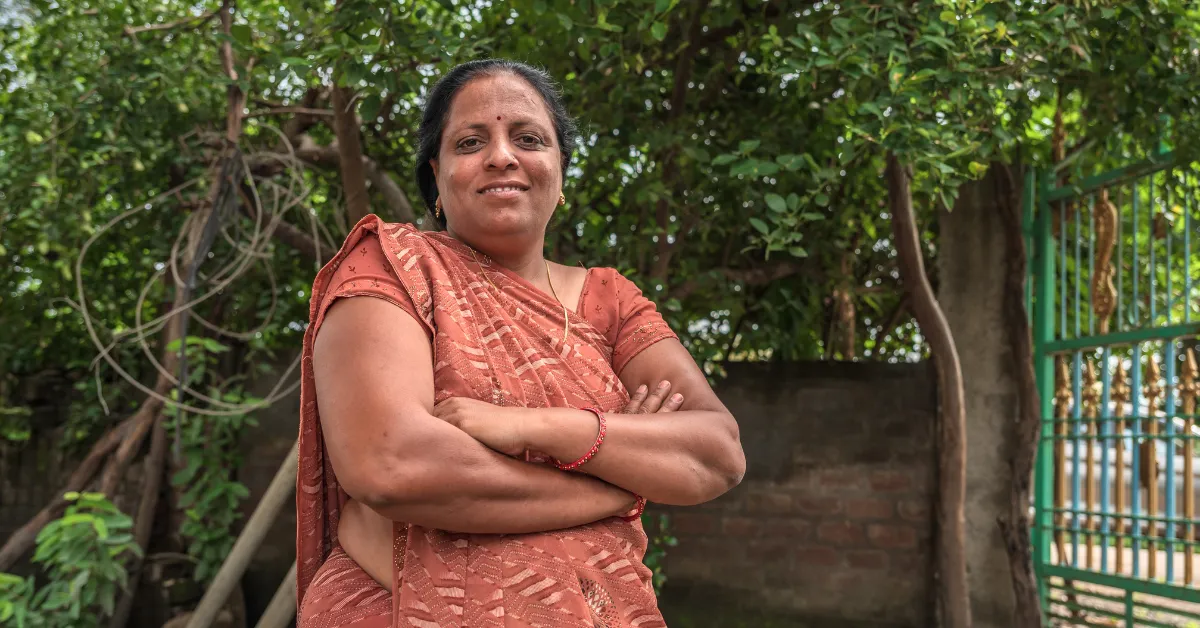
On a warm afternoon in Balipur village, a group of women sits in a circle inside the Panchayat building. Some have come straight from the fields, their dupattas still dusted with soil. At the centre stands a woman, speaking with calm assurance about why daughters must study, why sons must share household work, and why silence is not the only option women have.
A few years ago, this would have been unthinkable.
The woman leading the conversation is Geeta Devda. Once confined within the walls of her home, she now helps other women step into public spaces, raise their voices in Gram Sabha meetings, and shape decisions that affect their lives.
Her journey from restriction to leadership is not just personal; it has unfolded alongside other women, shaped by shared struggles, collective courage, and growing trust.
Finding her voice in a village that expected silence
A resident of Balipur in Dhar district, Madhya Pradesh, she lives with her son and daughter. Before she became someone other women turned to for guidance, she was navigating a life that had changed too quickly.
“I got married when I was 16 years old. I was studying in my Class 10,” she tells The Better India.
The transition from school to marriage was not just early, it was disorienting.
“When I came to my in-laws’ house, I was having a hard time. I didn’t know how to live in the village. I had to face a lot of problems,” she says.
“Even if there was a labourer in the field, I had to reach there on time after finishing all the work at home. I didn’t know how to work in the fields because I had never done it before.”
The expectations were immediate, and the space to learn was limited. Alongside financial struggles, there were restrictions that made even stepping outside difficult. Over time, silence became less of a choice and more of a habit.
The transition from school to marriage was abrupt and disorienting.
“When I came to my in-laws’ house, I was having a hard time. I didn’t know how to live in the village. I had to face a lot of problems,” she says.
“Even if there was a labourer in the field, I had to reach there on time after finishing all the work at home. I didn’t know how to work in the fields because I had never done it before.”
Alongside financial struggles, restrictions on mobility made stepping outside difficult. Over time, silence became a habit.
But in 2013, an unexpected shift began.
“My sister-in-law used to go to a group in another village. I used to see her and think, “Can I also join? When she asked me, I said yes. I did not even ask my family members.”
It was a small decision, but not an easy one. Her family was initially apprehensive and refused permission, but she chose to go ahead.
Those meetings did not transform her overnight. But they gave her something new — a space to sit without fear, to listen, and slowly begin to speak.
From participation to purpose
The self-help group began with small savings — Rs 100 at a time — but its impact went far beyond money. It created a sense of belonging.
Alongside financial literacy, she learned tailoring. With restrictions still in place, she worked from home, stitching bags and household items, while other women helped sell them in the market.
For the first time, her work reached beyond her home.
A few years later, in 2018, another turning point came when she was introduced to Transform Rural India (TRI).
“I used to attend training sessions with other women. They told me about different projects. I said yes, but I also told them, ‘I am not educated; will I be able to work?’”
The doubt reflected years of limitation, but the willingness to try remained.
Through training on gender, rights, and leadership, her understanding began to expand.
Pallavi, a field officer who first met her during a cluster-level meeting, recalls:
“I saw her speaking very well about the problems in her village. She was confident and bold and did not mind sharing her thoughts; it was evident that whatever she was doing, it was with her full heart.”
The training encouraged women to think beyond immediate concerns.
“They are asked to think about their life, their family, and their village. From there, they begin to see themselves as part of change.”
And slowly, she did, seeing herself not just as someone affected by systems, but someone who could engage with them.
When survival turns into leadership
Then came a turning point that could have undone this progress.
“Because my children were small and my husband had passed away, I had to take care of all the responsibilities at home and farming.”
/filters:format(webp)/english-betterindia/media/media_files/2026/05/29/geeta-devda-2026-05-29-13-28-12.png)
The shift was sudden, the responsibility absolute. But this time, she did not face it the way she once might have. By now, she had a network, a skillset, and a growing sense of confidence.
So instead of retreating, she expanded her role.
“Now I do housework in the morning, cook food, and then go to the field. I stay in touch with the women and tell them how we can move forward independently.”
Her days became longer, but also fuller in purpose.
What began as participation in a group gradually evolved into leadership within it. She became the president of her self-help group and started encouraging other women to step into spaces they had long avoided — Gram Sabhas, Panchayat meetings, public forums.
“They did not go to Panchayat Bhawan or Gram Sabha. They used to sit on the floor while men sat on chairs. Now they sit equally and ask about their rights.”
The shift was subtle but powerful, moving from presence to participation and from participation to assertion.
Around the same time, another layer of change began to unfold — one that was more personal and more difficult to navigate.
In 2022, they received gender training from Transform Rural India (TRI). For the first time, we understood what gender really means — our roles, the differences between men and women, and even awareness about our own bodies.
“Earlier, these were things we were never told or were made to feel ashamed of. If I had known all this before, maybe I would not have been married so early. My education would not have been taken away,” adds Geeta.
These conversations challenged long-held beliefs, not just within the community, but among the women themselves.
/filters:format(webp)/english-betterindia/media/media_files/2026/05/29/geeta-devda-2026-05-29-13-33-41.png)
“At the start, women in our group felt this was inappropriate. They asked why we were talking about such things.”
So she adapted, simplifying conversations around gender roles, myths, and body awareness.
“We also asked men to sit and listen so that there is no miscommunication and gender roles are redefined.”
Trust grew slowly, but with that came openness. Women began sharing experiences they had never spoken about before, including domestic violence.
“We told them, if you go alone, no one will listen. If you go together and voice your concerns, everyone will listen.”
That idea, of going together, became central to everything that followed.
When one voice becomes many
The change is most visible in the women around her.
One such story is Rajkor didi’s. Once confined to home and labour work, she rarely spoke in meetings. That began to change through the Nari Adhikar Kendra.
“She used to come and talk to us openly and ask us about our problems. Slowly, we began to understand — not just the problems, but how to deal with them.”
With that understanding came something deeper — a quiet but steady confidence.
“Earlier, we did not speak even at home. Now we are not afraid of anyone. We can speak and give answers.”
That shift began to reflect in everyday life.
/filters:format(webp)/english-betterindia/media/media_files/2026/05/29/geeta-devda-2026-05-29-13-30-57.png)
“We learnt about education, about schemes. We took a loan and started work. I got a flour mill and spice grinder.”
But the most meaningful change is harder to see and impossible to miss.
“This confidence, this freedom to speak – it means everything. If we had taken out time earlier like this, we could have done anything,” says Rajkor.
As more women spoke up, conversations expanded to issues like domestic violence.
“They started sharing how helpless they felt. Since the sarpanch is also a man, they did not know where to go. So I told them, you can come to the Nari Adhikar Kendra and report your problems.”
Gradually, cases began to be reported.
In one instance, an elderly woman was abused and thrown out of her home. The police initially did not listen. But this time, she was not alone.
“They went to the doctor first, then spoke to other women, and together decided to take action. They went to the police station as a group. That collectiveness made a difference.”
“It will take time, because this has been there from the beginning.”
In another instance, women demanded a closer Gram Sabha.
“We went together, gave applications, and finally, through the collective effort of Didi’s Gram Sabha meetings, started happening there.”
Step by step, the shift became collective.
A circle that continues to widen
Today, her life holds many roles – farmer, mother, community leader, and coordinator.
She earns Rs 15,000 a month, supports her children, and works closely with women across villages. What once felt distant, learning to ride a scooter, has grown into bigger milestones, including buying her own car in February 2026.
But her real impact lies in the spaces she has opened for others.
“She had leadership qualities, but she did not have the platform earlier. Now she is motivating others, especially young girls, to continue their education,” says Pallavi.
/filters:format(webp)/english-betterindia/media/media_files/2026/05/29/geeta-devda-2026-05-29-13-32-23.png)
“If we had known earlier, things could have been different. That is why we must tell other women and educate them.”
Back in the Panchayat building, the meeting continues. The circle is fuller now. Women who once sat quietly are asking questions, sharing opinions, and making decisions.
She is still there, but no longer at the centre.
Because the space no longer depends on one voice, it holds many.
And in that widening circle lies the real transformation, not just of one woman stepping beyond confinement, but of an entire community learning how to lead.
All image courtesy TRI team
Disclaimer : This story is auto aggregated by a computer programme and has not been created or edited by DOWNTHENEWS. Publisher: thebetterindia.com