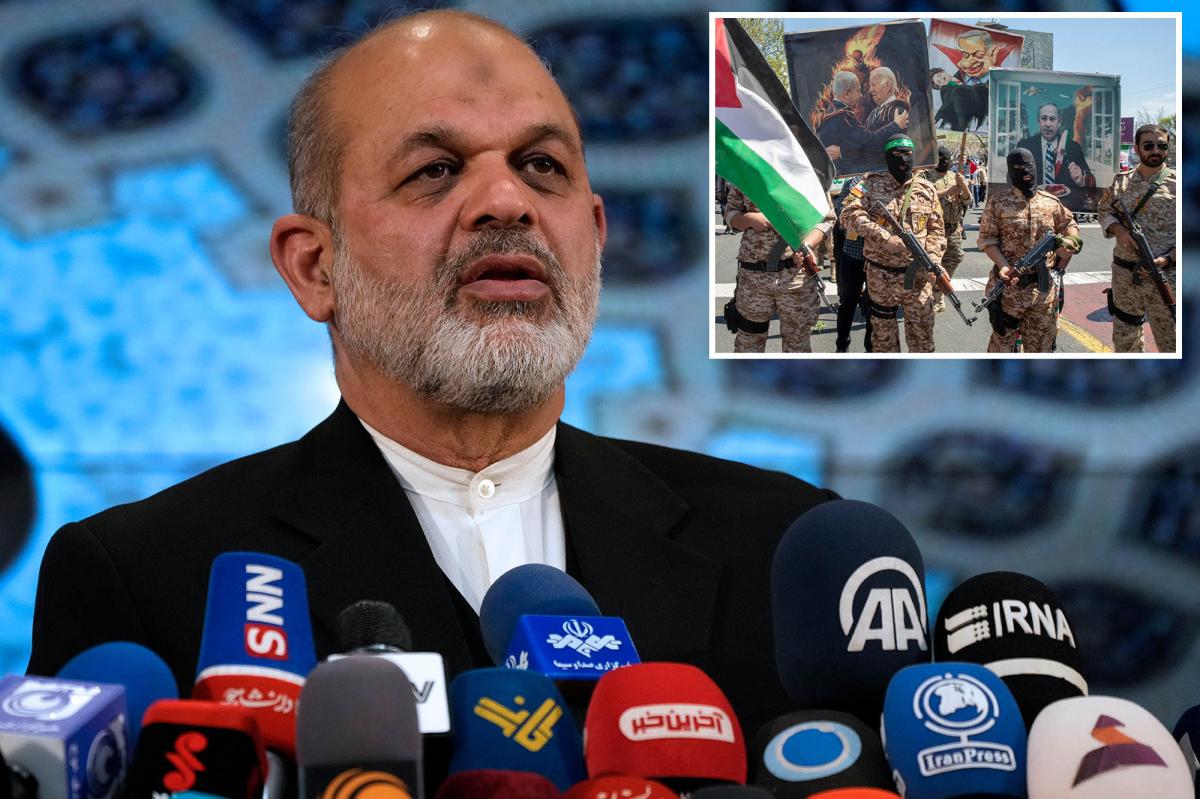
After US-Israeli airstrikes rocked Iran’s leadership, killing dozens of top officials in the initial days of the war, one man has risen to control the Islamic Republic from the shadows.
Maj. Gen. Ahmad Vahidi, the commander of Iran’s Islamic Revolutionary Guard Corps, has mobilized his inner circle to take control of Iran’s military response and negotiating team, analysts said.
As soon as Vahidi, 67, and his allies took control, Iran shifted to an even harder-line stance, with officials refusing to join peace talks with the US this week and Tehran ramping up attacks on ships trying to sail through the Strait of Hormuz.
Vahidi, who is heavily sanctioned by the West and linked to terror attacks in Argentina, represents Iran’s most extreme faction that has sidelined Tehran’s moderates, including those leading the current negotiations with the US.
Even if the US were to secure a deal with Iran’s delegation, the team may not have any actual pull in Iran as long as Vahidi and his allies run the show.
Who is Ahmad Vahidi?
Vahidi had served as the commander of Iran’s elite Quds Force in the 1990s, building up Iran’s influence across the Middle East before handing the reins to terror mastermind Qasem Soleimani.
Vahidi and Soleimani have often been credited with laying the groundwork for Iran’s terror proxies to bloom abroad, including the Hezbollah terrorist group in Lebanon.
Unlike the last two IRGC chiefs, Vahidi served in Iran’s political machine, holding senior roles and serving as defense minister and interior minister under two administrations.
The seasoned military commander and politician was appointed as the IRGC’s deputy chief last December by slain Supreme Leader Ali Khamenei.
Once Khamenei and former IRGC Chief Mohammad Pakpour were killed by US-Israeli airstrikes on Feb. 28, Vahidi rose to the top of Iran’s paramilitary force.
Who is really in charge in Iran?
Following Khamenei’s death, Vahidi pushed for his lackluster son, Mojtaba Khamenei, to be his successor despite reports that the slain ayatollah never wanted him in charge.
With Mojtaba injured in the Feb. 28 strikes and yet to be seen in public, it’s clear that the new supreme leader is nothing more than a tool for the real regime heads, said Khosro Isfahani, research director for the Washington-based National Union for Democracy in Iran think tank.
“If Mojtaba is alive, and that is a big if, he is just a sock puppet. He is the first AI-generated supreme leader in human history,” Isfahani told The Post, referencing the fake photos the regime had posted of Mojtaba following his appointment.
“He has zero political capital, zero public support, and zero sway over the decision-making. The regime has and will continue attributing statements to him,” Isfahani added.
Usurping Iran’s negotiating team
Vahidi’s control of Iran’s negotiating team became evident when he was able to tap Mohammad Bagher Zolghadr, Iran’s Supreme National Security Council secretary and an IRGC veteran, to join the delegation earlier this month.
Zolghadr was specifically sent to make sure the delegation was following the IRGC’s hardline commands, according to the Institute for the Study of War.
The security secretary proved to do just that when he reported Foreign Affairs Minister Abbas Araghchi after the diplomat allegedly suggested that Iran was willing to make concessions during the first round of peace talks.
“Zolghadr sent a complaint to senior IRGC leaders, almost certainly including Vahidi, that Araghchi had surpassed his mandate during the negotiations by expressing flexibility regarding Iran’s support for the Axis of Resistance,” the ISW said of the initial peace talks.
“Zolghadr’s anger caused senior leaders in Tehran, including former IRGC Intelligence Organization Chief and long-time member of Mojtaba’s inner circle, Hossein Taeb, to call the negotiating delegation back to Tehran,” the think tank added.
Iran’s delegation has yet to return to Pakistan to continue peace talks with the US, suggesting Vahidi and Zolghadr’s alliance continues to dominate Iran.
Iran’s good cop, bad cop routine
As renewed peace talks with Iran have yet to manifest, Khosro said Iran was sticking to its “good cop/bad cop” routine, with Vahidi playing the role of bad cop while Iranian Parliament Speaker Mohammad Ghalibaf plays good cop.
Ghalibaf is reportedly leading Iran’s delegation along with Araghchi, but the speaker’s past suggests that he’s still cut from the same cloth as Ghalibaf, Khosro said.
“A comparative study of the two key players in the arena, Vahidi and Ghalibaf, shows that they grew through the ranks of the IRGC together and have historically advocated for identical policies and strategies,” he pointed out.
Ties to terrorism abroad, brutal crackdown
Vahidi was among nine top Hezbollah and Iranian officials accused of helping orchestrate the 1994 bombing of the Asociación Mutual Israelita Argentina (AMIA) Jewish community center, in Buenos Aires, which killed 85 people.
Interpol issued a red notice against Vahidi, urging law enforcement entities around the world to find and arrest him, making the IRGC commander an internationally wanted terrorist.
Along with the infamous 1994 bombing, Argentine investigators have also linked Vahidi to the 1992 bombing of an Israeli Embassy in Buenos Aires.
Vahidi was also hit by sanctions in the US for his links to Iran’s nuclear and missile programs, with the IRGC head facing a second wave of sanctions in 2022 after Iran’s brutal crackdown of protesters over the death of Mahsa Amini.
The European Union also hit Vahidi with sanctions in 2022 for the regime’s use of live ammunition in the 2022 protests, which left nearly 500 people dead, according to human rights groups.
Disclaimer : This story is auto aggregated by a computer programme and has not been created or edited by DOWNTHENEWS. Publisher: nypost.com