
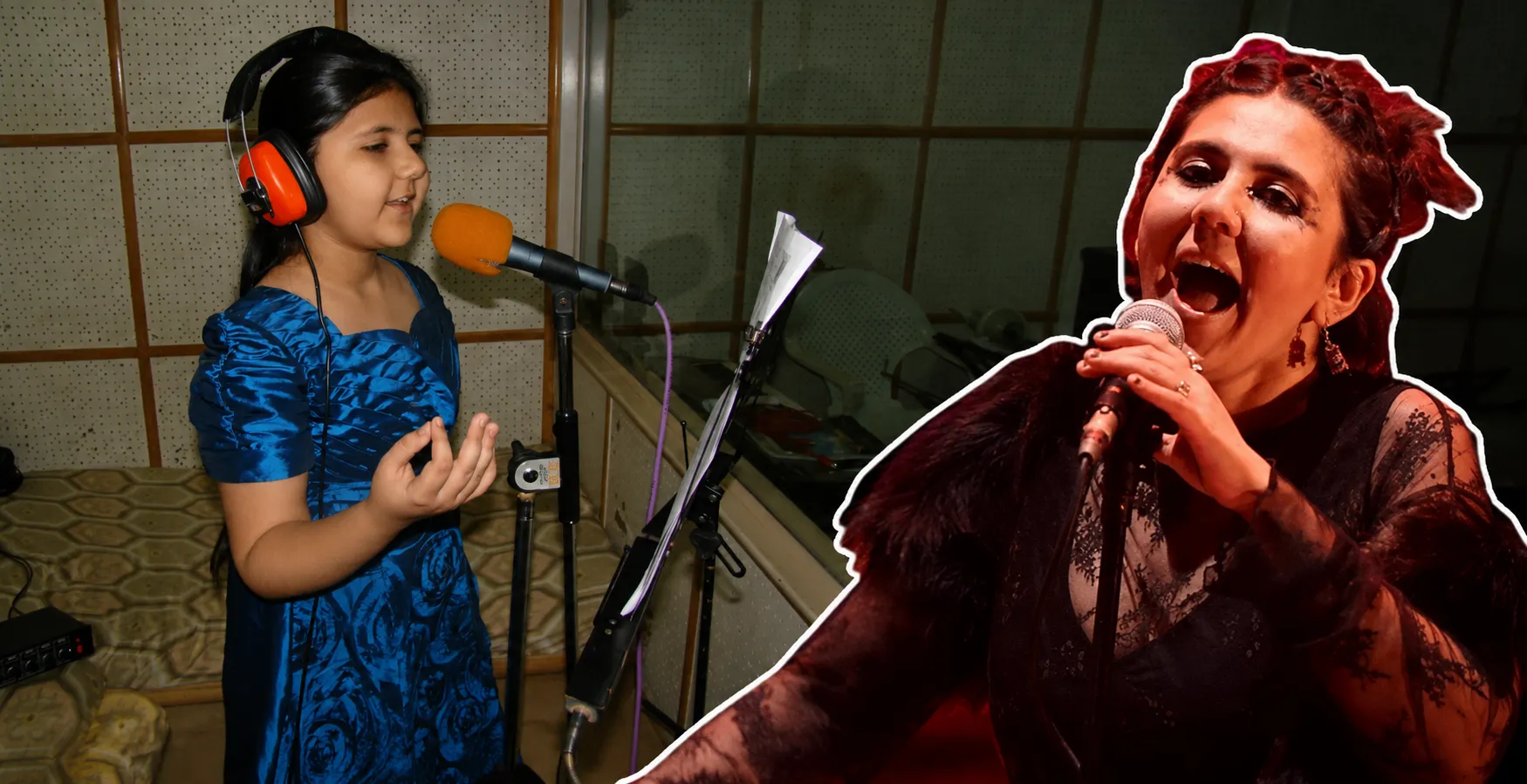
At three years old, Swara Oza walked into a professional recording studio in Rajkot and sang a lullaby called Hun Taaro Lalo. She has no memory of expecting it to travel anywhere. Two decades later, people her own age tell her they grew up hearing it sung to them as children.
That early, unplanned reach set the tone for a career built almost entirely on instinct, and it eventually led the 24-year-old to invent a genre nobody in Gujarati music had attempted before: G-pop.
Beyond the nine nights of Navratri
For decades, Gujarati music has largely followed one calendar. It surges during the nine nights of garba each Navratri, when dandiya sticks click across Ahmedabad and Rajkot, and then it recedes for the rest of the year, tied mostly to film soundtracks.
Oza wanted something that could live on a phone screen every day of the year, not just one fortnight. So working with her mother, composer Neema Oza, she coined a term for what they were building together: G-pop, a fusion of the Gujarati language with contemporary pop, R&B and even techno.
A family act, one gold medal and a dhol
The Oza household has been steeped in music for generations. Swara’s great-grandfather played dhol at Rajkot’s Sarvodaya Raas Mandal, her father Mitesh is a percussionist, and her grandmother plays the harmonium.
But it is her mother Neema, a classically trained Visharad and gold medallist, who writes, composes, mixes and masters every G-pop track, working alongside Swara on melody and lyrics in a single sitting rather than separate stages. That process produced Temperature High, now credited as the genre’s first release and the song that gave it its name.
Where pop structure meets Gujarati lyrics
The bet behind G-pop, already proven by Indian film songs that went viral worldwide without a single translated lyric, is not that listeners need to understand Gujarati. It is that a Western pop hook, synths, drum machines, and verse-chorus architecture can carry Gujarati lyrics on top of it without either element giving way to the other. Fireman is the clearest example.
The song arrived to Oza in a dream: a woman looking in the mirror, declaring her own beauty, then calling the fireman to put out the fire she had become, its siren mimicked directly in the song’s hook. Neema turned that single voice note into a finished arrangement in one sitting, siren and all, without a rewrite.
The same convergence shows up across Dago, Alien and Ishq No Rang, R&B, Arabic-inflected pop and club music dressed around lyrics that never once switch to English or Hindi.
With nearly 30 G-pop songs to her credit, Oza has performed at Mumbai’s Nita Mukesh Ambani Cultural Centre and Ahmedabad’s Natarani, drawing crowds who arrive expecting garba and leave having heard something closer to a Western pop concert, sung in their own language.
Her YouTube channel lists over 152,000 subscribers, much of that reach built through clips travelling online rather than a label, a route several independent Indian singers have taken to sudden audiences in recent years.
/filters:format(webp)/english-betterindia/media/media_files/2026/08/14/3-2026-08-14-15-46-52.png)
None of it has come easily. Oza has spoken about producers who showed interest and then went quiet, and about being invited to open shows only to be dropped at the last moment.
What has carried G-pop instead is a mother-daughter creative partnership no studio system could replicate, and an artist unwilling to soften her own image for approval. She has talked candidly about being bullied over her weight as a child, and today designs her own stage outfits and refuses to edit her acne out of posts, a choice that echoes the same instinct that has pushed other young Indian creators to stop hiding behind filters.
For a singer who nearly gave up music altogether as a teenager, the pull back came, fittingly, through pop itself. Discovering Justin Bieber and One Direction is what sent her back to the microphone she had grown up in front of, this time on her own terms.
G-pop has stopped being an experiment and become, by Oza’s own reckoning, a genre other Gujarati artists are starting to try for themselves, proof that a regional language and a pop hook were never as far apart as Gujarati music’s calendar made them seem.
Sources
‘Musicana | Swara Oza turns the ‘Temperature High’ with G-pop‘: by Subhashini Ramasamy for Deccan Herald, Published on 24 July 2026
‘Interview: Indie Artist Swara Oza Reflects as a G-pop Pioneer to “Expect the Unexpected”‘: by Nandini Iyengar for Mido Media, Published on 3 June 2026
‘Swara Oza: The G-Pop Rhapsody‘: by Prakhar Aditya for HunarManch, Published on 16 June 2025
Disclaimer : This story is auto aggregated by a computer programme and has not been created or edited by DOWNTHENEWS. Publisher: thebetterindia.com





