
The men stole the country while it was asleep. Min Aung Hlaing and the army seized power before dawn and arrested Myanmar’s de facto leader Aung San Suu Kyi, whose party had been due to return to office for a second term. Black military vehicles rolled through the streets of the Potemkin capital Naypyitaw and state TV announced the decade-long reprieve from outright dictatorship was over.
Myanmar’s sweetheart rose on that Monday morning of February 1, 2021, expecting to open her gymnasium for the students she coached. Instead, the coup left her shocked and outraged.
An actor and businesswoman with a national profile, Htar Htet Htet was at the time best-known abroad for being crowned most popular at the Miss Grand International beauty pageant in 2013.
Within days, Htar Htet Htet was on the streets of Yangon at the forefront of anti-coup protests as bullets flew. Within weeks, she was in border jungles with resistance fighters. Within months, she earned international headlines and viral attention as the beauty queen taking on the junta.

Now, years later, she has starred in a new film, Ray, that she calls a “95 per cent” accurate account of her story in an effort to keep attention on Myanmar’s slide into civil war and the pain its citizens have endured.
“When I look back, my life feels like a different lifetime,” Htar Htet Htet said. “I was super busy, and my life was stable. Much easier than it is now.”
While she was stunned by the coup, what she couldn’t stomach most was the army’s “bullying”. Confusion and misinformation reigned in the first 72 hours, but by the weekend Htar Htet Htet was among the anti-coup protesters. In the crackdown that followed, she saw a young student of 16 or 17 shot and killed.
“They just wanted to protest peacefully. We just want our freedom, our future. But the military, they shot the young child. A lot of people were arrested and tortured and killed, it was very painful for me.”
By March, it became more dangerous and increasingly personal. Given her fame, Htar Htet Htet was noticed at the protests and received threats through her Facebook page.
“They said they would kill me, they’d rape me if they found me. I realised it was no longer safe to stay in Yangon, I needed to protect myself.”
Demonstrators were armed mainly with placards and emotions, demanding democracy, justice and freedom. The army responded with violence and coercion, and clemency only to those who swore obedience.
“I cannot accept that kind of situation. That’s why I left my country, I left my home. It was really painful to me, but why would I say sorry to them?”
Together with her husband, Htar Htet Htet decided to leave town. In the jungle, joining a resistance camp in Karen territory near the border with Thailand, life was tough. Food was a rationed portion of rice and beans twice a day, power was scarce, and phone or internet connections required a 15-minute march up the mountain.
The fighters included many young people who had run away from home. Htar Htet Htet put her gymnastics coaching to use when troops needed strength and conditioning training.
“Also the little things, the small things, like if they didn’t have water in the toilet then we’d fill it,” she smiles. “We try to help everything that we can.
“Everyone had the same feeling in the jungle, because we missed our homes, we missed our families, and we missed our friends.”
What money they had taken with them was absorbed by the cost of keeping the camp running and fed. “We spent all our own money as well, so we didn’t have any more funds.”
They relied on the goodwill of friends, but resources were soon stretched. They hatched a plan to use Htar Htet Htet’s celebrity to their advantage.
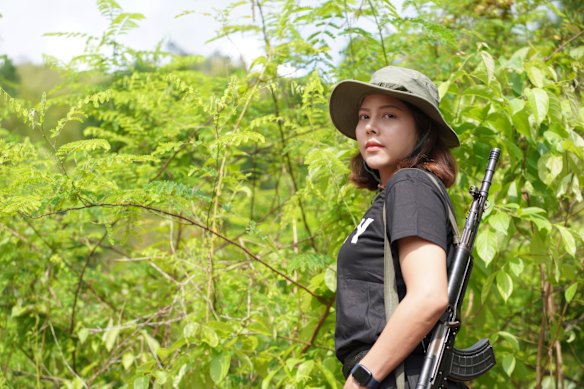
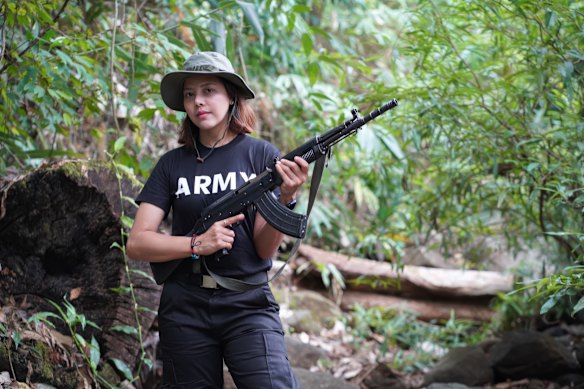
The photos of the beauty queen hoisting weapons, wearing black “army” gear in the jungle worked; between international news coverage and social media, support flowed in for the resistance.
Life was precarious. On trips down the mountain for supplies, Htar Htet Htet would be noticed in villages and her movements were tracked. She made an enemy of the junta, and they were watching.
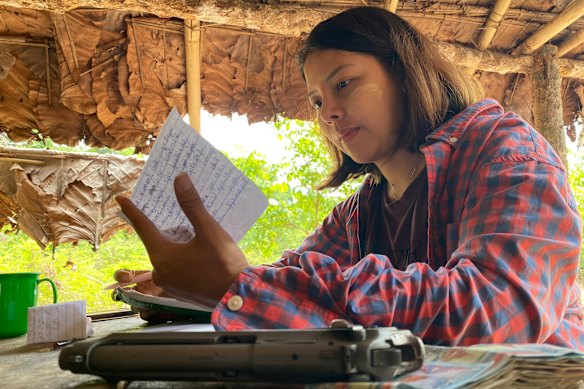
“At the top of the mountains we have nothing, but sometimes we go to the village to get noodles … that was a very lucky time. Juice and cold drinks … at the top of the mountains we can get rice and beans only. I followed them every time because I want to eat it,” she laughs.
The shop owners kept her identity secret, but on one occasion two men were hovering with malicious intent. She believes she was spared only because the supply run had an armed escort.
“If we didn’t have our friends, the soldiers … if they weren’t there, they might arrest us.”
The film delves into this and more: Myanmar’s turbulent past and troubled present, Htar Htet Htet’s tense border crossing into Thailand, and setting up a life in Australia and the strain her stance took on her family.
Ray was a labour of love from a small team: exiled filmmaker The Khit Nay was the director; husband and wife team Sophia and Robert Sarkis, who are active in diaspora events, were executive producers; much of the cast and crew were volunteers, and filming largely took place outside Melbourne.
Htar Htet Htet has been pleased with the reception as Ray was screened in Australia and worked its way around international venues. While she found reliving the events difficult, she embraced the opportunity.

“We want to share with the international audience what the truth is and what happened in Myanmar. If sharing the story helps people understand, then it’s worth it.
“My story is a small part of the struggle in Myanmar. The reality is much bigger and much more painful.”
Htar Htet Htet works as a gymnastics coach two days a week in Sydney, but her heart yearns for home. Her message for those living in Myanmar under the junta? “You are not forgotten.”
Start the day with a summary of the day’s most important and interesting stories, analysis and insights. Sign up for our Morning Edition newsletter.
Disclaimer : This story is auto aggregated by a computer programme and has not been created or edited by DOWNTHENEWS. Publisher: www.smh.com.au



