
The highest degree of love is to let.
To do what you can and then let go.
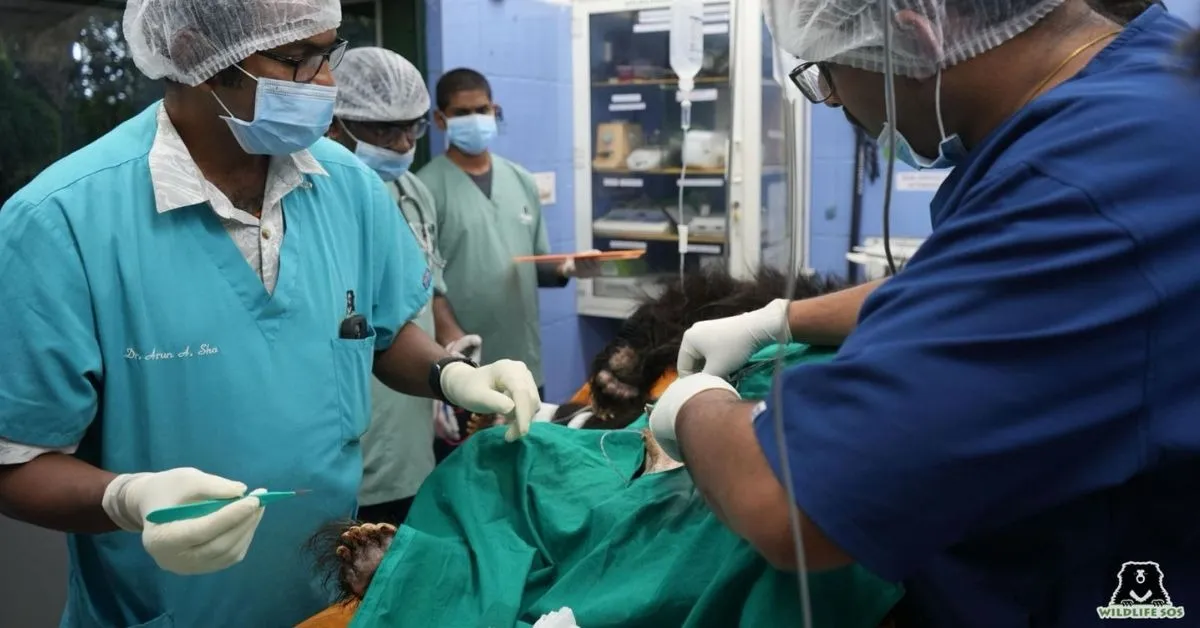
That’s what Dr Arun A Sha learnt during the 23 years that he’s worked with sloth bears: rescuing them, surgically treating their wounds, and helping them recuperate. Having joined Wildlife SOS in 2003, right after his master’s degree in wildlife medicine from TANUVAS (Tamil Nadu Veterinary and Animal Sciences University, Chennai), Dr Arun has contributed to — and pioneered — the project directed towards ending the exploitation of sloth bears.
As I speak to him, I have to constantly remind myself that it’s an animal that is the subject of this conversation. The fondness with which he speaks about them could easily let you think he’s talking about a dear friend. But then, as he reminds me, that’s just what these bears have been to him.
It’s tough not to let emotions get in the way as Dr Arun goes on to detail why protecting the ‘vulnerable’ Melursus ursinus is so crucial.
The dancing bears of India
As I research for this piece, I go down a rabbit hole of articles and videos that talk about the sloth bear. I’m intrigued by the moniker that’s used for them — ‘dancing bears’. But why, I wonder. In my search for the answer, I stumble upon a video that shows a man teasing the animal by pulling a rope that goes through the bear’s nose. When the cubs are young, a red-hot poker is driven through their muzzle to create a piercing through which the rope is later strung.
Pain dictates the dance, as the bear makes rhythmic movements to try to escape this fate.
This inhumane practice goes back 400 years. The Kalandar tribe would entertain the emperors with the bears; over the centuries, it transformed into cheap roadside entertainment. Poaching compounded the problem. Poachers would kill the mother bears so they could sell the cubs to the tribe. This, despite the bears being listed under Schedule I of the Indian Wildlife (Protection) Act, 1972, which grants them protection against poaching, hunting, and trade.
As Dr Arun’s interactions with the tribe revealed, they did not know better. “Their grandfathers and forefathers had also been doing this; most of them had never studied, and this was the only profession they knew.”
As of 1996, research conducted by Wildlife SOS indicated the presence of more than 1,200 ‘dancing’ bears scattered throughout India. With cooperation from Government officials, International Animal Rescue, One Voice, Free the Bears, and others, Wildlife SOS rescued over 628 sloth bears. Instead of penalising the Kalandar tribe, they decided to engage in dialogue with the community, providing them with seed funds to start their own businesses.
Dr Arun adds that while changing the community mindset was one arm of the programme, the other was to stop the poaching of the sloth bears. “Because if it continued, then there would be a constant supply of bears from the jungle to the poachers. So we focus on confiscating cubs from the jungle during the breeding season (April to June) before they get into the poachers’ hands. We rear these cubs at our Bannerughatta Bear Rescue Centre, Agra Bear Rescue Facility, Van Vihar Bear Rescue Facility, and West Bengal Bear Rescue Centre,” he explains.
Today, the population of these sloth bears stands at 20,000 in India.
The ones that are housed at the Wildlife SOS centres are provided with safety, food, and shelter. Here, the bears are allowed to ‘retire’ in peace after a life of being forced to perform. They are given regular medical and dental checks, and the team of veterinarians constantly tend to their medical needs.
Dedicating his life’s efforts to the sloth bear
There’s a chapter titled ‘Veterinary Medicine in the Rehab of “Dancing” Bears in India in the tenth edition of the book Fowler’s Zoo and Wild Animal Medicine Current Therapyunder Section 19, Carnivores.This makes Dr Arun very proud, as this was one of the reference books for wildlife veterinarians, and he recalls referring to it while he was learning how to medically treat the bears’ injuries.
/filters:format(webp)/english-betterindia/media/media_files/2026/04/02/sloth-bears-2-2026-04-02-18-19-53.jpg)
When Dr Arun first started, he was baffled by the lack of information in medical books about sloth bears. “We usually follow Western wildlife books, but these bears are native to India, and so, there is no information on their veterinary care and medicine,” he explains.
So, everything that Dr Arun learnt about how to medically treat these sloth bears came from trial and error, attempting to replicate procedures that had been performed on other wild animals, discovering innovative ways to navigate certain medical issues, and then documenting these for posterity. “I had to understand the diseases that were most common in captivity,” he explains.
One of these is tuberculosis. As Surya Sen, Executive Director, Bannerughatta Biological Park, Karnataka, explains, “The bears contract tuberculosis from humans during their time spent in proximity with them.”
Commending the efforts of Dr Arun and Wildlife SOS, Surya says they work closely with the Karnataka Forest Department to rescue the bears from the Kalandar community and then to rehabilitate them. “Most of the bears at the centre are very old now, but are living a peaceful life,” he says.
Acknowledging that animal geriatric care is tough, Surya says it needs a committed team to tend to the animals, and this is where Dr Arun’s work carries a lot of weight.
One of the most significant projects undertaken by Wildlife SOS is the radio-collaring of sloth bears. By fitting the bears with GPS devices, it will help monitor the animals’ movements and prevent conflicts with humans, even when they venture into human settlements to feed on fruit and crops. To date, over 20 sloth bears have been radio-collared and released back into their natural habitat with an effective early warning system in place.
Tending to the sloth bears’ medical needs
Conflict mitigation is a big part of Wildlife SOS’s efforts — both when bears venture into human territory and during captivity.
“There was one incident where a sloth bear got into a conflict with poachers, and two of its five digits (toes on a paw) were severed. The wound was open. Wild animals tend to chew on their open wounds and worsen them. So in these cases, we usually fit the bears with an Elizabethan collar (a protective, cone-shaped collar that prevents them from biting, licking, or scratching wounds),” Dr Arun explains.
He adds that to heal the wound, they tried a grafting technique using the skin of the tilapia fish, which was one of the first times that such a procedure had been performed on sloth bears.
This is where Dr Arun emphasises the importance of documentation. “Maybe this procedure has been done before, but since there are no published papers that talk about it, it’s difficult to say. Indian wildlife vets must be connected so that everyone’s actions and procedures can be in the public domain.”
In a bid to do this, Dr Arun started his YouTube channel ‘Dr Arun’s life with Wildlife’, where he routinely speaks about the medical procedures he performs, new things he’s learnt, and how he’s adapting certain procedures based on what is done in cases of other wild animals.
He gives the example of the perineal urethrostomy (a surgical procedure that creates a new, permanent or temporary opening for urine to exit from the urethra through the perineum — between the scrotum and anus — bypassing the penis).
Elaborating on this, Dr Arun shares, “One of the male bears had a urinary tract obstruction. We were dealing with the problem with medication, and then started conducting ultrasounds and X-rays to check if there were mucus plugs or stones that were blocking the ureters. However, there was neither. In this case, there was physical damage to the tubes [that carry urine to the penis], shortening their length.”
He continues, “So, we brought the intact part of the tube closer to the bear’s skin surface, allowing the urine to flow out from there, instead of from the penis. After surgery, the bear was able to pass urine just like a female bear would (where the opening for urine is next to the anal opening). This was the first time that such a procedure had been done in sloth bears.”
/filters:format(webp)/english-betterindia/media/media_files/2026/04/02/sloth-bears-3-2026-04-02-18-27-11.jpg)
While success after a case brings relief, Dr Arun says it’s all about exploring what medical avenue will bring the animal relief at the earliest. And the hard work is worth it.
The veterinarian recalls his time spent with six sloth bear cubs in the Agra facility of Wildlife SOS. “I had scratches all over my body. But I almost felt like a mother to them as I cared for them, ensuring that they were getting their feed on time and were okay.”
That time taught him a lot about the biological instincts of the animal, the connections they form, their patterns, and their social behaviours. But most of all, it taught the veterinarian about the meaning of love — in its truest form.
All pictures courtesy Wildlife SOS
Sources
Bears by Wildlife SOS.
‘Radio collar to monitor sloth bears in Karnataka’, Published in Deccan Herald on 12 December 2023.
‘Dr Arun A Sha’: by Smriti Suri, Published on 21 August 2025.
Disclaimer : This story is auto aggregated by a computer programme and has not been created or edited by DOWNTHENEWS. Publisher: thebetterindia.com



