
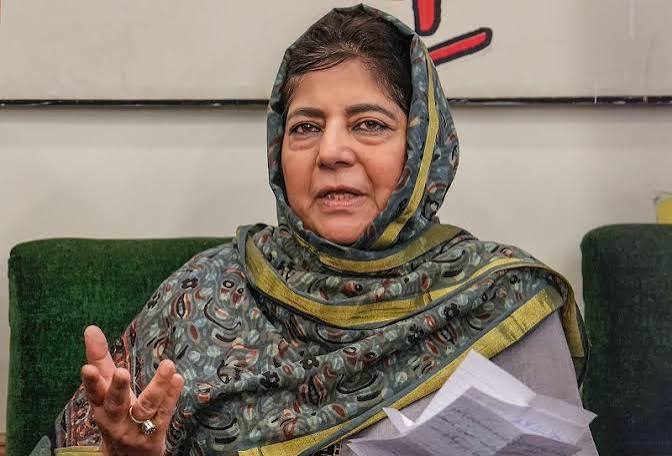
SRINAGAR: Former Jammu and Kashmir chief minister and president of the People’s Democratic Party (PDP), Mehbooba Mufti, is facing intense criticism for her recent comments on the use of pellet guns in Kashmir—remarks she made while drawing a comparison with the recent CJP-led protests at New Delhi’s Jantar Mantar. As one critic sharply noted, “Her statements have reopened old wounds in the Valley and reignited debate over one of the most painful chapters of recent Kashmiri history.”
Earlier this week, Mufti travelled to New Delhi with her daughter, Iltija Mufti, to express solidarity with the protesters at Jantar Mantar. The movement saw mass sit‑ins, hunger strikes, clashes with police, and heavy security deployment, eventually ending on July 26, after the government accepted key demands and Union Education Minister Dharmendra Pradhan resigned.
After meeting the demonstrators, Mufti spoke to reporters and made a remark that has since sparked widespread criticism. She contrasted the police response in New Delhi with security operations in Kashmir, saying that the use of pellet shotguns in the Valley “makes some sense” when viewed in the context of militants confronting security forces. Because of that dynamic, she argued, a certain degree of force “banta hai (is justified).” In New Delhi, however, the students carried no stones or weapons, yet were met with unprovoked aggression from police and rioters — a contrast she described as deeply troubling.
The reaction in Kashmir was swift and unforgiving. Many accused her of attempting to retrospectively justify the widespread and indiscriminate use of pellet shotguns during her tenure as chief minister. Critics pointed out that hundreds of Kashmiri youth were grievously injured during the 2016 uprising following the killing of Hizb-ul-Mujahideen commander Burhan Wani. Security forces used pellet shotguns extensively to quell mass protests, resulting in thousands of injuries. According to medical reports from that period, scores of young men and women suffered permanent eye damage; several were left completely blind. Hospitals in Srinagar and south Kashmir were overwhelmed with pellet victims, many with multiple perforations in the eyes, skull, and vital organs.
The backlash on social media has been relentless. Journalist and writer Sofi Yousuf described Mufti’s remarks as even worse and fatuous than her infamous “toffee and milk” comment—another statement that has haunted her political career. At the time, responding to questions about the killing of minors during clashes, Mufti had, in the presence of then Home Minister Rajnath Singh, asked whether the children had gone to security camps “to fetch toffees and milk.” Critics labelled the remark insensitive and divisive, and it continues to be invoked by her detractors.
“Her latest comments have revived painful memories for families of pellet victims,” said a netizen. Many questioned whether Mufti was implying that all Kashmiri protesters were militants. They pointed to cases like Insha Malik, a 14-year-old girl from Shopian who was blinded in August 2016 when over a hundred pellets shattered her window and struck her face, causing severe brain injuries and permanent loss of vision.
The National Conference (NC) demanded a public apology. Party spokesperson and MLA Tanvir Sadiq called her remarks “apathetic,” stating: “For a former Chief Minister to virtually justify the use of force against Kashmiri protesters by saying ‘banta hai’ is nothing short of disgraceful… Worse still, she has gone to the extent of branding protesting Kashmiris as militants.” He added that Kashmiris deserve the same dignity and rights as any other citizens of India and accused the PDP of repeatedly rationalising Kashmiri suffering.
Even the BJP joined the criticism. Its Pampore (Pulwama) unit posted on social media: “Mehbooba Mufti, are you even feeling shame? Are you saying all Kashmiris are militants?”
Leaders of the PDP and their supporters rallied behind the party president, arguing that her remarks comparing security crackdowns in Delhi and Kashmir were deliberately distorted by political rivals, including the NC, to manufacture a misleading narrative. According to the PDP, Mufti’s comments were not a justification of state force but a critique of what she sees as the Bharatiya Janata Party (BJP)’s tendency to brand dissenting voices as “anti‑national.” They maintained that her intention was to highlight how democratic criticism is increasingly framed as a threat to national security, rather than to defend or normalise heavy‑handed policing.
PDP leader and MLA Waheed Ur Rehman Para shifted the focus to the present situation. Writing on ‘X’, he said: “Around 2,500 Kashmiri youth have reportedly been picked up in the last few days… If reconciliation is the right path for young people in the rest of the country, why is it considered the wrong path for Kashmir?” He warned that applying different standards to Kashmir risks deepening alienation.
Nevertheless, the controversy has once again placed Mufti at the centre of Kashmir’s fraught political discourse, with critics arguing that her remarks reflect a pattern of minimising state excesses. Though Mufti supporters insist her comments were misinterpreted, the storm shows no sign of abating, and the debate over pellet guns—one of the darkest symbols of Kashmir’s unrest—has been reignited with renewed emotional force.
Disclaimer : This story is auto aggregated by a computer programme and has not been created or edited by DOWNTHENEWS. Publisher: deccanchronicle.com





