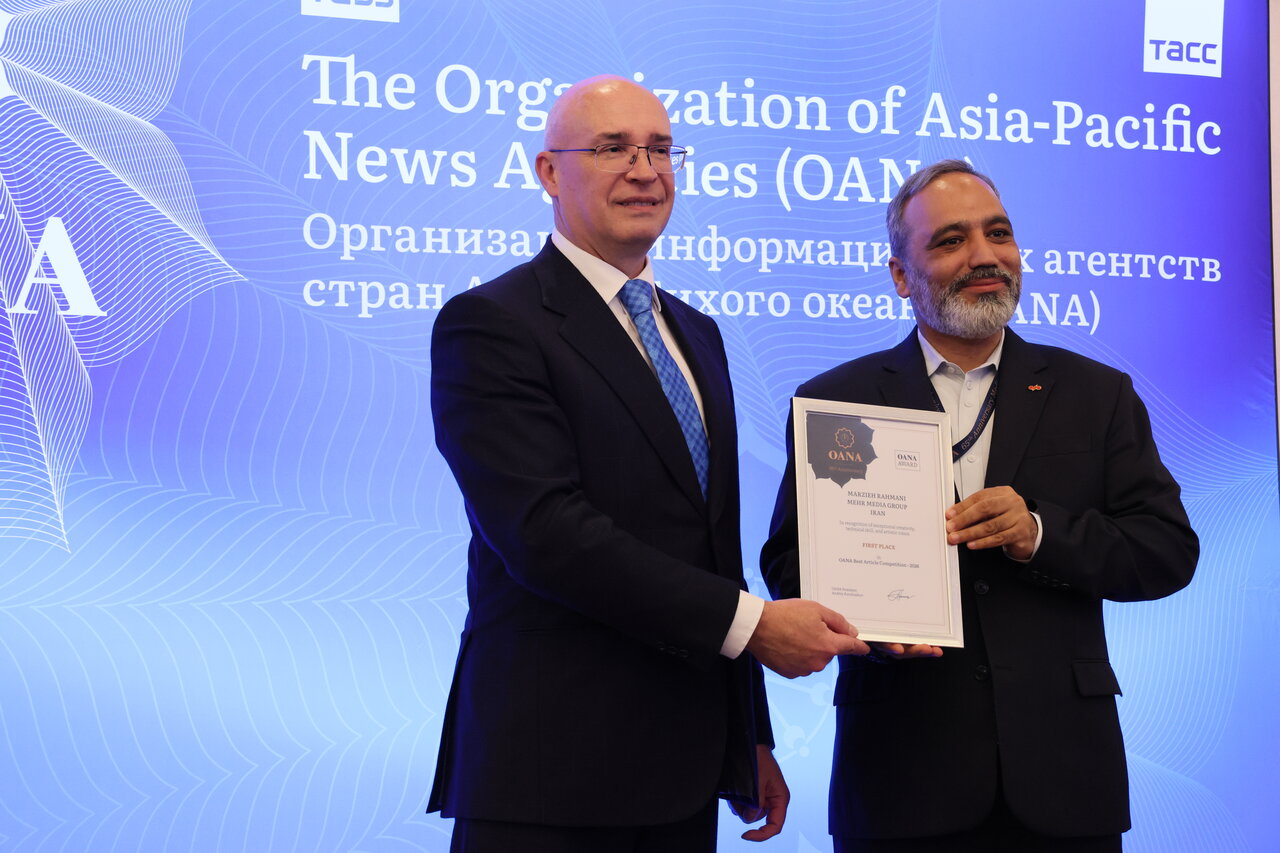
TEHRAN – Mehr Media Group received two awards at the OANA Awards 2026 during the Organization of Asia-Pacific News Agencies (OANA) 65th anniversary conference in Moscow on Monday.
In the Best Article Competition, the article “Iranian art: the triangle of beauty, creativity and culture” by Marzieh Rahmani won first place, and the article “War of narratives in the field; A reporter from the heart of the field / How did the right narration keep people in the scene?” by Azadeh Fazli won second place, Mehr reported.
The awards were received by Mehr Media Group CEO Mohammad Mahdi Rahmati, who earlier in the day addressed the OANA Media Forum.
Speaking at the panel titled “Strategies to Combat the Spread of Misinformation and Fake News,” Rahmati pointed to the media’s role in shaping the public’s perception of reality and said: “Today, the media is not merely a tool for transmitting news; it can influence how people perceive reality, contribute to the formation of public narratives, and in some cases, even change how public opinion perceives a crisis.”
“For this reason, the responsibility of the media is not limited to speed; accuracy, fact-checking, transparency, and professional ethics are also essential components of this responsibility,” he added.
Rahmati stated that what audiences accept as reality is often influenced by narratives that are repeated and republished over time.
“The media can place a subject at the center of public attention or push it to the margins. Rahmati emphasized: The main danger arises when the media presents a subject that lacks an objective or documented basis in a way that causes the audience to accept it as truth,” he noted.
“Our duty should not be to construct an artificial reality; our duty is to tell our audience only what is real, verifiable, and evidence-based. A powerful media organization is not one that can tell stories better than others, but one that can build its narrative on truth and evidence,” he added.
“When a credible media outlet remains silent or reacts with delay during a crisis, an information vacuum is usually filled by other narratives that may be incorrect, exaggerated, or even intentionally misleading,” he asserted.
“This does not mean the media should publish news hastily and without fact-checking; rather, it must do two things simultaneously: verify information while ensuring that an information vacuum is not left unanswered for an extended period,” he emphasized.
Referring to what he termed the “cost of a narrative vacuum,” Rahmati noted that during the January 8-9 unrest in Iran, varying figures regarding the death toll were circulated. “Donald Trump, in his social media posts, cited extremely high numbers, including claims of over 100,000 deaths. These figures gained widespread political and media attention without providing complete lists of names, individual details, or evidence that could be independently verified.”
“In contrast, according to official statistics released by the Iranian government, the number of fatalities was announced as 3,117, of whom 2,427 were ordinary citizens who lost their lives due to rioters, according to the report,” the Mehr Media Group CEO stated.
“The importance of this figure is not limited to the number 3,117; the names, details, and information regarding these individuals have also been published, which allows for the possibility of verifying the statistics,” he said.
“The difference between these two types of narratives demonstrates why documentation is important. Unsubstantiated figures can spread rapidly and influence public opinion, but a documented narrative allows others to independently examine and evaluate the information,” he explained.
Continuing his speech, Rahmati stated: “In today’s world, almost no subject remains unspoken forever. If a media organization remains silent on a matter, other media outlets, social networks, or anonymous users may present their own narratives about it. Therefore, the main issue is not whether we should talk about a crisis or not; the core issue is how we should talk about it.”
Referencing a report by Mehr News regarding the recent attack on a wedding ceremony in Kouhestak, Sirik, he said: “Based on the information provided in this report, five people—including a four-year-old child—were killed, and 63 people were injured, 50 of whom were women and children.”
“A Mehr News correspondent arrived at the scene immediately after the wedding ceremony was targeted and prepared field reports. This immediate presence ensured that direct information, images, and initial evidence were recorded and published before incomplete, distorted, or fake narratives could dominate the media landscape,” he added.
“The reports prepared by the Mehr correspondent provided a foundation for forming an accurate narrative of what had occurred, and many other media outlets and sources cited these reports and images,” Rahmati noted.
“In such cases, the media must build its narrative on evidence, such as hospital images, interviews with witnesses, medical information, photos from the scene, and technical evidence,” he emphasized.
Referring to the ongoing investigation into this incident, the CEO of Mehr Media Group noted: “A documented report can go beyond the news agency itself and become part of an international fact-checking process.”
“In this incident, the reports and images published by Mehr News were utilized by foreign media and independent researchers, serving as references in their investigation and fact-checking processes,” he underlined.
Citing a report from Drop Site News and an analysis by Christiaan Triebert, he said: “Drop Site utilized footage recorded at Minab Hospital, and Triebert examined a piece of weaponry and the markings on it, providing further technical details. Following this process, the United Nations fact-finding committee announced that the United States had directly targeted the wedding ceremony.”
“If a report is accurate, documented, and functional, it can become a source for international media and research,” he stressed.
In another part of his speech, Rahmati addressed the necessity of correcting media errors, stating: “No media organization is completely immune to mistakes, especially in conditions where the volume of news is extremely high, and newsrooms face intense time and information pressure.”
The CEO of Mehr Media Group defined the process of correcting an error as including: identifying the mistake, explaining what happened, apologizing to the audience, removing or correcting the inaccurate content, and ultimately maintaining long-term transparency. “When a media organization explicitly announces that a report was incorrect, explains why the mistake occurred, and corrects it, it demonstrates respect for the truth and for its audience.”
“Correcting a report may have a short-term cost to a media organization’s credibility, but concealing a mistake can incur a much higher cost and severely damage audience trust,” he noted.
On the role of new technologies in combating fake news, Rahmati stated: “Today, it is no longer possible to fight fake news using only traditional methods. The volume of information, the speed of dissemination, and the complexity of fraudulent content have increased to such an extent that media organizations require new tools and broader cooperation.”
He identified three essential elements in this regard: “integrated newsrooms, artificial intelligence, and fact-checking networks. AI should not replace journalists or editors, but it can assist media outlets in searching, organizing, comparing information, identifying patterns, and conducting preliminary investigations.”
“Cooperation between OANA and the Global Fact-Checking Network (GFCN) can also assist news agencies in creating shared experiences, methods, and standards, allowing them to combat misinformation with greater coordination and a more professional approach,” he asserted.
In another part of his speech, the CEO of Mehr Media Group stressed the necessity of turning media MoUs into practical cooperation, saying: “Simply signing an MoU is not enough to solve the problem of misinformation; an MoU only becomes valuable when it leads to practical collaboration.”
Rahmati called for the establishment of professional and continuous communication between OANA member agencies and foreign media bureaus across various countries.
“Trust is the foundation of this cooperation. If we trust one another, we can examine narratives with greater accuracy, share information more rapidly, and respond to suspicious claims through professional dialogue rather than fragmented reactions,” he added.
In his concluding remarks, Rahmati linked all these discussions to the principle of professional ethics: “Technology, artificial intelligence, social networks, and international cooperation are all important tools, but none of them can replace media ethics.”
“Media ethics means striving to achieve the best possible outcome in any situation, even when the media is facing time pressure or political and economic pressures,” he noted.
He emphasized the importance of continuing the work of the OANA Ethics Committee and publishing documents and recommendations tailored to the current conditions of media organizations, saying: “Media ethics becomes even more critical during a crisis, as inaccurate news can impact security, human lives, international relations, and public trust.”
In summarizing his speech, Rahmati emphasized: “Media organizations must not allow an information vacuum to form during a crisis; speed must always be accompanied by accuracy and fact-checking; documented reporting can serve as a basis for subsequent fact-checking; transparent correction of errors is a sign of accountability; and AI and fact-checking networks can create new capacities for combating fake news.”
“All these efforts must be built upon trust, cooperation, and professional ethics. The responsibility of the media is not to construct an artificial reality for the audience, but to report the truth with accuracy, transparency, and responsibility,” he concluded.
SS/
Disclaimer : This story is auto aggregated by a computer programme and has not been created or edited by DOWNTHENEWS. Publisher: tehrantimes.com