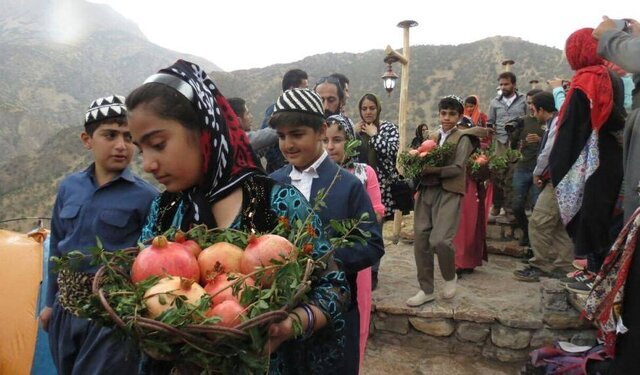
TEHRAN – Some Iranians observed Mehregan, an ancient festival associated with Mehr, friendship, and the autumn harvest, on Friday, keeping alive a tradition that has survived in different forms across Iran over centuries.
Anthropologist Alireza Hasanzadeh, who is responsible for Iran’s Mehregan nomination dossier, told ISNA that the earliest known evidence of the festival dates to the Achaemenid era, based on Greek sources, while historical accounts describe elaborate celebrations during the Sasanian period.
“If Mehregan is considered among informal traditions such as Yalda and Chaharshanbe Suri, its observance may be even older,” Hasanzadeh said.
The festival’s name is derived from Mehr, a concept in Iranian culture associated not only with the deity Mithra but also with friendship, covenant and loyalty. Historical and mythological accounts place Mehregan alongside Nowruz as one of the major traditional Iranian celebrations.
In Iranian mythology, the festival is also associated with the victory of Fereydun over Zahhak and the beginning of Fereydun’s reign.
But Mehregan cannot be defined by a single historical period or narrative. Its timing and customs have changed over the centuries, while different communities and regions have developed their own ways of observing it. This diversity is now regarded as part of the festival’s intangible cultural heritage.
Iranian Zoroastrians in cities including Yazd, Kerman, Tehran and Shiraz continue to hold ceremonies for the festival. At the same time, the UNESCO dossier documents its observance among Muslim communities in different parts of Iran, particularly in rural areas.
The rituals vary according to religious beliefs and local customs. Zoroastrian communities may recite religious texts, while Muslim communities hold their own prayers. Shared elements include preparing a ceremonial table, seasonal foods, visiting relatives and friends, and communal gatherings.
The UNESCO dossier identifies rural communities in northern provinces, particularly Gilan, Mazandaran and Golestan, as well as Zoroastrian communities in provinces including Tehran, Yazd, Fars, Kerman, Sistan-Baluchestan, Alborz and Khuzestan, among those associated with the tradition.
Iran and Tajikistan jointly submitted Mehregan for inscription on UNESCO’s Representative List of the Intangible Cultural Heritage of Humanity, and it was inscribed in 2024 during the 19th session of UNESCO’s Intergovernmental Committee for the Safeguarding of the Intangible Cultural Heritage in Paraguay.
UNESCO describes Mehregan as a celebration connected with the autumn harvest. Its customs, foods and rituals vary according to local traditions and the beliefs of the communities taking part.
In Tajikistan, the festival retains a strong post-harvest character, with farmers and gardeners playing a central role in celebrations that include feasting, music and community gatherings.
Unlike Nowruz, which is deeply integrated into Iran’s official calendar and public life through the New Year holidays, Mehregan has a less prominent place in contemporary urban society. Yet its continuing observance among Zoroastrian and Muslim communities, particularly in rural areas, means that the festival remains a living tradition rather than simply a remnant of Iran’s ancient past.
Its survival also reflects a broader feature of Iranian intangible heritage: traditions can change in form, meaning and setting while retaining elements that connect contemporary communities with earlier generations.
AM
Disclaimer : This story is auto aggregated by a computer programme and has not been created or edited by DOWNTHENEWS. Publisher: tehrantimes.com